
The photographs that survive of Teresa of the Andes can create a misleading first impression. Dressed in a Carmelite habit, her expression composed and solemn, she seems far removed from the ordinary concerns of adolescence.
But before she was Sister Teresa, she was Juanita Fernández Solar — a Chilean girl who loved horses, swimming, tennis, music, mountains and the sea. She played the piano, enjoyed time with friends and grew up surrounded by a large family. She was affectionate and sociable, but she also had a strong personality and struggled with aspects of her own temperament.
She was not someone who believed herself to be naturally perfect.
That distinction matters because Juanita lived for only 19 years, and less than one of those years was spent inside a Carmelite monastery. Yet decades after her death, the Catholic Church would recognize her as a saint.
Her story is not remarkable because she had decades in which to accomplish extraordinary things. It is remarkable precisely because she did not.
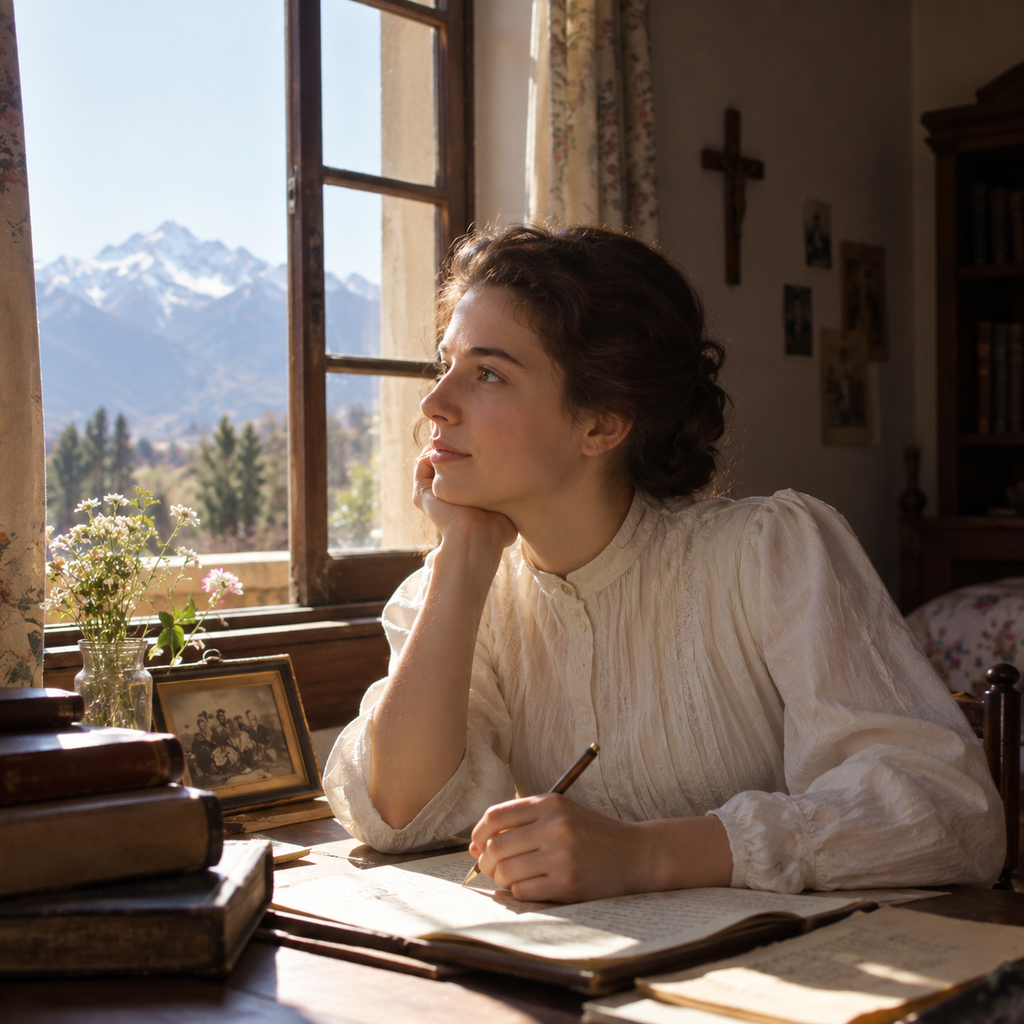
Before the convent, there was Juanita
Juana Enriqueta Josefina de los Sagrados Corazones Fernández Solar was born in Santiago, Chile, on July 13, 1900, to Miguel Fernández Jaraquemada and Lucía Solar Armstrong. To her family, she was simply Juanita.
She grew up in comfortable circumstances, dividing part of her childhood between Santiago and the family’s property at Chacabuco, north of the capital. It was there that she became an accomplished horsewoman, riding across the estate in the landscape beneath the Andes.
Her later reputation can make it tempting to imagine a childhood dominated entirely by prayer and religious discipline. The surviving accounts paint a broader picture.
Juanita enjoyed physical activity and the outdoors. She rode horses, swam and played tennis. She loved the mountains and the ocean. Music was also part of her life: she played the piano and guitar, sang and knew how to dance.
Official Catholic accounts describe her as cheerful, sociable and communicative.
In other words, the young woman who eventually chose an enclosed religious life had not spent her youth detached from everything outside it.
She knew what she was leaving behind.
Her own writings reveal a less polished portrait
Juanita’s private writings are particularly valuable because they prevent her biography from becoming an idealized portrait created only after her death.
Her diary, written intermittently between 1915 and 1919, was never conceived as a book for a future audience. It records prayers and spiritual reflections, but also resolutions, frustrations and the young writer’s assessment of her own successes and failures.
Accounts preserved by the sanctuary dedicated to her describe a girl with a strong will who had to work on controlling anger, stubbornness and impulsive reactions.
This makes the person behind the saint considerably more interesting.
Her spiritual development was not based on the belief that she had nothing about herself to change. Quite the opposite: self-examination became an important part of the way she understood faith.
She noticed traits she disliked. She made resolutions. Sometimes she failed to live up to them. Then she tried again.
That cycle appears much closer to ordinary human experience than the flawless childhood sometimes imagined when looking backward at the life of a saint.
A childhood experience that stayed with her
Juanita received her First Communion on September 11, 1910, when she was ten.
She later remembered the occasion as a turning point in her religious life. In her diary, she recalled going to her father after confession and asking him to forgive the times she believed she had upset him. His response was that he had nothing to forgive and was happy to see her behaving so well.
What began within the religious culture of her family gradually became something deeply personal.
By around the age of 14, Juanita had begun thinking seriously about becoming a Discalced Carmelite nun. Vatican accounts confirm that the desire existed several years before she actually entered religious life.
This was therefore not a sudden decision made shortly before she disappeared behind convent walls. She lived with the idea throughout much of her adolescence while continuing to participate in family life, friendships and the activities she enjoyed.
Choosing Carmel did not mean rejecting her family
One detail is important when trying to understand her decision: Juanita was deeply attached to her family.
After her older sister married in 1918, Juanita left school and returned home, helping her mother and assuming more responsibility in the household. Her brother Luis later remembered the change she brought to family life, describing her as the joy of the home.
Her eventual departure for the convent therefore cannot easily be interpreted as an escape from an unhappy existence.
She was walking away from people she loved.
For Juanita, that sacrifice was part of the choice itself.
At 18, she entered the monastery
On May 7, 1919, Juanita entered the Carmelite Monastery of the Holy Spirit in Los Andes, roughly 90 kilometres from Santiago.
She was 18 years old.
There she became known as Teresa of Jesus. On October 14, she received the Carmelite habit and began her novitiate.
The change in daily life was dramatic. The Discalced Carmelites followed a contemplative vocation centred on prayer, silence, work and community life. The energetic young woman who had ridden horses across Chacabuco and played tennis was now living within an enclosed religious community.
She had spent years preparing herself for this.
What she could not have known was how little time remained.
Teresa would never reach the first anniversary of her arrival at Carmel.
The illness came suddenly
On Good Friday, April 2, 1920, Teresa spent hours in prayer. The other sisters eventually noticed that she was running a high fever and sent her to bed.
Her condition did not improve.
She was diagnosed with typhoid fever, a serious infectious disease at a time when modern antibiotic treatment was not yet available. Her health deteriorated rapidly.
On April 6, her mother arrived at the monastery with authorization from the apostolic nuncio that would have allowed Teresa to leave the enclosure and be taken to a hospital in Santiago. The transfer never took place.
By the following day, the possibility that she might die had become very real.
She was still only a novice.
She made her religious profession while dying
Under normal circumstances, Teresa had not yet reached the stage at which she would make her religious vows.
Her illness changed everything.
On April 7, she was permitted to make her profession in articulo mortis — a provision for someone considered to be in danger of death. Had she recovered, she would have returned to her status as a novice and continued her formation.
There would be no recovery.
Five days later, on April 12, 1920, Teresa of Jesus of the Andes died. Records preserved by her sanctuary place her death at 7:15 in the evening.
She was 19 years old.
Only about eleven months had passed since she entered Carmel.
The diary that almost disappeared
Had Juanita made one different decision before entering the monastery, our understanding of her today might have been considerably poorer.
She considered destroying her diary.
The pages contained thoughts she regarded as private, and she had never written them with the expectation that strangers would eventually read them. Her mother, however, asked her to leave the diary behind as a keepsake.
Juanita agreed.
The notebooks survived her.
They would eventually become one of the most revealing records of the person who existed before the formal portraits, titles and canonization.
The diary does not merely preserve the voice of a future saint. It preserves the voice of a young woman in the process of becoming someone: questioning herself, setting standards, falling short of them and beginning again.
That may be one reason her writings remain so accessible more than a century later.
Her reputation survived long after the funeral
Teresa’s funeral took place on April 14, 1920.
Accounts preserved by the sanctuary describe a monastery chapel filled with mourners, including people who had never personally known the young Carmelite but had already heard about her reputation for holiness.
In the years that followed, reports of favors attributed to her intercession began reaching the religious community.
Formal recognition, however, came much later.
The diocesan process connected with her cause began in 1947. In 1986, Pope John Paul II recognized the heroic nature of her virtues, giving her the title of Venerable.
During his apostolic visit to Chile, John Paul II beatified Teresa in Santiago on April 3, 1987.
Canonization followed six years later.
Chile’s first saint
On March 21, 1993, Pope John Paul II canonized Teresa of Jesus of the Andes in St. Peter’s Square in Rome.
Juanita Fernández Solar became the first Chilean recognized as a saint by the Catholic Church. Vatican records also identify her as the first Discalced Carmelite nun from outside Europe to be canonized.
Her remains are now venerated at the sanctuary in Auco-Rinconada de Los Andes, which has become a major destination for pilgrims.
Yet the extraordinary scale of her later reputation stands in sharp contrast to the small geographical and chronological boundaries of her life.
She never became a famous missionary. She did not establish hospitals or schools. She did not spend decades leading a religious community or produce an enormous theological body of work.
She barely reached adulthood.
What can 19 years leave behind?
Looking only at Teresa’s Carmelite portrait makes it easy to begin her biography at the end.
Her writings invite us to do the opposite.
Before the habit there was a girl racing across the countryside on horseback, playing tennis, swimming, making music and spending time with the people she loved. There was also a strong temper she wanted to control, a character she believed needed work and a series of private decisions about the kind of person she hoped to become.
The Catholic understanding of her sainthood cannot be separated from her faith, prayer and religious vocation. But the human dimension of her life may explain why she remains compelling even to someone encountering her name for the first time.
Her life was remarkably short, yet it was not presented by those who knew her best as effortless perfection.
The solemn photograph shows Teresa the Carmelite.
Her diary allows us to meet Juanita.
And perhaps the distance between those two images is the most revealing part of all: transformation did not require her to begin as a flawless person. It happened through choices made repeatedly, failures acknowledged, habits challenged and convictions lived as seriously as she knew how.
Juanita Fernández Solar had only 19 years in which to make that journey.
More than a century later, people are still reading what she left behind.