
Most people know the feeling. The alarm goes off, the room is still comfortable, and getting out of bed suddenly seems like the least appealing thing in the world. After a demanding week or a restless night, wanting a little more time under the covers is hardly unusual.
But sometimes the experience is different.
A person may already be awake. They may not even feel sleepy. They know they have work, school, appointments, or ordinary responsibilities waiting for them, yet leaving the bed feels disproportionately difficult. Hours can pass while they scroll through their phone, stare at the ceiling, or simply remain there because facing the day feels harder than staying put.
Online, this experience is often given a striking name: clinomania.
Social media posts sometimes describe it as a psychological disorder, an addiction to staying in bed, or even a little-known medical condition. The word itself is real, but the medical picture is considerably more nuanced.
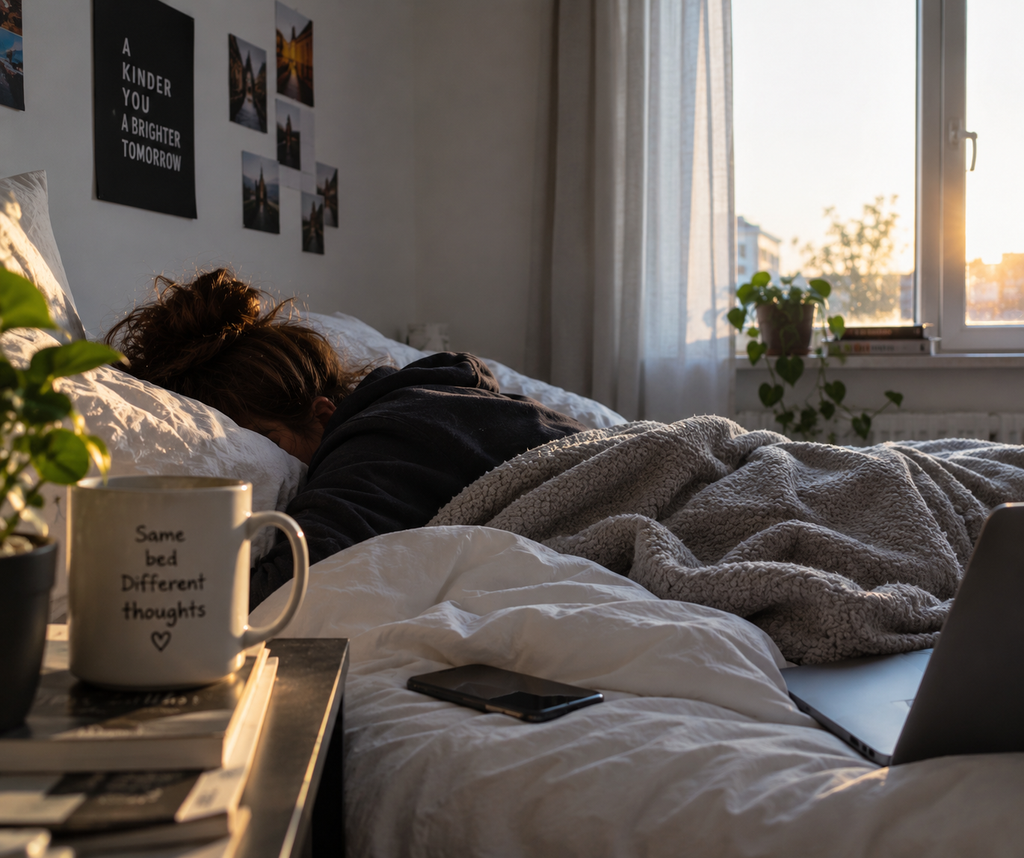
Is clinomania an actual medical condition?
Clinomania is generally used to describe an unusually strong or persistent desire to remain in bed for long periods of time.
The term has appeared in dictionaries and other reference sources for many years, so it was not invented by TikTok or Instagram. However, that does not make it a recognized modern medical diagnosis.
Reference sources such as Treccani explicitly describe clinomania as a non-medical term, and it is not classified as a distinct mental or physical disorder in major diagnostic systems such as the World Health Organization’s ICD-11.
That distinction matters.
A person can have a genuine and troubling experience without the label attached to it being an official diagnosis.
Instead of asking, “Do I have clinomania?”, a more useful question may be:
Why has getting out of bed become so difficult for me?
The answer can be very different from one person to another.
Wanting a lazy morning is not a disorder
There is nothing inherently unhealthy about enjoying your bed.
It is warm, private, familiar and associated with rest. After a stressful few days, sleeping late or spending a Sunday morning reading in bed can simply be pleasant.
Human behavior does not need a medical label every time it becomes inconvenient.
What matters is the context.
Someone who chooses to spend a relaxed morning in bed and then continues with the rest of the day is in a very different situation from someone who repeatedly misses work, stops seeing friends, neglects basic daily activities or feels unable to leave bed despite wanting to.
The important question is therefore not simply how many hours someone spends lying down.
It is why they are doing it and what effect it is having on their life.
Why depression can sometimes look like “not wanting to get up”
One reason the idea of clinomania resonates with so many people is that similar behavior can occur during depression.
Depression is not simply persistent sadness.
The US National Institute of Mental Health lists symptoms such as loss of interest or pleasure, low energy, fatigue, difficulty concentrating, slowed behavior and significant changes in sleep. Some people with depression sleep less than usual, while others sleep considerably more.
From the outside, this can be misinterpreted as laziness.
Inside, the experience can be very different.
Ordinary tasks such as showering, preparing breakfast, answering a message or getting dressed can begin to feel strangely demanding. Motivation may be severely reduced, while activities that once felt rewarding no longer provide the same emotional response.
In that situation, the bed can become more than somewhere to sleep. It can become a place of retreat where there are fewer demands, decisions and interactions.
That does not mean everyone who stays in bed is depressed, nor does it mean that “clinomania” is another name for depression.
It means that a noticeable change in someone’s ability to function deserves more careful attention than a social-media label can provide.
Fatigue and sleepiness are not the same thing
This distinction is particularly important.
Two people may both say:
“I could stay in bed all day.”
Yet they may be describing completely different experiences.
One might feel physically exhausted but remain fully awake.
The other may genuinely struggle to stay awake during the day.
In sleep medicine, excessive daytime sleepiness has a specific meaning. It involves difficulty maintaining wakefulness and alertness at times when someone would normally be expected to remain awake, sometimes accompanied by an irresistible need to sleep or unintended episodes of dozing.
That is very different from simply finding bed comforting.
If someone is repeatedly falling asleep during the day, needs unusually long periods of sleep or wakes after many hours feeling profoundly unrefreshed, the issue may belong more to sleep medicine than to anything described online as clinomania.
What about hypersomnia?
Hypersomnia is another term that is frequently confused with clinomania.
In everyday conversation, people often use it to mean “sleeping too much.” Clinically, the terminology is more precise.
Sleep specialists distinguish symptoms of excessive sleepiness or unusually long sleep duration from specific disorders such as idiopathic hypersomnia.
People with hypersomnolence disorders may sleep for long periods yet still struggle to feel alert. Some also experience severe sleep inertia, meaning that becoming fully awake after sleep can be exceptionally difficult.
That is not quite the same experience as being awake but preferring or feeling compelled to remain in bed.
This is why accurate descriptions matter. “I cannot stay awake” and “I am awake but cannot bring myself to get up” may point clinicians in very different directions.
And what is dysania?
Another term commonly encountered online is dysania.
It is generally used to describe extreme difficulty getting out of bed in the morning. Like clinomania, however, dysania is not typically treated as a standalone medical diagnosis.
The two expressions are sometimes used interchangeably online, even though they emphasize slightly different experiences.
Clinomania usually refers to the strong desire to remain in bed, while dysania tends to describe the difficulty of actually leaving it after waking.
Neither label explains the underlying reason.
Sometimes the cause may be physical
Persistent exhaustion is not always psychological.
A wide range of medical problems can reduce energy levels or make a person feel persistently tired. NHS guidance, for example, notes that significant fatigue can occur with conditions including iron-deficiency anaemia, diabetes, sleep apnoea and myalgic encephalomyelitis/chronic fatigue syndrome, commonly known as ME/CFS.
Other accompanying symptoms can provide valuable clues.
Someone experiencing fatigue alongside paleness, shortness of breath or heart palpitations may require evaluation for anaemia.
Persistent thirst, frequent urination and unexplained weight loss can point in a completely different direction.
Loud snoring, gasping during sleep, witnessed pauses in breathing and daytime sleepiness may raise concern about obstructive sleep apnoea.
In each of these cases, stopping at the conclusion “I must have clinomania” could delay attention to the actual problem.
The label describes the behavior.
It does not explain the cause.
Why calling someone lazy can miss the point
When another person spends a great deal of time in bed, “lazy” is an easy judgment to make.
Sometimes people certainly do postpone responsibilities because they would rather remain comfortable.
But persistent inability to function is not automatically a matter of willpower.
If depression, a sleep disorder or a physical illness is involved, telling someone to “just get up” does little to address what is happening.
In depression treatment, clinicians may use approaches that specifically target withdrawal and reduced activity rather than simply demanding greater motivation.
One well-established example is behavioral activation.
Behavioral activation is more than simply forcing yourself to move
Behavioral activation is a structured psychological treatment used particularly for depression.
Instead of relying on generic advice such as “be more positive” or “push yourself harder,” it helps people gradually reconnect with meaningful, rewarding or necessary activities and examine patterns of withdrawal and avoidance.
A large systematic review and meta-analysis published in Clinical Psychology Review in 2026 examined 105 randomized studies involving 13,933 participants. The researchers found behavioral activation effective for adult depression, with results comparable to other psychotherapies in direct comparisons.
That does not mean behavioral activation is a treatment for “clinomania.”
It demonstrates something more useful: when staying in bed is part of depressive withdrawal, clinicians have evidence-based methods for addressing the underlying disorder.
There is a significant difference between a structured therapy and simply telling an exhausted person to get out of bed.
Can staying in bed become part of a difficult cycle?
For some people with depression, withdrawal can create a self-reinforcing pattern.
Remaining in bed may initially feel relieving because it temporarily removes demands. But reducing social interaction, movement, everyday routines and activities that once provided satisfaction can also reduce opportunities for positive experiences.
Over time, returning to normal routines can feel increasingly difficult.
This idea helps explain why behavioral activation can be useful in some cases of depression.
However, it is important not to turn that observation into a universal rule.
Not every person who spends a great deal of time resting should simply increase activity.
ME/CFS is a particularly important example. One of its defining features can be post-exertional malaise, in which physical or mental exertion causes a worsening of symptoms. Recommendations therefore need to be tailored to the individual and the underlying condition.
“Get out of bed and exercise more” is not appropriate medical advice for every form of fatigue.
Is there a test for clinomania?
There is no blood test, scan or standardized medical investigation that confirms clinomania.
That is because there is no recognized standalone disorder to test for.
A clinician would instead investigate the symptoms themselves.
Is the person sleeping excessively?
Are they experiencing daytime sleepiness?
Have they lost interest in activities they previously enjoyed?
Is their mood persistently low?
Do they snore heavily or stop breathing during sleep?
Have their energy levels changed suddenly?
Are other physical symptoms present?
Depending on the answers, a doctor may consider blood tests, sleep assessment, mental-health evaluation or other investigations.
There is no universal checklist of “clinomania tests.”
When should staying in bed become a concern?
Sleeping late occasionally is not a medical emergency, and wanting to avoid the alarm on a cold morning does not indicate illness.
The situation deserves more attention when there is a persistent and unexplained change in sleep, energy, mood or everyday functioning.
For example, someone may begin missing work or school, withdrawing from other people, losing interest in things they normally enjoy or struggling to complete basic daily activities.
Persistent extreme fatigue or severe daytime sleepiness also deserves medical evaluation.
If symptoms suggest depression and continue rather than improving, seeking professional help is appropriate.
And if a person experiences thoughts of suicide or self-harm, urgent professional support is needed regardless of what label they may have encountered online.
The problem with turning a relatable feeling into a diagnosis
Clinomania is almost perfectly suited to social media.
The word sounds clinical. It is memorable. And it describes something nearly everyone has experienced at least occasionally: the feeling that staying under the covers is far more appealing than beginning the day.
That makes it easy to watch a short video and think, “That is exactly what I have.”
But recognizing yourself in a description is not the same as receiving a diagnosis.
For one person, staying in bed may simply be comfort.
For another, it may follow a period of intense stress.
For someone else, it may occur alongside depression, a sleep disorder or a medical condition causing profound fatigue.
The same behavior can have very different explanations.
Perhaps that is the most useful way to understand clinomania.
The bed is where the behavior becomes visible. It does not tell us why the behavior is happening.
When staying there begins to replace work, relationships, interests and ordinary life, the most important step is not finding the perfect internet label.
It is finding out what changed.
This article is intended for general informational purposes and does not replace medical, psychological or psychiatric evaluation.