
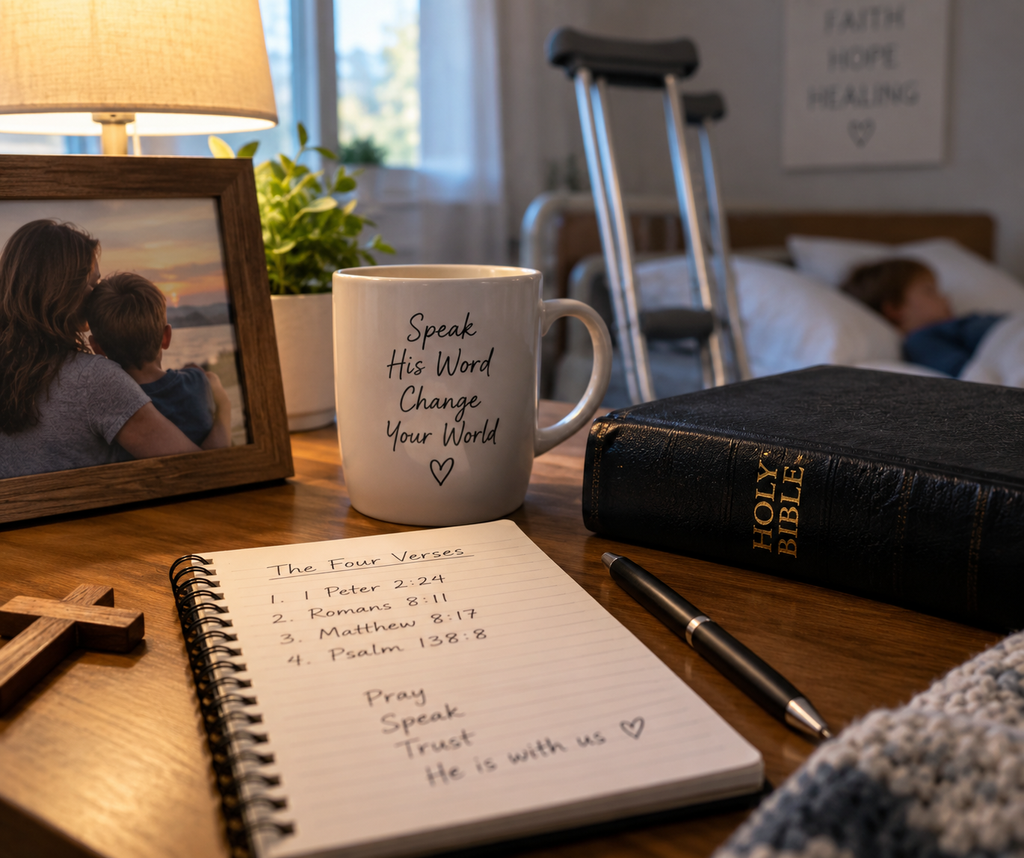
Four Bible references have become closely associated with Christian author and pastor Bev Tucker: 1 Peter 2:24, Romans 8:11, Matthew 8:17, and Psalm 138:8.
Seen on their own, they could easily look like another collection of encouraging verses shared across Christian social media. Yet for Tucker, these passages are connected to a deeply personal family story and to a much broader belief about the role of spoken words in a believer’s life.
She has explained that she began declaring these Scriptures repeatedly during a period when one of her sons was dealing with a serious hip condition. Over time, that experience became part of the spiritual framework she now teaches: Scripture, in her view, is not only meant to be read or silently believed, but also spoken into difficult circumstances.
That idea became especially visible in 2026 with the publication of You Can Change Your World By Speaking To It, a book centered on the belief that words spoken in agreement with Scripture can shape the way Christians confront fear, illness, lack, and other challenges.
The concept is compelling, but it also raises an important question.
What is the difference between praying Scripture with faith and claiming that spoken words themselves can directly alter physical reality?
Who Is Bev Tucker?
Bev Tucker is an American Christian pastor and author whose work has focused heavily on what many evangelical circles call deliverance ministry, together with inner healing and spiritual freedom.
According to material published by her ministry, Tucker and her husband, Lewis, became involved in this form of ministry after what they understood to be a spiritual calling. Before moving more deeply into religious work, Tucker had a background that included teaching and mentoring.
Her ministry shares testimonies from people who say they experienced freedom from fear, addiction, emotional pain, or other struggles through prayer and deliverance practices.
Such accounts are important within a religious context, but they should still be described accurately. They are personal testimonies published by a faith-based ministry, not findings from controlled medical or psychological studies.
Tucker’s work predates her latest book. In connection with her 2018 title Rejection: Identity Thief Exposed, she was described as serving in ministry at Life Church Assembly of God in Roscoe, Illinois, where she taught classes and led conferences related to deliverance.
She has also written Setting the Captives Free: Deliverance Manual, which presents deliverance through a Christian framework centered on prayer, spiritual authority, and the name of Jesus.
Her more recent work, however, places much greater emphasis on one particular subject: the words believers speak.
The Idea Behind You Can Change Your World By Speaking To It
Tucker’s 2026 book draws heavily on biblical passages that emphasize the significance of speech.
One is Proverbs 18:21, which says that death and life are in the power of the tongue. Another is Mark 11:23, where Jesus speaks about faith that can tell a mountain to move.
Tucker understands such passages as invitations for Christians to speak deliberately and confidently over their circumstances rather than continually repeating fear, defeat, or hopelessness.
The promotional description of the book uses language such as “command your morning” and speaks about declaring God’s Word over areas including healing, provision, and everyday life.
For some readers, this approach will sound familiar because it overlaps with themes often associated with the Word of Faith movement.
At the same time, Tucker has publicly tried to distance her teaching from a simplistic prosperity message.
In a June 2026 interview, she was asked directly how her teaching differs from prosperity theology. She criticized the idea of using spiritual declarations primarily as a way to pursue wealth and argued that this was not the purpose of what she was teaching.
During the same conversation, however, she shared the family story that helps explain why these four specific Scriptures became so important to her.
The Story of Her Son and the Four Scriptures
Tucker says one of her sons, Bryant, was around eight years old when he developed a serious condition affecting his hip.
In recounting the story, she refers to avascular necrosis and describes a childhood hip disorder that appears consistent with Legg-Calvé-Perthes disease, a condition in which blood supply to the femoral head is temporarily disrupted and part of the bone can die before going through a rebuilding process.
This is an important point where medical facts and personal testimony need to be kept separate.
According to Tucker, doctors considered the condition severe. She says the family later began speaking selected Bible verses over the child’s hip every day.
Years afterward, Tucker says another orthopedic surgeon compared imaging studies and found that the bone had recovered to an extent the family regarded as extraordinary.
Publicly available sources do not provide a complete medical record, the original and follow-up imaging, or an independent clinical analysis establishing that the recovery was medically inexplicable.
For that reason, the claim of miraculous healing should be understood as Tucker’s testimony rather than as a medically verified conclusion.
What can be established from the interview is that she directly identifies the four Scriptures she says the family used.
1 Peter 2:24 — “By His Wounds You Have Been Healed”
The first passage is 1 Peter 2:24.
It speaks of Christ bearing sins and contains the well-known phrase commonly translated as “by his wounds you have been healed.”
Tucker applies this wording not only to spiritual restoration but also to physical healing.
The surrounding biblical context, however, focuses strongly on sin, Christ’s suffering, and the restoration of people to God. The verse also echoes Isaiah 53.
Christian traditions differ over how far the healing language should be extended into a universal promise of physical recovery in this life.
There is therefore an important distinction between seeing the verse as a source of hope in illness and treating it as a guarantee that every disease must disappear if enough faith is exercised.
Romans 8:11 — Life for Mortal Bodies
The second passage is Romans 8:11.
It says that the Spirit of the One who raised Jesus from the dead dwells in believers and that God will give life to their mortal bodies through His Spirit.
Tucker has described applying this verse specifically to her son’s affected bone, focusing on the language of God bringing life to the body.
The larger context of Romans 8, however, is much broader than immediate physical healing.
The chapter deals with life in the Spirit, suffering, mortality, hope, redemption, and ultimately resurrection.
Within historic Christian interpretation, the verse has a strong connection to the future resurrection of the body, not simply to the immediate reversal of a present medical condition.
Matthew 8:17 — “He Took Up Our Infirmities”
The third passage has one of the clearest connections to bodily illness.
Matthew describes Jesus healing people and then links those healings to the prophetic words that He “took up our infirmities and bore our diseases.”
For Tucker, this passage became another Scripture to speak directly over illness.
The Catholic Catechism also cites Matthew 8:17 when discussing Christ’s relationship with the sick.
It teaches that Jesus came to heal the whole person, body and soul, and that His healings were signs of the coming Kingdom of God.
Yet the Catechism also makes an important qualification: Jesus did not heal every sick person during His earthly ministry.
His healings pointed beyond temporary physical restoration toward a deeper victory over sin and death.
That distinction matters.
Christian faith can affirm that God is able to heal without turning healing into an outcome that God must provide in every individual case.
Psalm 138:8 — Trust That God Will Not Abandon His Work
The fourth passage is Psalm 138:8.
Different Bible translations render the wording slightly differently, but the basic idea is one of confidence that the Lord will fulfill His purpose and will not abandon the work of His hands.
Tucker says she applied this verse directly to her son’s situation.
In its original setting, however, the Psalm is not specifically about disease.
It is about trust.
The writer faces trouble yet remains confident that God’s faithfulness has not disappeared.
Of the four passages, this may be the easiest to apply broadly to illness or crisis without turning it into a direct medical promise.
Can Spoken Words Actually Heal?
This is where the discussion moves from theology into a very different field.
Psychology has good reason to study the language people use toward themselves.
Research on self-talk suggests that inner dialogue can influence attention, motivation, emotional regulation, confidence, and performance in certain settings.
In that sense, words do matter.
A person who constantly rehearses catastrophe, helplessness, and failure may respond very differently from someone who cultivates hope, focus, and a belief that a difficult situation can still be faced.
But none of this is equivalent to evidence that repeating a sentence causes diseased tissue to regenerate or directly cures an infection, tumor, or orthopedic condition.
Those are medical claims, and medical claims require medical evidence.
Prayer itself has also been examined in clinical research. One widely discussed randomized study, known as STEP, involved more than 1,800 patients undergoing coronary artery bypass surgery.
The study did not find a reduction in complications attributable to intercessory prayer as tested within that experimental design.
That does not prove or disprove the existence of God, nor can such a study determine whether or how God responds to prayer.
It can only measure specific predefined medical outcomes under specific conditions.
Science and faith are not always asking the same question.
That is precisely why an individual religious testimony should not be presented as clinical proof.
What Does Catholic Teaching Say About Prayer for Healing?
Catholic teaching avoids two opposite claims that often dominate discussions like this.
One extreme says miracles cannot happen.
The other says that anyone with enough faith must necessarily receive physical healing.
The Catechism supports neither position.
It explicitly acknowledges that the Holy Spirit may give some people a special charism of healing.
At the same time, it states that even the most intense prayers do not always result in the healing of every illness.
That distinction makes room for a believer to pray boldly without turning prayer into a guaranteed mechanism.
A Christian may ask for healing.
A Christian may ask for a miracle.
A Christian may repeat Scripture and hold onto hope even in a frightening diagnosis.
But the absence of physical healing does not automatically mean that the person lacked faith.
That matters because the opposite message can become deeply damaging.
If someone is told that healing will inevitably follow sufficient faith and the illness remains, the suffering person may begin to believe that the failure was somehow their own.
Christian theology does not reduce illness and faith to such a simple equation.
The Most Difficult Part of Tucker’s Story
One element of Tucker’s account deserves particular caution.
In her 2026 interview, she says that after the initial period of her son’s treatment, she did not take him back to a physician for a long period of time.
She also emphasizes that she is not opposed to doctors and says the family later returned to orthopedic care when he experienced pain again.
That part of the story should never be turned into a general recommendation.
Prayer and medical care are not mutually exclusive.
A person can read Scripture, pray for healing, and still attend follow-up appointments, complete appropriate investigations, and follow evidence-based treatment.
Stopping medical monitoring or treatment for a serious condition can carry real risks.
Tucker’s family’s decision belongs to their personal story. It should not be treated as medical guidance for someone else.
So Is There Any Value in Speaking These Four Verses?
From a spiritual point of view, there certainly can be.
For a Christian, speaking Scripture can become a form of prayer, meditation, and deliberate resistance to fear.
The value does not have to depend on believing that the words operate like a supernatural formula.
A person facing illness may repeat the promise of 1 Peter.
They may remember the life-giving Spirit described in Romans.
They may pray with Matthew’s language about Christ carrying human infirmity.
They may hold onto the confidence of Psalm 138 that God’s faithfulness has not ended.
And they may ask for healing with complete sincerity.
What Christianity does not require is the conclusion that because the verses were spoken, physical healing must happen on demand.
Perhaps the Real Power of the Story Is Not a Formula
The appeal of Bev Tucker’s message is easy to understand.
It reaches people at precisely the moment when they may feel least powerful: after a frightening diagnosis, during a long illness, or while watching someone they love suffer.
In situations like these, refusing to let fear become the only voice in the room can be deeply meaningful.
Tucker says to speak the Word.
Medicine says to investigate, treat, and monitor the condition.
Psychology suggests that the way we think and speak can influence how we cope, behave, and endure difficult circumstances.
Christian faith leaves room for something that medicine cannot measure in the same way: hope that God may intervene.
These do not necessarily have to compete with one another.
A person can pray and still see a doctor.
They can hope for a miracle and still take prescribed treatment.
They can speak Scripture without treating Scripture as magic.
The real danger begins when hope is turned into medical certainty, or when someone who remains ill is made to feel that insufficient faith was the reason.
Faith does not always mean knowing exactly what God will do.
Sometimes faith is continuing to trust even when the outcome is still unknown.