
She had once been the church pianist.
Then polio changed almost everything.
David C. Gibbs Jr. was still a child when his mother became seriously ill. According to the story he would later tell in sermons, the disease left her with profound physical disabilities and dependent on others for some of the most basic daily tasks.
Years later, Gibbs — an attorney and founder of the Christian Law Association — would return again and again to his mother’s story when speaking about faith, suffering, perseverance, and usefulness.
What makes the account especially memorable is not only what happened to her physically, but what Gibbs says she did afterward.
He describes a woman who could no longer live independently, yet who became deeply involved in a church ministry for children. Over time, according to his testimony, that work grew from only a handful of children to a large Sunday school operation supported by dozens of buses.
Some versions of the story even mention as many as 5,000 children attending on a Sunday.
It is an extraordinary claim.
And because it is extraordinary, it deserves to be told carefully.
Several parts of the story are supported by biographical material from people familiar with the Gibbs family. Other details — especially the dramatic numbers and conversations — come primarily from David Gibbs himself and cannot currently be verified through independent public records.
The distinction matters.
But it does not make the story any less remarkable.
When Polio Entered the Gibbs Family
David Gibbs has said that he was around eight years old when his mother contracted poliomyelitis.
Before that, she had been active in church life and played the piano.
Polio was one of the most feared infectious diseases of the twentieth century before widespread vaccination dramatically reduced its impact. Some people experienced only mild symptoms, while others developed paralysis. In severe cases, the muscles responsible for breathing could also be affected.
For the Gibbs family, the disease was not a distant public-health threat.
It changed their home.
In sermons where Gibbs recounts the experience, he describes a long period of treatment and separation from his mother. Retellings based on his testimony say that she spent an extended time hospitalized and at one stage required treatment involving an iron lung, the negative-pressure ventilator famously associated with severe paralytic polio.
When she eventually returned home, she had not recovered the life she once knew.
The Pianist Returned Home With Severe Disabilities
Gibbs’ descriptions of his mother after polio are difficult to forget.
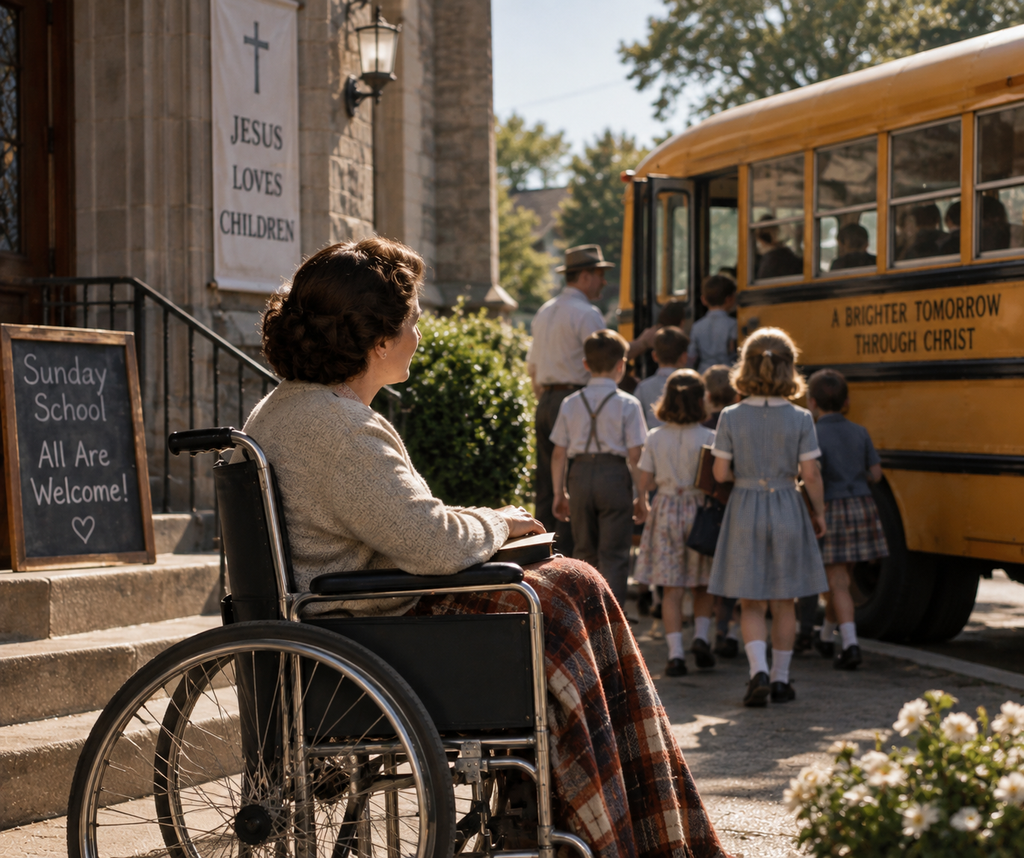
He recalls a woman who needed a wheelchair and required help with ordinary physical tasks. In one transcript of his preaching, he says that she could not feed herself and needed others to move her from place to place.
Other versions of the account describe her as unable to support her head without assistance.
Whether every physical detail can be independently documented today is difficult to establish, but the central fact is supported by other biographical material: his mother did suffer from polio and lived with serious physical limitations afterward.
For Gibbs, however, this was never where the story ended.
According to him, his mother began asking a different question.
Not, “How can I get my old life back?”
But rather, “Is there still something I can do?”
A Sunday School With Almost No Children
The opportunity, as Gibbs tells it, came through a church that needed help working with children.
His mother accepted.
There was only one obvious problem.
There were hardly any children.
In one of Gibbs’ sermon transcripts, he says that the class effectively began with just two students: David and his sister.
Still, his mother taught them seriously.
She prepared as though the room were full.
Eventually, other children began to appear.
According to the story, some were initially curious about the woman in the wheelchair. But they kept coming.
And the small Sunday school began to grow.
Then Mrs. Gibbs started thinking about transportation.
She Wanted Buses, but She Had No Buses
This is where the story takes its most dramatic turn.
Gibbs says his mother knew that transportation could determine whether many children were able to attend church activities. He also recalled a family history of bringing children to church using available vehicles.
But she wanted something more practical.
She wanted buses.
There was a serious obstacle: she did not own any.
And she did not have the money to buy them.
So, according to Gibbs, she asked to be taken to a bus company.
David pushed her wheelchair inside.
The request she made was unusual.
She was not there to purchase a bus.
She wanted the company to provide one.
For free.
The Answer Was Supposed to Be No
According to Gibbs’ version of events, company staff initially explained that they simply did not give buses away.
His mother was not easily discouraged.
When she discovered that the executive speaking with her did not actually own the company, she asked to speak with the person who did.
Eventually, the owner reportedly came down to meet her.
Gibbs says the man had already noticed how difficult it was for her to get out of the car and enter the building.
He was willing to listen.
Then came another practical problem.
Who would drive the bus?
Mrs. Gibbs apparently had not solved that part.
So she expanded the request.
She needed a bus.
And a driver.
And, if the goal was to reach children across a wider area, she would eventually need more than one.
It is the kind of conversation that sounds almost too perfectly constructed for a sermon.
That is exactly why the source matters.
Different Versions Give Different Numbers
The broad story is consistent, but some details vary depending on which transcript or retelling is consulted.
In one available transcript of Gibbs’ sermon, the bus company provides two buses and two drivers for a Sunday. The following week, the number increases.
In another published retelling based on his preaching, the starting number is three buses, followed by four.
That discrepancy may seem small, but it is important when trying to treat an inspirational story as historical material.
We should not simply choose whichever version sounds more impressive.
The safest conclusion is this:
David Gibbs says his mother persuaded a transportation company to provide buses and drivers so children could attend Sunday school. The exact number involved at the very beginning differs between surviving versions of the story.
What he says happened later is even more striking.
Gibbs Says the Ministry Eventually Used 35 Buses
In one transcript, Gibbs states that the company eventually provided 35 buses and 35 drivers every Sunday.
Another version places that growth over a somewhat different time period.
He also says the Sunday school eventually reached thousands of children, with some versions mentioning at least 5,000 children attending on a Sunday.
That is the figure most likely to stop a reader.
Five thousand children.
Transported to church week after week.
All connected, according to Gibbs, to the determination of a woman who needed assistance with some of the most basic movements of everyday life.
It is also the point where responsible storytelling requires restraint.
We have not identified independent attendance records, transportation logs, or contemporary documentation that confirms the figure of 5,000.
So the number should be attributed to Gibbs.
It should not be presented as an independently established statistic.
What Can Be Confirmed About His Mother?
There is outside biographical material that supports important parts of the story.
A publication from Christchurch Baptist Fellowship discussing David Gibbs describes his mother as a church pianist whose later life was affected by polio.
The author also connects Gibbs’ parents with the early development of bus-based church outreach and describes Mrs. Gibbs as having a significant influence on young people.
That source contains another striking recollection.
The writer says that, as he remembers it, approximately 60 men attending Mrs. Gibbs’ funeral had entered Christian ministry under her influence or guidance.
That detail is itself a personal recollection rather than an official count, and it should be treated as such.
Still, it adds independent support to the broader picture.
Mrs. Gibbs was not merely a figure in one of her son’s sermons.
People outside the immediate family remembered her as someone deeply involved in religious work and mentorship despite the physical consequences of polio.
The Most Important Part of the Story May Not Be the Buses
The numbers are easy to remember.
Thirty-five buses.
Thousands of children.
But when Gibbs speaks about his mother, the emotional center of the story lies somewhere else.
He remembers being a child who was angry about what had happened.
His mother’s illness had disrupted the family. He could see what polio had taken from her, and he struggled with resentment.
According to Gibbs, his mother tried to teach him not to allow bitterness to define the rest of his life.
The official description of one of his messages, “God Will Make a Way,” presents the story specifically as an account of how his mother responded to polio and how her response shaped his own understanding of gratitude, hardship, and faith.
That theme appears repeatedly when Gibbs talks about her.
He remembers suffering.
But he also remembers prayer.
He remembers dependence.
But he also remembers purpose.
There Is a Risk in Telling Stories Like This
Inspirational stories involving disability can easily become uncomfortable when suffering is romanticized.
Polio was not a blessing.
It was a devastating disease that caused paralysis, lifelong disability, and death in families around the world.
Mrs. Gibbs did not become remarkable because she contracted polio.
If her son’s account is understood properly, what makes her remarkable is what she chose to do after the disease had already taken so much from her.
That distinction matters.
We do not need to describe suffering as somehow beautiful in order to recognize courage, faith, determination, or generosity in the person living through it.
And we should not reduce a disabled person’s value to how much they managed to accomplish afterward.
The more meaningful part of this story may be that Mrs. Gibbs continued to see herself as someone who could contribute, teach, influence others, and remain involved in a community even after losing much of her physical independence.
So How Much of the Story Is True?
The answer is more nuanced than either “everything is proven” or “it is just a church legend.”
There is reasonable support for the core biography.
David Gibbs’ mother suffered from polio.
She lived with serious physical disabilities afterward.
She remained involved in church life.
Other biographical sources connect the Gibbs family with extensive church bus ministry and describe her as having a strong influence on younger generations.
Then we have the much more detailed story told by David Gibbs himself.
That includes the meeting with the bus company, the donated transportation, the drivers, the expansion to dozens of buses, and the claim that thousands of children eventually attended.
Those details belong primarily to his testimony.
They have not, based on the public sources available, been independently documented to the same standard.
That does not mean they are false.
It means the responsible wording is:
David Gibbs says that his mother’s ministry eventually involved dozens of buses and thousands of children.
That one sentence preserves both the power of the story and the difference between testimony and verified record.
Her Legacy May Be Impossible to Reduce to a Number
Perhaps the exact attendance figure will one day be documented more clearly.
Perhaps church records, old transportation files, photographs, newsletters, or archived local reporting still exist somewhere.
But even without them, one element of Mrs. Gibbs’ influence is obvious.
Her son was eight years old when polio changed their family.
He watched her return home with profound physical limitations.
He helped push her wheelchair.
He watched her continue working with children.
And decades later, David Gibbs was still telling audiences about her.
That alone reveals something about the scale of her influence on at least one life.
Maybe the most important question is not whether the final number was exactly 5,000.
Maybe it is what happened between the day a woman came home from polio treatment and the day her son began telling thousands of strangers about what she had taught him.
Her story is not powerful because illness somehow made her stronger.
It is powerful because illness took away so much, and she continued searching for what she could still give.
And that is probably why, so many years later, her son kept telling her story.