
A family day at the seaside turned into a life-or-death emergency when two boys became trapped beneath a pier in Blackpool as the tide rose around them. The children, aged 10 and 12, were forced to cling to the structure while waves repeatedly swept through the area and one of them began disappearing beneath the water.
The incident was later documented by the Royal National Lifeboat Institution, better known as the RNLI. Footage recorded from rescuers’ helmet cameras shows just how serious the situation became before both boys were finally brought to safety.
What makes the story especially important is that there was no dramatic storm and no giant wave announcing the danger. The sea simply kept rising.
A Family Celebration That Suddenly Became an Emergency
The incident happened in Blackpool on 28 May 2026.
Subby, aged 10, and his 12-year-old cousin Kizza were visiting the seaside with their family during the school half-term holiday. According to the RNLI, the family had travelled from Leeds and were also celebrating Eid al-Adha.
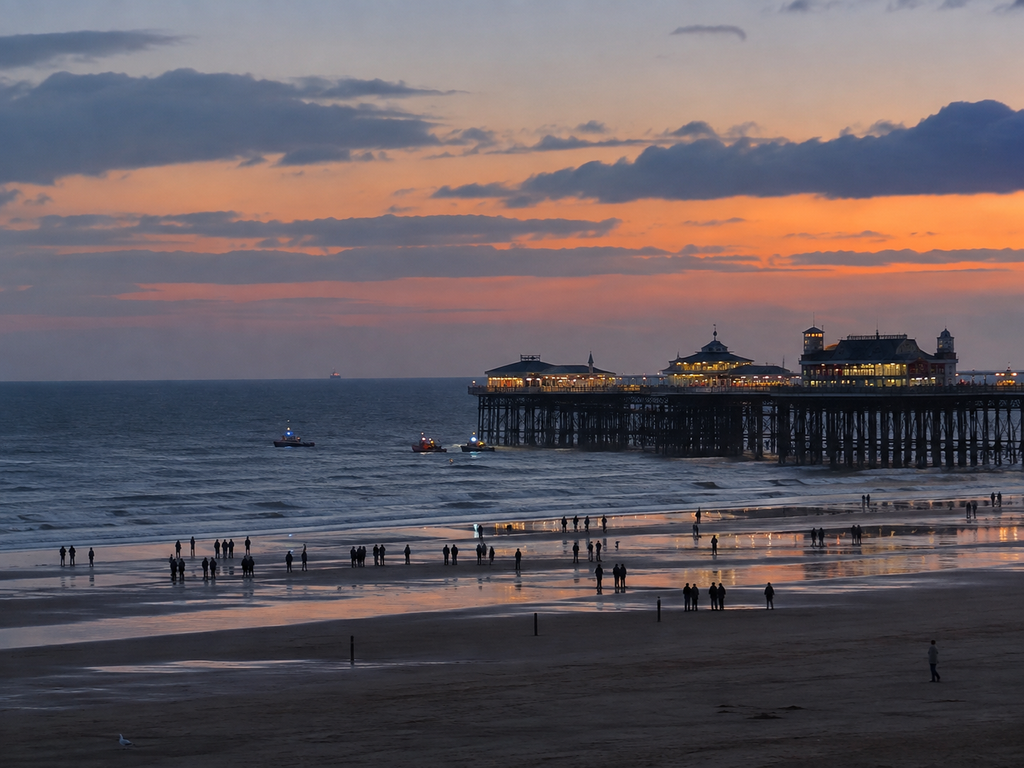
At some point, the boys ended up beneath one of Blackpool’s piers.
As the tide came in, the area around them changed. Water rose around the supporting structure, leaving the children unable to return safely to shore. They eventually had to hold onto the pier supports while waves continued to move through the space around them.
What may have looked like a manageable situation at first was becoming more dangerous with every passing minute.
A Mother Watching Her Son Struggle in the Water
Subby’s mother, Zully, tried to reach the children herself.
She later told the RNLI that the tide was rising rapidly and that she was hit by a powerful wave while attempting to move toward them. Ted, Kizza’s 21-year-old brother, warned her to turn back because the boys were too far away.
But walking away was almost impossible for her emotionally.
She believed that as long as her son could hear her voice telling him to keep holding on, he might continue fighting.
At one point, she could see the water going over Subby’s head and did not know whether he would come back to the surface.
Police officers eventually pulled her away from the water because she was also at risk of becoming trapped.
By then, the boys had reportedly been holding onto the structure for around 40 minutes.
A Young Man Also Tried to Reach Them
Ted had climbed onto part of the pier structure in an attempt to help the two boys.
Footage released by the RNLI shows him positioned higher on the supports while the children remained below. He could stay close to them, but he could not stop the rising water or safely remove them himself.
His situation illustrates one of the most difficult realities of water emergencies.
When someone you love is in trouble, the instinct to jump in and help can be overwhelming. But the same conditions that placed the first person in danger can quickly endanger the would-be rescuer as well.
That is why professional lifesaving organisations repeatedly warn people not to enter hazardous water unless they have the training and equipment to do so safely.
A Bystander Called 999
Someone nearby eventually called the emergency services.
The Coastguard requested assistance from Blackpool RNLI, and a volunteer crew was launched.
According to the RNLI, its D-class lifeboat reached the children in approximately four minutes after the call for assistance.
That speed mattered.
Subby had already been seen going beneath the water, and rescuers had to manoeuvre carefully around the pier supports before bringing both boys aboard one at a time.
They were then taken directly toward paramedics waiting on shore.
Ted remained on the structure temporarily and was later recovered by another RNLI crew using an Atlantic 85 lifeboat.
All three survived, and the RNLI later reported that the boys made a full recovery.
The Family Had Checked the Tide — So How Did This Still Happen?
One of the most striking details in the RNLI account is that the family had not simply ignored the sea conditions.
Zully said she had checked tide information online before their visit.
Even so, she had not expected conditions to change so quickly.
This is an important reminder that knowing the approximate time of high tide is only part of understanding coastal risk. The height of the tide, the shape of the beach, local currents, weather conditions and the layout of structures such as piers can all affect how quickly an area becomes unsafe.
Two beaches experiencing the same stage of the tidal cycle can look very different depending on local geography.
That is why coastal safety advice often recommends checking official local information rather than relying only on a general understanding of when the tide is coming in.
The Tide Does Not Arrive as One Giant Wave
Tides are often misunderstood.
Some people imagine the incoming tide as a single large wave suddenly moving toward shore. In reality, the change is generally gradual.
The water keeps advancing.
A few centimetres at a time may not seem significant, especially to someone who is walking, taking photographs or watching children play.
But over 20, 30 or 40 minutes, the landscape can change dramatically.
A patch of exposed sand can disappear. A route around rocks can become submerged. An area beneath a pier that seemed accessible earlier may become impossible to leave safely.
That slow transformation is part of what makes rising tides so deceptive.
Why Piers Can Become Particularly Hazardous
A pier may appear to provide shelter from open water, but the structure itself can add another layer of danger.
Waves and currents interact with supporting columns, beams and other hard surfaces. Conditions vary from place to place, but water around these structures can become turbulent and difficult to predict.
There is also a straightforward physical danger.
In open water, a person may be able to float or move with the waves. Close to a pier, those same waves can push someone against rigid supports.
A person may be struck, lose grip or become exhausted while repeatedly trying to keep their head above water.
As the tide rises, available space can also decrease, leaving fewer safe routes out.
Cold Water Can Make an Already Dangerous Situation Worse
Sea temperature is another factor people often underestimate.
Even on a warm day, coastal water can be cold enough to trigger a strong physiological reaction when someone enters unexpectedly.
The RNLI warns about a phenomenon known as cold water shock, which can occur in water below roughly 15°C.
A sudden immersion may cause an involuntary gasp, rapid breathing, an increased heart rate and temporary difficulty controlling respiration.
For someone already frightened or struggling in waves, those reactions can quickly intensify panic.
This helps explain why being a confident swimmer in a pool does not automatically mean someone will cope equally well in cold, moving seawater.
“Float to Live”
One of the RNLI’s best-known safety messages is called “Float to Live”.
If a person unexpectedly finds themselves in difficulty in the water, the advice is to resist the immediate urge to thrash or swim as hard as possible.
Instead, they should try to lean back, keep their ears in the water, relax as much as possible and focus on controlling their breathing.
Gentle movements of the arms and legs can help maintain buoyancy.
The goal is not perfect stillness. It is to regain enough control to breathe normally and assess what to do next.
Only once the initial shock has passed should the person think about calling for help or moving toward safety if that is realistically possible.
If Someone Else Is in Trouble: Phone, Float, Throw
The RNLI also uses another simple safety message: “Phone, Float, Throw”.
“Phone” means calling the emergency services immediately.
“Float” means encouraging the person in the water to try to float on their back.
“Throw” means providing something buoyant if it can be done without putting yourself at risk.
A lifebuoy is ideal, but in an emergency other floating objects may also help someone remain above water until trained rescuers arrive.
The key message is that jumping into the water is not automatically the safest or bravest response.
Sometimes the most useful thing a witness can do is raise the alarm quickly and remain in a position where they can direct rescuers to the person in danger.
Why the RNLI Shared the Footage
The rescue itself happened in May, but the RNLI publicised the family’s story and the dramatic video footage later in the summer.
The timing was deliberate.
The family agreed to speak publicly in support of drowning-prevention awareness ahead of World Drowning Prevention Day, observed on 25 July.
That context matters because the footage was not released simply as dramatic social-media content.
It became part of a broader safety message about tides, cold water and the dangers of attempting untrained rescues.
An Ordinary Day That Changed in Less Than an Hour
Perhaps the most unsettling part of the Blackpool rescue is how ordinary the day initially was.
A family had travelled to the coast. They had checked the tide. Children were playing nearby. There was no spectacular storm warning everyone to stay away from the water.
Then the sea began to rise.
Around 40 minutes later, two boys were clinging to a pier structure, a young man was trying to reach them and a mother was watching her child disappear beneath the water while lifeboat crews raced toward the scene.
All three survived.
That is why the story matters beyond the dramatic footage.
Coastal danger does not always announce itself loudly. Sometimes it develops quietly, while everything still appears normal.
Checking tides, paying attention to local warnings, keeping a charged phone nearby and knowing simple rules such as “Float to Live” may seem like minor precautions.
Most days, they may never be needed.
On a day like the one experienced by Subby, Kizza and their family, they can make the difference between a frightening memory and a tragedy.