
Six minutes after takeoff, the passengers aboard Daallo Airlines Flight 159 heard an explosion.
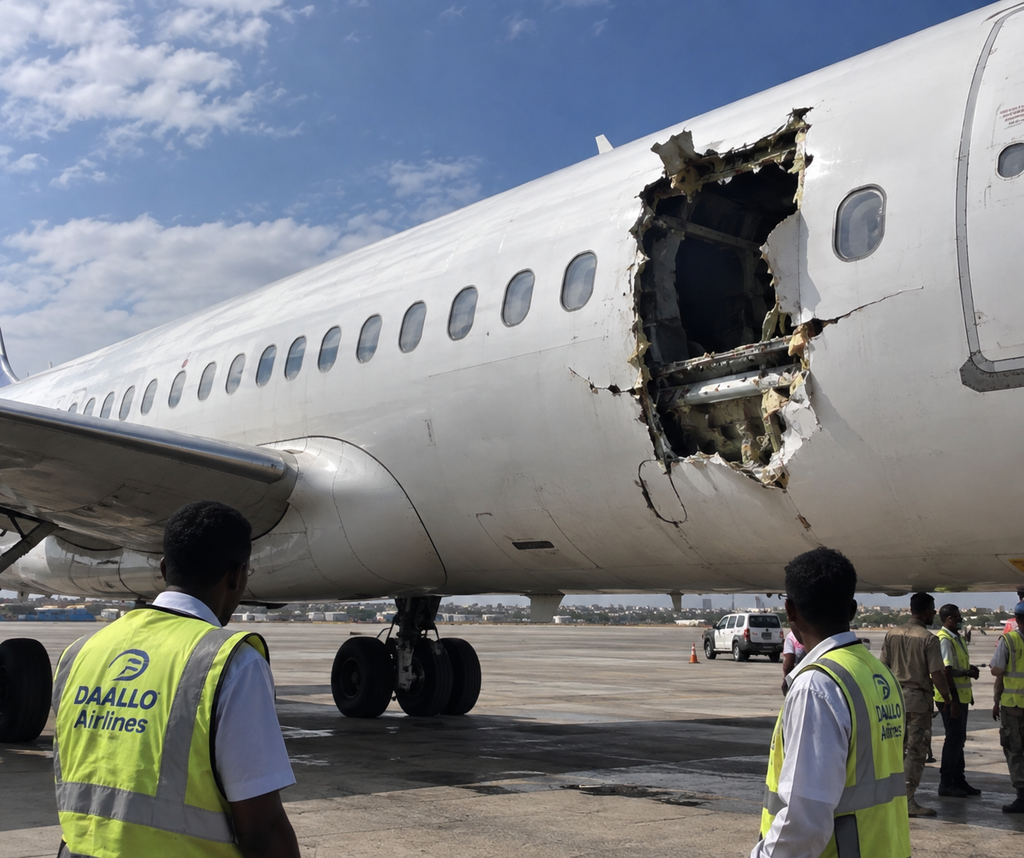
A blast had ripped through the right side of the Airbus A321, leaving a large opening in the fuselage. Cabin pressure began to fall, oxygen-mask compartments opened, and one passenger was no longer inside the aircraft.
In the cockpit, the crew had little time to understand exactly what had happened. Their immediate concern was simpler: the aircraft was damaged, but it was still responding to their commands.
They turned back toward Mogadishu.
Twelve minutes after the explosion, the Airbus was safely on the ground.
There had been 81 people aboard. Eighty survived.
The only person killed was the man carrying the explosive device.
The story of Daallo Airlines Flight 159 has circulated online for years, often presented as an extraordinary example of a terrorist plot defeated by bad timing. The real event is just as remarkable, but several details commonly repeated on social media are wrong or remain unproven.
The aircraft was not carrying more than 150 people. The explosion did not occur at 14,000 feet. And although the relatively low altitude almost certainly mattered, investigators did not establish that a badly timed bomb was the reason everyone else survived.
What happened on February 2, 2016, was more complicated — and arguably more compelling.
A Routine Flight Out of Mogadishu
Daallo Airlines Flight 159 was scheduled to fly from Mogadishu, Somalia, to Djibouti.
The aircraft operating the flight was an Airbus A321 registered SX-BHS and leased to Daallo Airlines by the Greek carrier Hermes Airlines.
There were 74 passengers and seven crew members aboard.
Many of those passengers had originally been booked on a Turkish Airlines service. After that flight was cancelled, they were transferred to Daallo for the journey to Djibouti, where they could continue onward.
The Airbus departed Mogadishu at approximately 08:35 UTC.
The first officer was flying the aircraft while the captain monitored the flight. Air traffic control had cleared them to climb toward FL300, roughly 30,000 feet.
They never reached it.
At 08:41:03, as the aircraft climbed through approximately 10,400 feet — a little over 3,100 meters — an explosion was recorded.
Almost immediately, the cockpit received warnings related to cabin pressure.
Something serious had happened behind them.
Investigators Found the Source Near Seat 16F
The explosion occurred around row 16 on the right side of the aircraft, in the area between the wing and the second emergency exit.
Investigators eventually determined that an improvised explosive device had been concealed inside a laptop carried by a passenger seated at 16F.
That passenger was identified as Abdullahi Abdisalam Borleh.
The blast caused significant localized structural damage. Investigators documented tearing and deformation consistent with an explosion originating inside the cabin, along with heat damage and soot.
A section of the aircraft’s outer structure had been blown open.
Borleh was ejected through the opening.
His body was later recovered on the ground near the town of Balad.
Remarkably, no one else aboard the aircraft was killed.
The Laptop Raised a Much Bigger Security Question
The discovery of an explosive device hidden inside a laptop immediately raised an obvious question: how had it reached the aircraft?
Airport surveillance footage provided investigators with part of the answer.
Video released after the attack appeared to show Borleh inside the airport accompanied by men described as airport workers. One of them could be seen handing him an object believed to be the laptop later associated with the explosion.
The investigation therefore pointed to something far more serious than a passenger simply slipping through an ineffective security checkpoint.
People familiar with the airport environment appeared to have been involved.
The final investigation described considerable planning, recruitment and coordination behind the attack. That finding matters because it contradicts one of the most popular versions of the story online: the idea that the entire operation failed simply because the attacker did not know what he was doing.
The attack itself was not amateurish.
Its outcome was shaped by several other factors.
The Strange Story Behind the Window Seat
One detail reported in the days following the bombing made the case even more unsettling.
According to Daallo Airlines management, Borleh had not originally been sitting in the window seat.
He reportedly asked another passenger to switch places with him.
The passenger agreed, leaving Borleh at 16F, directly beside the aircraft’s outer wall.
The seat-switching account came from statements made after the attack rather than being established as a separate finding in the final technical report, so it deserves that qualification.
What investigators did establish was that the passenger at 16F was carrying the explosive device.
And its location mattered.
When the device detonated, the force of the blast was directed into the surrounding cabin and aircraft structure. The fuselage was breached, and the man sitting beside it was thrown outside.
Why Were the Oxygen Masks Hanging Down?
Photographs taken after the emergency showed oxygen masks hanging throughout parts of the cabin.
At first glance, that seems exactly what we would expect after an aircraft suddenly loses pressure.
But investigators noticed an interesting problem.
The automatic passenger oxygen system was designed to deploy at a cabin altitude of approximately 14,000 feet.
Flight 159 was only passing through about 10,400 feet when the explosion occurred.
The pilots also reported that they had not manually activated the passenger oxygen system.
Investigators therefore considered it likely that at least some of the mask compartments had been forced open by the physical effects of the explosion rather than by normal automatic deployment.
It is a small technical detail, but it gives some idea of the force passengers experienced inside the cabin.
The Aircraft Was Badly Damaged — But Still Flyable
The explosion had opened the fuselage, injured passengers and caused a rapid loss of cabin pressure.
What it had not done was equally important.
The pilots could still control the aircraft.
Within seconds of the blast, the captain took over flying duties and lowered the nose while beginning a turn back toward Mogadishu. The first officer worked through the relevant procedures and communicated with air traffic control.
The cockpit recording later showed a crew continuing to divide responsibilities and communicate despite having very limited information about the damage behind them.
At one point, cabin crew contacted the cockpit about the situation in the passenger compartment.
The captain told them they were returning to Mogadishu and would be on the ground within minutes.
At approximately 08:53, they landed.
Only about 12 minutes had passed since the explosion.
The final investigation specifically highlighted the crew’s cooperation and management of the emergency as contributing factors in the safe outcome.
Was the Bomb Supposed to Explode Later?
This is where the documented story becomes separated from one of its most popular internet interpretations.
Flight 159 had departed around 20 minutes late.
After the incident, this led to a compelling theory: perhaps the bomb had been set to explode after a predetermined amount of time, with the expectation that the aircraft would already be cruising at a much higher altitude.
If so, the delay could have meant that the device detonated while the Airbus was still relatively close to the ground.
It is an intriguing possibility.
It is not, however, something the final investigation established as fact.
The technical report did not conclusively identify a timer programmed for a particular point in the flight, nor did it conclude that an error in timing caused the attack to fail.
A later United Nations monitoring report did note that the device had been detonated at an unsuitable altitude and that the bomber was the only fatality.
That gives us good reason to pay attention to the altitude.
It still does not prove the familiar story that a 20-minute delay caused a timer to go off before the attacker intended.
Why Altitude Mattered
Commercial aircraft cabins are pressurized because the atmosphere becomes increasingly thin as an aircraft climbs.
At normal cruising altitude, the pressure outside the aircraft is much lower than the pressure maintained inside the cabin. If a large opening suddenly appears in the fuselage, that pressure difference becomes extremely important.
Flight 159 was still climbing when the bomb exploded.
At roughly 10,400 feet, the aircraft was far below its intended cruising altitude.
The breach was still dangerous. The aircraft lost cabin pressure, passengers were injured, and the structural damage was substantial.
But the pressure environment was not the same as it would have been at around 30,000 feet.
The relatively low altitude therefore appears to have limited some of the consequences of the fuselage breach.
That does not mean altitude alone saved the flight.
The location and extent of the damage mattered. The aircraft remained controllable. Its critical flight systems continued functioning. And the pilots were close enough to Mogadishu to return quickly.
Survival came from a combination of circumstances rather than one cinematic twist.
Al-Shabaab Claimed Responsibility
The militant group Al-Shabaab later claimed responsibility for the bombing.
The group said the intended target had been a Turkish Airlines flight, a claim that attracted particular attention because many of the passengers aboard the Daallo aircraft had indeed been transferred following the cancellation of a Turkish Airlines service.
The investigation also exposed serious concerns about security at Mogadishu’s airport.
Several people were eventually prosecuted in connection with the attack.
In May 2016, a Somali military court convicted ten people. Two received life sentences, while eight others were given prison terms for their roles in the operation.
The case demonstrated that the bomb’s presence aboard the aircraft was not merely the result of a single security checkpoint failing to identify a suspicious passenger.
The vulnerabilities extended deeper into the airport system.
The Numbers Often Shared Online Are Wrong
The basic event is so extraordinary that it hardly needs embellishment.
Yet two incorrect numbers continue to appear in retellings.
First, the explosion did not occur at 14,000 feet. Flight-recorder data placed the aircraft at approximately 10,400 feet when the blast happened.
Second, there were not more than 150 people aboard.
There were 81: 74 passengers and seven crew members.
Eighty survived.
There is even a small inconsistency within the final report concerning the number of injured passengers. Its summary refers to three injured passengers, while another section and the conclusions mention two. What is consistent throughout the record is that Borleh was the sole fatality.
The Attack Also Changed the Conversation About Airport Security
The final investigation did more than reconstruct what happened in the air.
It examined how an explosive device concealed in a laptop could have reached a commercial aircraft in the first place.
Among the resulting recommendations were stronger screening of passengers and airport employees, tighter control of access to restricted areas, explosive-trace detection and additional checks involving electronic devices.
The broader lesson went beyond laptops.
Airport security depends not only on screening passengers at a checkpoint but also on controlling who has access to aircraft, luggage and restricted areas behind that checkpoint.
Flight 159 exposed what can happen when that internal layer of security is compromised.
Twelve Minutes Between an Explosion and a Safe Landing
The most popular version of this story offers an irresistible ending: a bomber supposedly miscalculated his timer, the aircraft happened to be too low, and his own mistake saved everyone else.
Reality does not give us such a neat conclusion.
What we know is more substantial.
An explosive device concealed inside a laptop detonated aboard a passenger aircraft during its climb out of Mogadishu. The blast tore open the fuselage. The man carrying the device was ejected from the aircraft. Cabin pressure was lost and nearby passengers were injured.
But the Airbus remained controllable.
The pilots reacted within seconds, reversed course and brought it back to the airport.
Twelve minutes after the explosion, they landed.
Of the 81 people who had departed Mogadishu, 80 were still alive.
The relatively low altitude probably helped. The location of the damage mattered. The aircraft’s ability to remain flyable mattered.
And so did the people sitting in the cockpit.
The extraordinary part of Flight 159 is not that one lucky coincidence magically saved an airplane. It is that several factors aligned at precisely the moment they were needed — and that when a routine flight suddenly became an extreme emergency, the crew still had an aircraft they could control and enough time to bring it home.