
A striking story has been appearing in social media ads: a physician connected to Harvard reportedly lived for years with a progressive neuromuscular disease, began practicing Falun Gong, and then experienced a dramatic improvement that some accounts describe as a complete recovery.
It sounds like the kind of extraordinary health story that demands skepticism.
Yet the person at the center of it is not a character created for a modern advertising campaign. Wang Zhiyuan was telling his story publicly more than two decades ago.
The more difficult question is not whether Wang made these claims. He did. The question is what his case can actually tell us about his illness, his recovery, and the role he believed Falun Gong played in it.
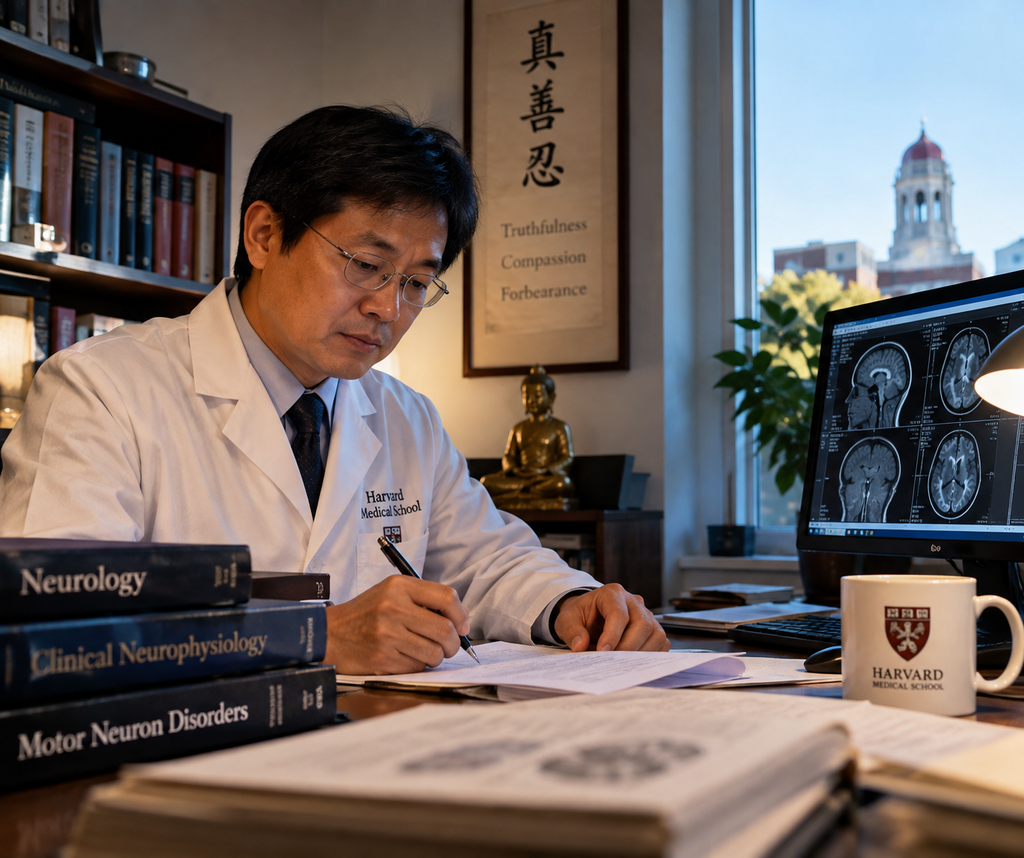
Who is Wang Zhiyuan?
In a personal account published on Minghui, a website associated with Falun Dafa, on April 1, 2001, Wang Zhiyuan identified himself as a physician, a Falun Dafa practitioner living in Boston, and a researcher at Harvard Medical School.
That distinction matters because some modern versions of the story describe him as a “Harvard professor.” The earlier account identifies him as a researcher, not a professor.
Wang also wrote that he had begun practicing Falun Dafa in February 1998. His account therefore predates today’s social media advertisements by many years.
There is an important limitation, however. Much of the detailed biographical and medical information available online about Wang comes either from his own testimony or from publications associated with Falun Dafa. His reported Harvard affiliation should not be interpreted as Harvard Medical School endorsing his health claims.
His original diagnosis was not simply described as ALS
One detail tends to disappear when the story is condensed for social media.
In his 2001 account, Wang wrote that he had suffered since 1983 from what he called “Progressive Spinal Muscular Atrophy.”
Later accounts associated with Falun Dafa increasingly described his condition as amyotrophic lateral sclerosis (ALS), commonly known as Lou Gehrig’s disease.
That change in terminology deserves attention because the two descriptions are medically related, but they are not terms that should automatically be treated as interchangeable.
Where progressive muscular atrophy and ALS overlap
Progressive muscular atrophy, or PMA, is a rare motor neuron disease characterized predominantly by signs of lower motor neuron degeneration. Patients can develop progressive weakness, muscle wasting and fasciculations.
Its relationship with ALS has long been discussed in neurology.
Research published in Nature Reviews Neurology has described clinical, pathological and genetic evidence supporting the view that PMA belongs within the broader ALS spectrum. Some people initially diagnosed with PMA later develop upper motor neuron signs as well.
Other neurological literature continues to recognize PMA as a distinct clinical phenotype, even while acknowledging its close relationship with ALS.
That makes the later association of Wang’s illness with ALS medically understandable. It does not, however, establish that his original diagnosis was classic ALS.
Without access to his original neurological examinations, electromyography results and medical records, it is impossible to retrospectively establish exactly how his condition would be classified using modern diagnostic criteria.
His illness reportedly began 15 years before Falun Gong entered his life
The timeline is another important part of the story.
According to Wang, his health problems began in 1983. He wrote that he had explored different approaches, including other forms of qigong, while searching for relief from a condition he believed conventional medicine could not cure.
Falun Dafa entered the story much later.
Wang said he began practicing it in February 1998.
Falun Gong, also called Falun Dafa, combines meditative exercises with a spiritual and moral philosophy. Wang described beginning the practice as a turning point in his life.
What he claimed happened afterward is the reason his story continues to circulate decades later.
Wang described a dramatic change in his health
Accounts of Wang’s experience say that his physical condition improved significantly after he began practicing Falun Dafa.
He reportedly experienced greater strength and energy, fewer muscular symptoms, weight gain and improvements in other aspects of his health.
Some later Falun Dafa publications make an even stronger claim: that within approximately three months, Wang had recovered from the illness they describe as ALS.
It is an extraordinary claim.
But this is also where an important distinction becomes necessary.
There is a substantial difference between documenting that someone reported a recovery and demonstrating what caused that recovery.
Is there medical evidence that Falun Gong cured him?
The publicly available material does not establish that conclusion.
Wang’s case has been repeated in Falun Dafa publications for many years, and his personal testimony is clear: he believed the practice was responsible for the profound improvement in his health.
What is not publicly available is equally significant.
There is no widely accessible set of original medical records documenting his neurological condition before 1998 alongside independent neurological assessments showing what happened afterward. Nor is the case presented in the medical literature as a clinically documented demonstration that Falun Gong reversed PMA or ALS.
This means two statements that may sound similar actually carry very different scientific weight.
“Wang said his condition improved after he began practicing Falun Gong” is a description of his testimony.
“Falun Gong cured Wang’s motor neuron disease” is a medical claim requiring evidence of causation.
The available evidence supports the first statement, not the second.
A genuine improvement would still not establish its cause
This distinction remains important even if Wang experienced precisely the improvement he described.
Medicine frequently encounters situations in which symptoms change after a person starts a treatment, supplement, diet, exercise program or spiritual practice. The sequence alone cannot establish that the new intervention produced the change.
Researchers would need to consider the accuracy of the original diagnosis, the natural course of the condition, other illnesses and treatments, individual variability and alternative explanations.
This is particularly relevant with motor neuron disorders, where differential diagnosis can be challenging and several conditions can resemble aspects of ALS.
PMA itself can also have a variable clinical course. Modern neurological research places it close to the ALS spectrum, while recognizing that patients do not necessarily follow identical patterns of progression.
An individual case can therefore be scientifically interesting. It may even provide a reason to investigate a hypothesis.
But it cannot establish the effectiveness of a treatment for an entire disease.
That requires independently verified diagnoses, objective measurements, appropriate comparison groups and reproducible clinical research.
So how much of the viral story is true?
There is a real story behind the advertisement.
Wang Zhiyuan was publicly discussing his illness and Falun Dafa at least as early as 2001. In that account, he identified himself as a physician and researcher at Harvard Medical School, said he had suffered from a progressive muscular atrophy condition since 1983, and stated that he began practicing Falun Dafa in February 1998.
Independent neurological research also supports one important part of the medical background: progressive muscular atrophy is a genuine motor neuron disorder closely associated with the ALS spectrum.
And Wang consistently attributed the dramatic improvement in his health to Falun Dafa.
What remains unverified is the most consequential part of the story: that Falun Gong itself caused the recovery.
Without the original clinical documentation and independent medical evaluation needed to establish such a causal relationship, Wang’s experience remains an unusual personal case rather than evidence that Falun Gong can treat or cure ALS, PMA or other motor neuron diseases.
That distinction may be less dramatic than the version presented in a short advertisement, but when the subject is an incurable neurological disease, it is also the distinction that matters most.