
Airports are designed for movement, but usually not this kind.
Travelers hurry toward gates, watch departure screens, drag suitcases through crowded terminals and calculate whether they have enough time for one last coffee. What they don’t normally expect to see is a man throwing off his shoe, spinning across the floor and dramatically collapsing to Céline Dion.
That man was Blake McGrath.
His performance lasted just 21 seconds. It was long enough for McGrath and his assistant to miss their flight — and memorable enough to eventually inspire strangers thousands of miles away to recreate it.
What looked like another playful social media video became an international airport dance trend. But there is another detail that makes the story considerably more interesting: McGrath wasn’t an amateur who unexpectedly discovered he could dance.
He had already spent much of his life doing it professionally.
The man behind the viral airport dance
Someone discovering McGrath through Facebook or TikTok today could easily assume that he built his career by dancing in kitchens, grocery stores and airport terminals.
His career actually predates TikTok by many years.
The Canadian dancer and choreographer became familiar to American television audiences after appearing on the first season of So You Think You Can Dance. He later appeared on MTV’s DanceLife and went on to serve as a judge and choreographer on the Canadian version of So You Think You Can Dance.
His professional biography also lists work involving some of the biggest names in pop music, including Madonna, Janet Jackson, Britney Spears, Jennifer Lopez, Mariah Carey and Beyoncé, as well as work across television and film.
Blake McGrath’s professional biography
So the internet didn’t turn an ordinary traveler into a remarkably talented dancer.
It gave an established professional an entirely different kind of stage.
An idea at Dallas Fort Worth International Airport
The video that sparked the trend was filmed at Dallas Fort Worth International Airport in the fall of 2024, while McGrath was traveling for work.
He remembered a friend who had filmed himself dancing in an airport years earlier and decided to create his own version.
The soundtrack could hardly have been more dramatic: Céline Dion’s It’s All Coming Back to Me Now.
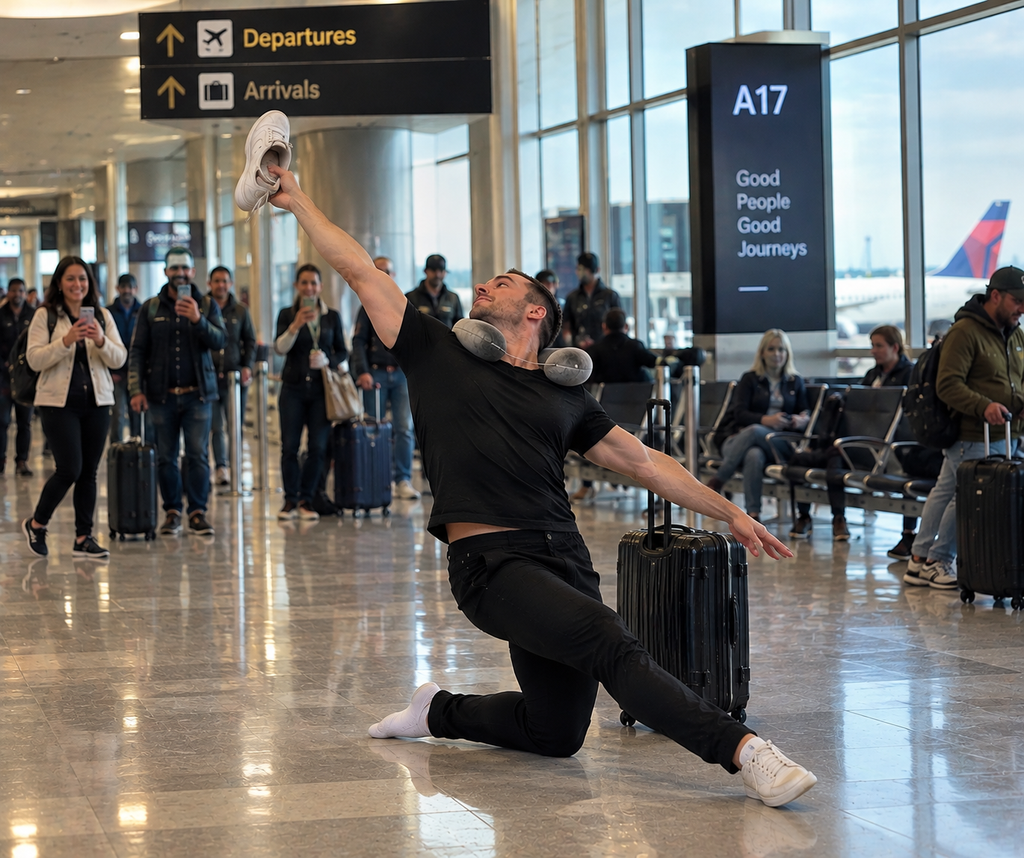
With his assistant filming, McGrath turned an ordinary section of the terminal into a miniature performance space. Wearing a travel pillow around his neck and incorporating his luggage into the routine, he eventually removed a shoe, spun across the floor and threw himself into the theatricality of the song.
It may have looked carefully planned, but McGrath later explained that much of what happened once the camera started rolling was improvised.
The finished clip lasted 21 seconds.
There was just one problem.
Their flight wasn’t waiting for the performance to end.
A successful video and a closed boarding gate
McGrath and his assistant watched what they had filmed and liked the result. They were reportedly even considering posting it immediately.
Then they checked the time.
They should already have been at their gate.
They ran, but by the time they arrived, boarding had closed. Their plane left without them.
Instead of hiding the mishap, McGrath made it part of the joke when he shared the video online. The basic message was wonderfully simple: he had successfully made the TikTok, but he’d missed his flight in the process.
Was it worth it?
The internet began answering that question almost immediately.
Then the numbers started climbing
McGrath later recalled that the video received roughly 100,000 views within its first 20 to 30 minutes.
That was only the beginning.
By the time CNN covered the phenomenon in 2025, the clip had accumulated millions of views.
Yet view counts alone don’t explain why this particular story lasted longer than countless other viral clips.
People didn’t simply watch McGrath.
They started copying him.
Soon, other airport passengers were doing it too
The basic ingredients were easy to recognize: an airport terminal, Céline Dion’s unmistakably dramatic song, exaggerated choreography and, quite often, a shoe flying through the air.
Professional dancers joined in, but so did ordinary travelers.
The Washington Post documented versions of the trend appearing thousands of miles apart, with participants in places including the United States, the United Kingdom and New Zealand.
It wasn’t limited to young TikTok creators either.
Among the people featured by the newspaper was retiree Barbie Smith Simons, whose own take on the dance had accumulated more than half a million views by the time the story was published.
At that point, something important had changed.
It was no longer simply Blake McGrath’s video.
It had become a template that strangers could reinterpret for themselves.
Why does the idea work so well in an airport?
There is no single reliable formula for making something go viral. Timing, algorithms, an existing audience, music, shareability and simple luck can all play a role.
But the setting creates an obvious contrast.
Airports are highly structured environments. Travelers check documents, monitor screens, stand in lines and worry about getting to the correct gate on time.
Then someone suddenly behaves as though the terminal floor were a theater stage.
In McGrath’s case, there is another layer to that contrast. The apparent spontaneity is paired with the physical control of someone who has spent years training as a professional dancer.
For some of the people who later participated, the experience also became more personal than simply reproducing a viral video.
CNN reported on a traveler who experienced anxiety around flying and said performing the dance helped make the beginning of her journey feel less stressful. Another participant described it as an opportunity to slow down and enjoy the moment.
Those experiences shouldn’t be interpreted as evidence that a social media dance can treat anxiety. They are simply accounts of what participating in the trend meant to those particular travelers.
The stage moved into everyday life
The airport video also fits into a broader style of content McGrath has continued to create.
Instead of restricting dancing to studios and stages, he has performed in ordinary environments — at home, in stores and while traveling.
That is why someone encountering one of his kitchen videos today might have no idea how extensive his professional background actually is.
The skill hasn’t changed.
The surroundings have.
Stage lighting can become supermarket lighting. A carefully designed set can become a departure lounge. An audience sitting in rows can become a handful of confused travelers nearby — followed by millions of people watching through their phones.
The ordinary location is no longer something to hide.
It is part of the performance.
Not everyone wants an airport to become a dance floor
There is another side to the trend, and it would be misleading to ignore it.
Public spaces belong to everyone using them, and not everyone enjoys seeing them turned into sets for social media videos.
The Washington Post noted negative reactions from people who found airport performances irritating or inappropriate. McGrath himself acknowledged that critical comments existed, even as the broader response to the videos remained enthusiastic.
That disagreement is understandable.
One traveler may see 20 seconds of unexpected joy breaking up an otherwise tedious journey. Someone else may see a person disrupting a shared space to create online content.
Perhaps that tension is part of what makes the videos so difficult to ignore.
A man dramatically throwing his shoe into the air while Céline Dion plays is not exactly part of the normal boarding process.
What McGrath hopes people take from it
For McGrath, the phenomenon eventually became about more than views.
Speaking to CNN after the trend had spread, he talked about wanting people to allow themselves to feel like children again occasionally and to find moments of joy amid the heavier parts of everyday life and the news surrounding them.
That gives the story a slightly different ending from the usual tale of internet fame.
One professional dancer did something spontaneous while waiting for a flight. Strangers saw it and decided they wanted to try it too. Some were trained dancers; many weren’t. Some treated it purely as a joke, while others found that performing it made an ordinary journey unexpectedly memorable.
The most unlikely stages are sometimes the memorable ones
There is a certain irony to Blake McGrath’s story.
He spent years building a professional career in dance, working in television and entertainment and performing alongside internationally known artists.
Yet one of the moments that introduced him to a new audience didn’t happen on a television set or a conventional stage.
It happened in an airport.
It lasted 21 seconds.
And it cost him a flight.
Then, thousands of miles away, strangers began playing the same Céline Dion song and performing their own versions.
Blake McGrath didn’t become a dancer because a video went viral. He had already devoted much of his life to dance.
What the internet did was something less predictable: it turned one improvised performance between flights into an invitation that complete strangers around the world wanted to accept.