
A serious accident can be reconstructed through medical records, witness accounts and the physical injuries left behind. What happens inside a person’s consciousness during that same period is much harder to document.
That distinction sits at the heart of Gabe Poirot’s extraordinary story.
In October 2021, Poirot was 20 years old when a ride on an electric skateboard ended in a devastating crash. He has said he was traveling at roughly 30 mph — around 48 km/h — when he hit a bump, was thrown from the board and struck his head.
What followed was a severe medical emergency and a prolonged period of unconsciousness. Poirot survived.
But when he eventually emerged from the experience, he carried with him something medicine could not measure in the same way as his injuries: memories of what he believes happened while he was unconscious.
Poirot says he experienced leaving his body. He describes another realm that he identifies as Heaven. And, most strikingly, he says he encountered Jesus.
Years later, that account became the basis of his book, 18 Days in Heaven, and in March 2026 he discussed his experience on Fox News’ Saturday in America.
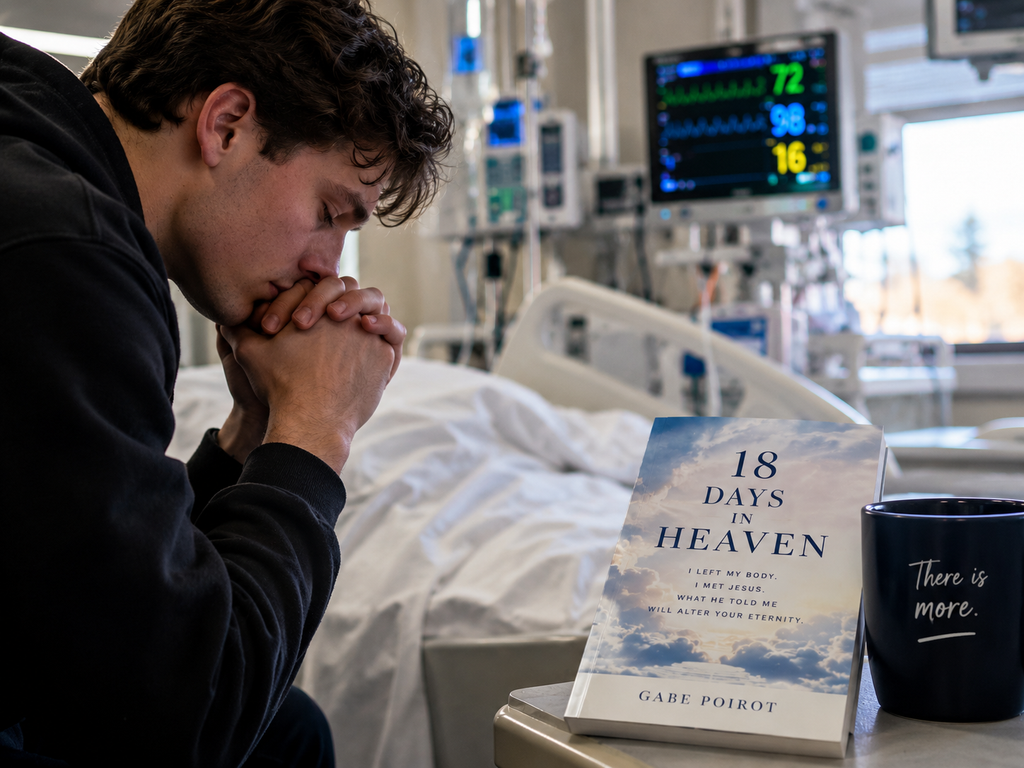
It is a remarkable claim, but also one that requires careful language.
There is an important difference between saying Poirot reports experiencing Heaven and saying Poirot went to Heaven. The first describes his testimony. The second presents an unverifiable interpretation as an established fact.
And once that distinction is made, his story opens the door to a much bigger question: what do we actually know about consciousness when a human being comes dangerously close to death?
The accident that divided his life into a before and an after
In his public accounts, Poirot describes riding electric skateboards with friends when his board encountered an irregularity in the road and he was thrown off.
The impact caused a serious head injury. Accounts surrounding the incident contain dramatic descriptions of his condition at the scene, but many of those details ultimately come from Poirot’s own retelling or sources recounting his story rather than publicly available hospital documentation.
That distinction matters when separating what has been independently established from what is being reported retrospectively.
Poirot consistently describes the crash as a catastrophic traumatic brain injury followed by an extended period of unconsciousness or medically induced coma. His official website similarly presents the 2021 accident as the event that radically altered the direction of his life.
He survived the physical trauma.
His account of what happened beyond the physical world would become far more difficult to categorize.
A memory of being somewhere else
Poirot describes the sensation of separating from his body and entering what he understood to be a spiritual reality.
His account contains several features that have appeared in other reports of near-death experiences: an apparent out-of-body perspective, movement into another environment, intense light and the perception of a presence.
For Poirot, however, the identity of that presence is not uncertain.
He says it was Jesus.
His story was eventually published as 18 Days in Heaven: I Left My Body. I Met Jesus. What He Told Me Will Alter Your Eternity, released in April 2026. The book presents the experience through an explicitly Christian interpretation.
The story gained wider attention through interviews and social media. On March 14, 2026, Poirot appeared with Kayleigh McEnany on Fox News’ Saturday in America, where he discussed the accident and the encounter he believes followed it.
That exposure also helped create a compelling headline: a young man who spent 18 days in Heaven.
The reality behind those words is more nuanced.
Did he actually experience 18 days in Heaven?
The number 18 refers to the period associated with Poirot’s coma and unconsciousness.
It should not automatically be understood to mean that he consciously perceived 18 ordinary, consecutive days in another realm.
This may sound like a small distinction, but scientifically it is enormous.
Suppose someone remains unconscious for days and later recalls an experience that seemed to last only minutes. There is currently no way to look at that memory and determine exactly where within the medical timeline it occurred.
Did it happen around the moment of the injury? During resuscitation? During a period of residual or recovering brain activity? While consciousness was returning?
The person’s recollection cannot provide a physiological timestamp.
That problem extends far beyond Poirot’s case. It is one of the reasons near-death experiences remain so difficult to investigate.
Near-death experiences are a legitimate subject of scientific research
Near-death experiences, usually abbreviated as NDEs, are not simply an internet phenomenon.
Researchers have studied them for decades.
That does not mean science has established that people temporarily visit an afterlife. Rather, it means the experiences themselves are repeatedly reported and display enough recognizable characteristics to warrant systematic investigation.
A 2024 scientific review examining prospective studies involving cardiac-arrest survivors found substantial variation in reported NDE incidence, ranging from roughly 6% to 39% across the included studies. The authors noted important methodological differences between studies, meaning those numbers should not be interpreted as a universal prevalence rate.
Descriptions vary considerably, but recurring features can include profound peace, bright light, movement through an unfamiliar environment, encounters with people or perceived beings, a review of one’s life and the sensation of observing one’s body from elsewhere.
Not everyone reports the same experience, and not every NDE is pleasant.
One characteristic, however, is particularly interesting: people can emerge from these experiences convinced that something deeply significant happened to them.
The consequences may persist long after the medical crisis has ended. Some survivors report altered attitudes toward death, spirituality, relationships and the way they want to live.
Poirot describes precisely that kind of transformation. He says the experience fundamentally changed his understanding of death.
Whether the interpretation is supernatural is a separate question.
A stopped heart does not give us a simple on-off switch for consciousness
Popular discussions about NDEs sometimes rely on an appealingly simple assumption: the heart stops, the brain switches off, and therefore any experience remembered from that interval must have occurred independently of the brain.
Human physiology does not provide such a clean boundary.
Cardiac arrest abruptly deprives the brain of normal blood flow and oxygen delivery, but dying is a biological process rather than a single instantaneous transition in which every neural process disappears simultaneously.
One of the most ambitious attempts to investigate this territory has been the AWARE II study, published in Resuscitation in 2023.
Researchers studied people undergoing cardiopulmonary resuscitation after cardiac arrest and, where possible, monitored brain activity. In some patients, EEG patterns interpreted by the researchers as consistent with organized brain activity were detected during prolonged CPR. Some survivors also reported memories or perceptions associated with the period surrounding resuscitation.
The findings are intriguing precisely because they complicate the picture.
They do not establish that consciousness leaves the brain, and they do not demonstrate an afterlife.
They suggest that the relationship between cardiac arrest, brain activity and conscious experience may be considerably more complex than the phrase “clinically dead” sometimes implies in popular storytelling.
Scientists have even tried to test out-of-body perception
One of the most fascinating aspects of AWARE II was an attempt to move beyond testimony.
If people experiencing cardiac arrest can literally perceive their surroundings from a position outside their bodies, researchers reasoned that there might be a way to test that proposition.
Visual and auditory targets were incorporated into the study environment.
Among the survivors who could subsequently be interviewed, no one identified the hidden visual image. One of 28 interviewed survivors identified the auditory stimulus. The number of surviving participants available for these assessments was small, however, making broad conclusions impossible.
The experiment illustrates an essential distinction.
A person saying, “I experienced myself outside my body,” tells us something meaningful about that person’s subjective experience.
Demonstrating that the person’s awareness physically operated independently of the brain would require another level of evidence entirely.
So far, controlled research has not produced convincing experimental proof that consciousness leaves the body and independently observes the external world during an NDE.
Could the brain itself create something that feels this real?
There are several scientific hypotheses.
Researchers have examined changes in oxygen delivery and cerebral blood flow, alterations in neurotransmitter systems, unusual electrical activity near critical physiological states, dream-like mechanisms and neurological processes occurring as consciousness disappears or returns.
Recent research has also examined bursts or patterns of organized brain activity in severely compromised patients, adding another layer to the question of what the brain may be capable of during the dying process.
These findings provide plausible biological mechanisms for at least some aspects of near-death experiences.
But there is not yet one universally established neurological explanation capable of accounting neatly for every reported NDE and every characteristic within it. The neurophysiology of these experiences remains an active subject of research and debate.
That uncertainty is important.
Saying that science has proved NDEs are “nothing but hallucinations” would go beyond the available evidence.
Saying that science has proved they are glimpses of an afterlife would do the same.
At present, neither conclusion has been demonstrated.
The timing problem may be the hardest one of all
Imagine that a patient is unconscious for several days and wakes with a vivid memory of an apparently coherent experience.
The memory is real in the straightforward sense that the person genuinely remembers it.
But when was it formed?
That is much harder to establish.
It could theoretically have emerged during different phases of the medical crisis, including around the initial loss of consciousness, periods of remaining brain activity, resuscitation or the gradual return of awareness.
Intensive-care patients can also experience vivid dreams, delirium, fragmented awareness and medication-related perceptual disturbances.
None of those possibilities proves that they explain Poirot’s experience.
But they demonstrate why retrospective testimony alone cannot establish that an experience occurred specifically while the brain was incapable of producing conscious awareness.
This is one of the places where personal certainty and scientific certainty become very different things.
His account has also been questioned from within Christianity
The debate surrounding Poirot is not simply a confrontation between religion and science.
His claims have also generated criticism among Christians.
In April 2026, Christian commentators Justin Peters and Jim Osman participated in an extended discussion with Poirot in which they challenged elements of his account on theological grounds. Their objections concerned whether aspects of his description were compatible with their understanding of Scripture. Poirot defended his account.
That disagreement reveals something often lost when stories like this become viral.
There is no single “religious response” to an NDE.
One Christian may regard such an account as a genuine spiritual encounter. Another may question it precisely because of religious doctrine. A neuroscientist may investigate possible brain mechanisms without making any claim about whether God or an afterlife exists.
Those positions answer different questions.
So what can we actually say about Gabe Poirot?
Behind the viral headline is a young man who survived a devastating accident and says the experience transformed him.
There is also a genuine scientific phenomenon behind the broader story. Some people who survive life-threatening medical events report remarkably vivid experiences, and researchers continue trying to understand what happens to consciousness as normal brain function becomes severely disrupted.
What the evidence allows us to say depends on where we draw the line.
We can accurately say that Gabe Poirot says he encountered Jesus.
We can say that he regards the experience as real and spiritually transformative.
We can say that elements of his account resemble features described in other near-death experiences.
We cannot establish as a scientific fact that he entered Heaven.
Yet the absence of such proof does not tell us exactly what his subjective experience was either.
Medicine can measure electrical activity, circulation and oxygenation. It can document an injury, record a cardiac rhythm and mark the day a patient wakes.
What it cannot currently do is place another person’s consciousness on a screen and replay everything that person experienced.
That is why Poirot’s story becomes more interesting when we resist the temptation to force it into either of two easy conclusions.
For him, the experience carries a clear meaning: he believes he encountered Jesus, and he says he no longer understands death as he once did.
For science, it belongs to a difficult and still evolving field of research into consciousness at the limits of life.
Eighteen days can be counted on a hospital calendar. What happened within Gabe Poirot’s consciousness during that period cannot be measured in quite the same way.
Between those two realities lies the part of his story we still cannot fully explain.