
A minor fall that would leave most children with nothing more than a bruise can, in some forms of osteogenesis imperfecta, result in a fracture. In the most severe cases, fractures may even occur before birth.
That is why osteogenesis imperfecta, commonly shortened to OI, is often referred to as “brittle bone disease.” The nickname is easy to understand, but it oversimplifies a condition that is far more complex than fragile bones alone.
Some people with OI experience only a handful of fractures during their lifetime. Others face repeated fractures, bone deformities, surgery and mobility challenges from early childhood. The condition exists on a broad spectrum, and one person’s experience can look very different from another’s.
Osteogenesis imperfecta is best understood not as one uniform disease, but as a group of rare genetic disorders that affect bone strength and connective tissue.
What exactly is osteogenesis imperfecta?
The name literally refers to imperfect bone formation.
OI is caused by genetic changes that interfere with the normal development or strength of bone. Its hallmark feature is an increased tendency to fracture, sometimes after trauma that would not normally be expected to break a healthy bone.
But bones are not always the only tissues involved.
Depending on the specific type of OI, a person may also develop short stature, scoliosis, joint hypermobility, muscle weakness, dental problems, hearing loss or a blue-gray appearance of the sclera, the normally white part of the eye.
The severity can vary enormously. Mild cases may not be diagnosed until childhood or even adulthood, while severe forms can be apparent before birth. MedlinePlus estimates that osteogenesis imperfecta affects roughly 1 in 10,000 to 20,000 people worldwide.
Why do the bones break so easily?
To understand OI, it helps to think of bone as a living composite material rather than a solid block of mineral.
Bone strength depends partly on minerals such as calcium and phosphate, but it also relies on a flexible structural framework made largely from type I collagen.
Collagen gives bone some of its ability to withstand stress without snapping.
In many forms of osteogenesis imperfecta, genetic changes disrupt either the amount or the structure of type I collagen. The two best-known genes are COL1A1 and COL1A2, which contain instructions for making components of this collagen.
Around 90% of OI cases are linked to variants in these two genes.
In some people, the body produces less normal collagen than it should. In others, collagen is produced but has an abnormal structure.
The result can be bone that is less mechanically resilient and therefore more vulnerable to fracture.
Other, rarer forms of OI are caused by changes in additional genes involved in collagen processing, bone formation and the activity of bone cells. This is one reason modern medicine now sees OI as a spectrum of genetically distinct disorders rather than a single condition.
Not everyone with OI has hundreds of fractures
Online portrayals of osteogenesis imperfecta often focus on the most severe cases. Those cases are real, but they do not represent every person with the diagnosis.
In milder forms, fractures may occur mainly during childhood and become less frequent later in life.
In severe forms, fractures can occur after minimal trauma or sometimes without an obvious injury at all. Some babies are born with fractures that occurred in the womb.
That wide range matters.
The words “osteogenesis imperfecta” alone cannot tell you how mobile someone will be, how many fractures they will experience or what their long-term outlook will be.
The specific genetic form, fracture history, skeletal changes and associated complications all matter.
Can OI be detected before birth?
Sometimes.
In severe cases, prenatal ultrasound can reveal abnormalities such as unusually short or bowed bones, fractures or other skeletal changes.
Milder forms may not be visible during pregnancy at all.
In those cases, suspicion may arise only after birth, often when a child begins to experience repeated fractures from relatively minor injuries.
Diagnosis may involve medical and family history, physical examination, imaging and genetic testing. Genetic testing can identify the underlying variant in many patients, although a negative result does not necessarily rule out OI in every case.
Why do some people with OI have blue-looking eyes?
One of the better-known features of certain forms of OI is a blue or blue-gray tint to the sclera.
The sclera is the white outer layer of the eye.
Collagen helps give this tissue its normal structure. When the sclera is thinner than usual, the darker tissues underneath can become more visible, creating a bluish appearance.
This feature is associated with some types of OI, but it is not present in every patient and its absence does not rule out the condition.
OI can affect the teeth too
Some people with osteogenesis imperfecta also develop dentinogenesis imperfecta.
Dentin is the hard tissue beneath tooth enamel. When dentin develops abnormally, teeth may appear gray, yellow-brown, blue-gray or translucent, and they may wear down or break more easily.
This is another reminder that OI is not simply a bone disorder.
Type I collagen is found in many connective tissues throughout the body.
Hearing loss is another possible complication
Hearing loss can occur in some people with osteogenesis imperfecta, sometimes becoming noticeable during adolescence or adulthood.
The underlying problem may involve structures in the middle ear, inner ear or both.
For that reason, hearing assessments may become part of long-term follow-up.
OI can also be associated with scoliosis, muscle weakness, short stature and, in more severe cases, respiratory complications related to the shape of the chest or spine.
How can a child have OI if neither parent does?
Because “genetic” does not always mean “inherited from an affected parent.”
Many of the best-known forms linked to COL1A1 and COL1A2 follow an autosomal dominant inheritance pattern. In those cases, one altered copy of the gene can be enough to cause the disorder.
If a parent has an autosomal dominant form of OI, each pregnancy generally carries a 50% chance of passing on that genetic variant.
But OI can also appear in a child with no family history of the disease.
Sometimes the genetic change arises for the first time in the child. This is known as a de novo variant.
There are also rarer recessive forms of OI in which both parents may be healthy carriers of a genetic variant. Some rare forms follow other inheritance patterns as well.
This is why genetic counseling can be especially valuable for families after an OI diagnosis.
Is osteogenesis imperfecta the same as osteoporosis?
No.
Both conditions can increase fracture risk, but they are fundamentally different.
Osteogenesis imperfecta is a genetic disorder present from birth and caused by changes that affect bone formation, collagen or related biological pathways.
Osteoporosis is a condition in which bone mass and strength decline over time. It is especially common in older adults and is influenced by age, hormones, genetics, nutrition, physical activity, medications and other medical conditions.
Both can make bones more fragile, but the underlying mechanisms are not the same.
Is there a cure?
There is currently no standard treatment that removes the genetic cause of all forms of osteogenesis imperfecta.
But that does not mean nothing can be done.
Modern treatment aims to reduce fractures and pain, strengthen muscles, improve mobility, correct some deformities and help people achieve as much independence as possible.
Care may involve pediatricians, geneticists, orthopedic surgeons, endocrinologists, rehabilitation specialists, physiotherapists, dentists and hearing specialists.
Physical and occupational therapy can be especially important because stronger muscles, better movement control and adaptive techniques can make everyday life safer and more independent.
Should children with OI avoid movement?
It may seem logical that a child with fragile bones should be kept as still as possible.
In reality, excessive immobilization can create additional problems.
Too little movement can reduce muscle strength and contribute to poorer bone health. Weaker muscles may then offer less support to an already vulnerable skeleton.
This is why treatment tries to balance safety with activity.
Physiotherapy can help improve strength, coordination and mobility. Low-impact exercise, including certain water-based activities, may be appropriate for some patients.
But exercise must always be individualized.
An activity that is safe for a child with mild OI may be inappropriate for someone with a severe form of the disease.
Why do some children have metal rods placed inside their bones?
Repeated fractures and bone weakness can sometimes lead to bowing of the long bones in the arms or legs.
For some patients, orthopedic surgeons may perform a procedure known as intramedullary rodding.
Metal rods are placed inside long bones to provide internal support, help correct deformity and improve mechanical stability.
In growing children, surgeons may sometimes use telescoping rods designed to extend as the bone lengthens.
Surgery does not correct the genetic cause of OI, but it can significantly improve function and mobility in selected patients.
What about medications that strengthen bone?
Some people with moderate or severe OI are treated with medications that reduce bone breakdown, including bisphosphonates.
These drugs can increase bone mineral density and may form part of an individualized treatment strategy.
But they should not be described as a cure.
They do not repair the underlying genetic change, and treatment decisions depend on age, disease severity and individual medical factors.
NIAMS notes that OI management can include medications commonly used for other bone disorders when specialists believe they may benefit a particular patient.
Can children with osteogenesis imperfecta walk?
Many can.
Children with mild OI may walk independently and have relatively few mobility limitations.
Others may use braces, crutches, walkers or wheelchairs, either temporarily or long term.
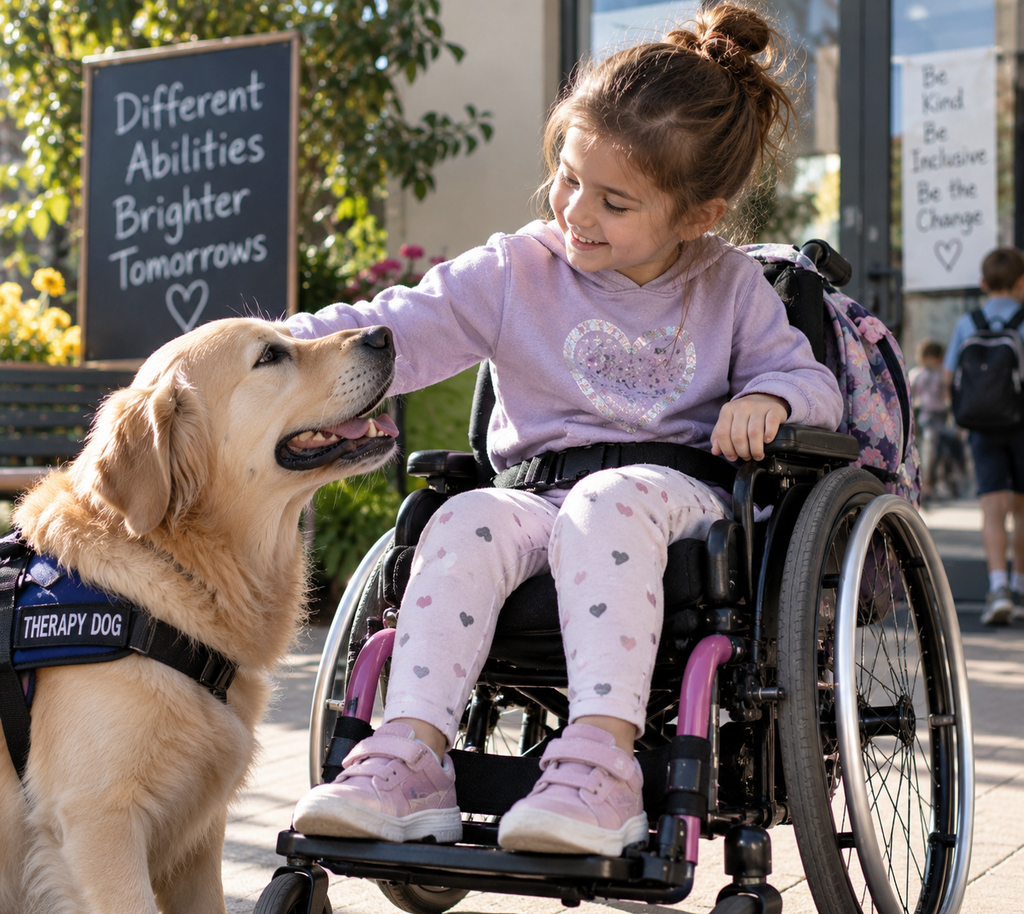
A wheelchair should not automatically be seen as a loss of independence.
For some children, it is precisely the tool that allows them to attend school, move safely through the community, spend time with friends and conserve energy without constantly risking another injury.
One of the main goals of modern OI care is to maximize independence rather than simply minimize movement.
Does OI affect intelligence?
Osteogenesis imperfecta primarily affects connective tissue and the skeletal system.
Physical disability should not be confused with intellectual disability.
A child may be very short, have severe skeletal deformities or use a wheelchair and still have normal cognitive development.
That distinction matters because visible physical disability can unfortunately lead people to make incorrect assumptions about someone’s ability to learn, communicate or make decisions.
How long do people with OI live?
There is no single life expectancy for everyone with osteogenesis imperfecta.
The disease spectrum is simply too broad.
People with mild forms may have a lifespan close to that of the general population.
Severe forms can cause major complications, particularly respiratory problems associated with abnormalities of the chest wall and spine. Some of the most severe forms can be life-threatening during pregnancy or shortly after birth.
That is why statements claiming that “people with OI live X years” are misleading without specifying the form and severity of the disease.
“Brittle bone disease” is a metaphor, not a complete definition
The popular name is memorable because it immediately conveys fragility.
But it can also create the wrong image.
People with OI are not fragile objects that need to be protected from life itself. Nor does every form of the condition mean that a bone will break from the slightest touch.
Children with osteogenesis imperfecta go to school, make friends, travel, learn, play and develop their own interests.
Some need only minor adaptations. Others undergo repeated surgery, rehabilitation and long-term medical care.
Safety matters, but so does independence.
One of the central challenges in modern OI care is finding the right balance between the two.
A microscopic genetic change can reshape an entire skeleton
Perhaps the most remarkable thing about osteogenesis imperfecta is how clearly it demonstrates the chain reaction between genes, proteins and the human body.
A tiny genetic change can alter the way a protein is produced. An altered protein can affect the structure of connective tissue. And a change in that tissue can alter the strength of the entire skeleton.
Yet the diagnosis still does not define the person.
There is currently no widely available genetic cure for osteogenesis imperfecta, but medicine can treat fractures, correct some deformities, improve mobility and help many patients become far more independent than would once have been possible.
That is why the phrase “brittle bone disease” will always be incomplete.
It tells us something about the bones.
It tells us almost nothing about the life, abilities and resilience of the person living with the condition.