
Gel manicures have become so routine that placing your hands beneath a small curing lamp hardly feels like something worth thinking about. Yet over the past few years, headlines have painted a much more unsettling picture: UV nail lamps damage DNA, gel manicures cause mutations, and repeated manicures might even increase the risk of skin cancer.
Those headlines did not appear out of nowhere. There is legitimate science behind some of the concern. But the evidence is considerably more nuanced than the phrase “gel nails damage your DNA” suggests.
Laboratory research has shown that radiation emitted by nail-curing lamps can damage cells under certain experimental conditions. What researchers have not established is that getting a gel manicure occasionally causes cancer in humans.
And while UV exposure deserves attention, it may not even be the most immediate risk associated with modern nail products.
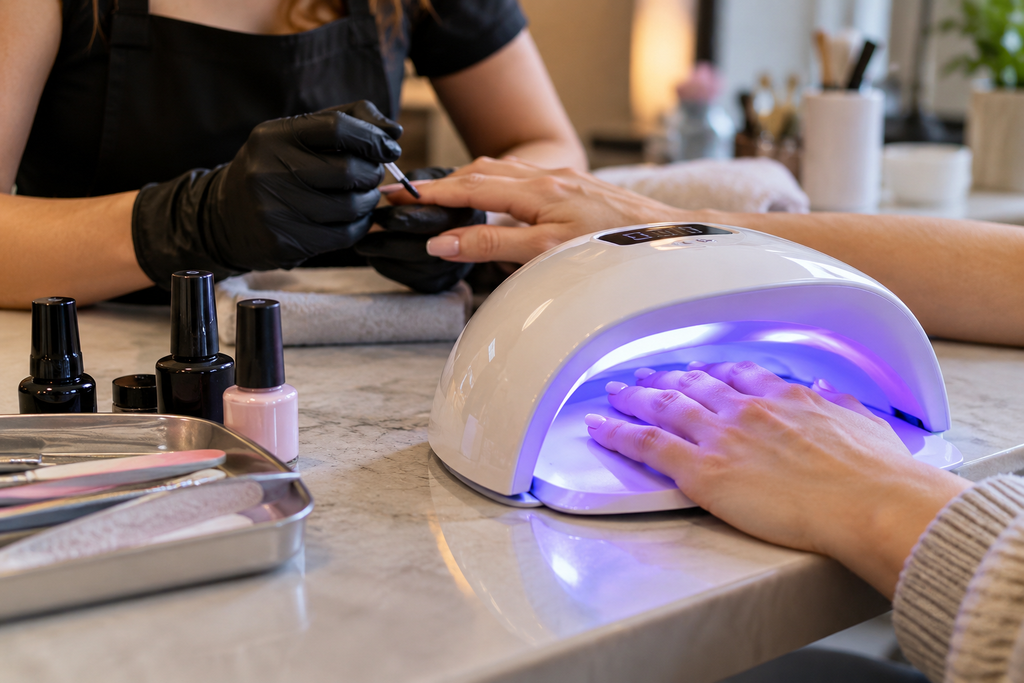
An LED nail lamp can still be a UV lamp
One of the most persistent misconceptions is that choosing an “LED lamp” means avoiding ultraviolet radiation.
It doesn’t necessarily work that way.
Gel products contain photoinitiators that respond to particular wavelengths of light, triggering the chemical reaction that hardens, or polymerizes, the product. Modern LED curing lamps can therefore still emit ultraviolet radiation, predominantly within the UVA range.
In the widely discussed 2023 study published in Nature Communications, researchers investigated a UV nail dryer emitting primarily in the 340–395 nm range.
So “LED” and “UV” aren’t really opposites in this context. LED describes how the light is produced; it does not automatically mean that ultraviolet wavelengths are absent.
The experiment behind the “DNA damage” headlines
The concern about DNA can largely be traced to research published in Nature Communications in 2023.
Scientists exposed several types of mammalian cells, including human epidermal keratinocytes, to radiation from a UV nail-curing device.
They observed increased levels of reactive oxygen species and DNA damage. Under some experimental conditions, surviving cells also accumulated mutations.
That finding matters.
It provides evidence that radiation from these devices has the biological potential to damage cells.
But there is an equally important part of the story that often disappears when the research reaches social media.
A laboratory cell experiment isn’t the same as getting your nails done
The researchers were studying cells under controlled laboratory conditions. They were not following thousands of people who received gel manicures and measuring how many subsequently developed skin cancer.
That distinction changes how the results should be interpreted.
Cell-culture experiments are valuable because they allow researchers to identify biological mechanisms that might be harmful. But a dish of cultured cells is not equivalent to intact human skin.
Our skin consists of multiple layers, and living organisms have sophisticated mechanisms for repairing DNA damage and removing severely damaged cells. Real-world exposure patterns also differ from experimental protocols.
The study therefore provides evidence of a potential biological mechanism, not proof that an ordinary gel manicure causes cancer.
The researchers themselves noted the need for long-term epidemiological studies before the cancer risk associated with these devices can be quantified.
Do UV nail lamps cause skin cancer?
This is where the evidence becomes much less certain.
A 2024 systematic review examined the available research concerning UV nail lamps and skin malignancies. Although the researchers initially identified 2,331 articles, only nine ultimately met the criteria for inclusion.
The authors found that the existing evidence was limited and that the studies carried substantial or unclear risks of bias. Their analysis suggested that prolonged, repeated exposure could potentially represent a low risk, while emphasizing the need for better research before that risk can be properly determined.
So two extreme interpretations should both be avoided.
It would be inaccurate to claim that nail lamps are biologically harmless. UVA is ultraviolet radiation, and cumulative UV exposure is relevant to skin health.
But current evidence also doesn’t justify telling someone that gel manicures have been demonstrated to cause skin cancer.
We simply don’t have that level of evidence.
What if you only get a gel manicure once a year?
This is an important distinction because risk depends partly on cumulative exposure.
Science cannot currently provide a number such as, “One gel manicure per year increases your lifetime cancer risk by X percent.” Studies capable of producing that estimate simply don’t exist.
Someone who uses a curing lamp once a year, however, experiences dramatically fewer exposures than someone who has a manicure every two or three weeks for decades.
At present, there is no evidence demonstrating a measurable increase in cancer risk from such infrequent use.
That doesn’t mean scientists have proven the risk to be mathematically zero. It means there isn’t evidence showing a detectable cancer risk at that level of exposure.
Those are very different statements.
A two-hour manicure doesn’t mean two hours of UV exposure
The length of the salon appointment can also create a misleading impression of how much radiation someone receives.
A gel manicure might take an hour or more, but the hands are not sitting underneath the lamp for that entire period.
Products are usually cured in several relatively short cycles. The precise curing time depends on the product, lamp and application system.
Trying to reduce UV exposure by arbitrarily shortening the manufacturer’s curing time isn’t necessarily a good solution either.
Improperly cured material may leave more unreacted components available to contact the skin, which brings us to another important concern: allergic sensitization.
Why does gel sometimes feel painfully hot under the lamp?
Anyone who has experienced a sudden burning sensation during curing might understandably wonder whether they are literally feeling UV radiation damaging their skin.
Usually, there is another explanation.
Gel polymerization can be an exothermic reaction, meaning that heat is released as the material cures. If that reaction happens rapidly, the resulting temperature increase can produce the familiar “heat spike.”
It can range from mild warmth to an unexpectedly intense burning sensation.
That feeling is therefore not evidence that you can somehow feel your DNA being damaged.
Severe discomfort shouldn’t simply be endured, however. The hand can be removed temporarily and the nail technician should be told what is happening.
UV exposure can be reduced quite easily
For people who regularly wear gel manicures but want to minimize unnecessary UVA exposure, protection is relatively straightforward.
The American Academy of Dermatology recommends applying a broad-spectrum, water-resistant sunscreen with SPF 30 or higher to the hands before a gel manicure. Another option is wearing dark, opaque gloves that protect against UV radiation while leaving the fingertips and nails exposed.
UV-protective fingerless gloves are particularly convenient because most of the skin remains covered while the nails can still be cured normally.
Care should be taken not to coat the actual nail surface with products that could interfere with adhesion.
The less famous risk may be more relevant: acrylate allergy
While UV lamps receive most of the alarming headlines, dermatologists have another concern involving gel and artificial nail products: allergic contact dermatitis caused by acrylates and methacrylates.
One particularly well-known allergen is HEMA, or 2-hydroxyethyl methacrylate.
A retrospective study conducted at Amsterdam UMC examined 67 patients diagnosed with allergic contact dermatitis caused by acrylate-containing nail cosmetics. Sixty-five of them — 97% — tested positive for HEMA.
That number sounds alarming until we consider who was being studied.
It does not mean that 97% of people who wear gel nails become allergic to HEMA. The researchers were looking specifically at patients who had already been diagnosed with allergic contact dermatitis from acrylate nail products.
The distinction is crucial.
Keeping uncured gel off the skin really matters
Acrylate monomers are particularly problematic before they have been properly polymerized.
Repeated skin exposure can eventually lead some people to become sensitized. Once the immune system develops an allergy, subsequent exposures may trigger dermatitis.
This is why a neat application is more than a cosmetic issue.
Gel should not repeatedly flood the cuticle or remain on the surrounding skin while the hand goes into the lamp. Appropriate curing is also important, and the product and curing lamp should be used according to the manufacturer’s specifications.
A lamp being extremely powerful does not automatically guarantee that every gel product placed beneath it will cure correctly. Different formulations are designed around particular curing conditions.
“HEMA-free” doesn’t necessarily mean “allergy-free”
HEMA-free nail products have become increasingly popular, partly in response to concerns about sensitization.
Removing HEMA may be useful, but it does not transform a product into something incapable of causing an allergic reaction.
HEMA is only one member of a much larger family of acrylates and methacrylates. Other ingredients can also cause sensitization.
Cases of allergic contact dermatitis involving products marketed as HEMA-free have been reported.
So rather than relying entirely on a label, one of the most useful precautions remains surprisingly simple: avoid getting uncured product on the skin.
What does an acrylate allergy look like?
It doesn’t always begin dramatically.
A person may initially notice itching around the fingertips, redness, swelling, dry or cracked skin or tiny blisters. Changes to the nail itself can occur, including separation of the nail plate from the nail bed.
And the reaction isn’t necessarily confined to the fingers.
Acrylate-related dermatitis can sometimes appear around the eyelids, face or neck, including through indirect transfer from the hands.
Persistent symptoms after gel or artificial nail products are therefore worth discussing with a dermatologist rather than repeatedly covering them with another manicure. Patch testing can sometimes identify the responsible allergen.
Does gel actually ruin natural nails?
It doesn’t have to.
Applying gel to a natural nail normally requires preparation of the surface so the product adheres properly. That should not mean aggressively grinding down the natural nail plate.
Damage becomes more likely when the nail is over-filed, repeatedly drilled down to the natural plate, or when adhered product is peeled or ripped off.
The American Academy of Dermatology notes that gel manicures can contribute to brittleness, peeling and cracking and specifically advises against picking gel polish off the nails.
That distinction matters because when someone says, “Gel destroyed my nails,” the gel itself may not be the entire explanation.
The way the manicure was applied and, particularly, how it was removed may have played a substantial role.
Gel or gel polish: is one actually safer?
There isn’t enough evidence to declare one universally safer than the other.
Both systems can involve acrylate chemistry, and both can require curing under UVA-emitting lamps.
A straightforward gel-polish manicure may involve less material and less filing than an elaborate set of sculpted gel extensions. But gel polish that is repeatedly peeled from the nails can still damage the superficial layers of the natural nail.
Conversely, a carefully applied strengthening gel over the natural nail is quite different from long extensions that require extensive shaping and removal.
From a safety perspective, the formulation, application technique, skin contact, curing process, frequency of use and removal method may matter more than whether the service is advertised as “gel” or “gel polish.”
Fragile nails don’t automatically require long extensions
There is also a misconception that choosing builder gel means committing to noticeably long artificial nails.
It doesn’t.
Builder gel can be placed directly over the natural nail to provide additional structure while keeping essentially the same length.
If nine nails are already the desired length and one has broken shorter, a technician can make a very small extension on that nail simply to match the others. The remaining nails don’t necessarily need extensions at all.
For someone who wants natural-looking nails, the difference may amount to only a few millimeters.
What shouldn’t be necessary is aggressively thinning the natural nail simply because a strengthening product is being applied over it.
DIY gel manicures deserve particular care
Home gel kits have made professional-looking manicures much more accessible. They have also made it easier for inexperienced users to repeatedly expose their skin to uncured products.
A small amount of gel running into the cuticle may seem insignificant. But repeated skin contact is precisely what should be avoided when dealing with sensitizing acrylates.
There is another potential problem: a product that feels hard at the surface isn’t necessarily proof that it has been optimally cured throughout.
Mixing unrelated gels and lamps, guessing curing times or frequently getting uncured product on the skin therefore isn’t ideal.
When it comes to preventing acrylate allergy, careful application may matter considerably more than achieving a flawless-looking finish.
A safer manicure is about more than choosing a product
When selecting a nail salon, the Instagram portfolio isn’t the only thing worth considering.
Good technique includes appropriate hygiene, keeping uncured material away from the skin, using products and curing equipment as intended, preparing the natural nail conservatively and removing old material without unnecessarily grinding away the nail underneath.
If every appointment involves aggressive filing until the natural nail becomes extremely thin or sensitive, switching from builder gel to gel polish won’t necessarily solve the underlying problem.
The technique itself needs attention.
So should we be afraid of gel manicures?
The scientific answer sits somewhere between reassurance and reasonable caution.
Yes, researchers have demonstrated that radiation from a UV nail-curing device can cause oxidative stress, DNA damage and mutations in cultured cells under experimental conditions. That finding shouldn’t be dismissed.
But it also shouldn’t be transformed into the much stronger statement that “getting gel nails mutates your DNA and causes cancer.” Current evidence does not establish that conclusion in humans.
Meanwhile, some of the more immediate risks are far less dramatic but much more practical: acrylate sensitization, uncured product touching the skin, excessive filing and traumatic removal.
For someone who gets a gel manicure only occasionally, current research does not demonstrate a measurable cancer risk from that infrequent exposure. For regular users who want to minimize cumulative UVA exposure, sunscreen or UV-protective fingerless gloves provide relatively simple additional protection.
Ultimately, gel manicures don’t need to be treated as either completely harmless or frighteningly dangerous. The evidence supports something much more useful: protect the skin, keep uncured gel away from it, cure products correctly, avoid unnecessary filing and remove the manicure without sacrificing layers of the natural nail.
That is a considerably less sensational conclusion than “gel nails damage your DNA” — but it is much closer to what the science actually tells us.