
You wake up with a fever and take something for the headache. By lunchtime, your nose is blocked and your muscles ache, so you reach for a multi-symptom cold medicine. That evening, still feeling miserable, you take another pain reliever.
Nothing about this sounds particularly reckless.
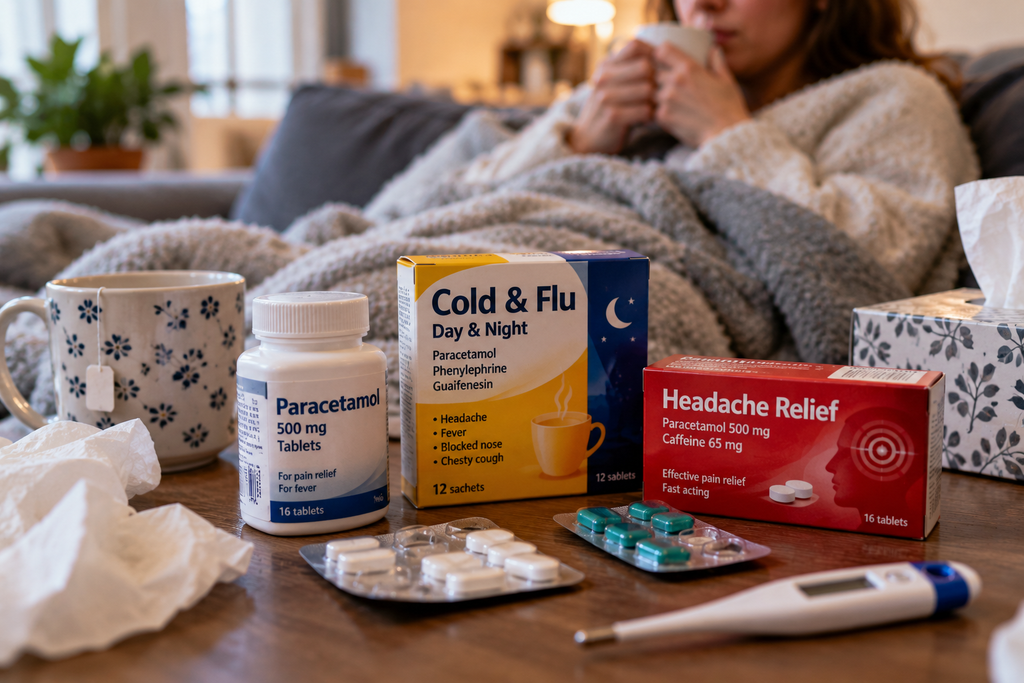
The packages may have different names, different colors and completely different instructions on the front. One may be marketed for headaches, another for colds and flu.
But turn the boxes around and you may discover something important: they contain the same active ingredient.
In the United States, that ingredient is usually called acetaminophen. In much of the rest of the world, it is known as paracetamol.
At recommended doses, acetaminophen is considered a safe and effective medication. But taking too much — sometimes without realizing it — can cause severe liver injury.
And one of the easiest ways to make that mistake is to count medications instead of active ingredients.
A surprisingly important cause of acute liver failure
The connection between acetaminophen overdose and acute liver failure has been documented for decades.
In a prospective study involving 22 medical centers across the United States, researchers examined 662 patients with acute liver failure. Acetaminophen toxicity was responsible for 275 cases, or about 42 percent.
But another finding may be even more relevant to the average medicine cabinet.
Among the acetaminophen cases, 48 percent were classified as unintentional overdoses. Within that group, 38 percent of patients had taken two or more acetaminophen-containing products.
These numbers need context.
They do not mean that 42 percent of people who take acetaminophen will develop liver failure, nor that 42 percent of accidental overdoses end that way.
The researchers were studying people who already had acute liver failure.
What the findings do show is that acetaminophen toxicity can account for a substantial proportion of severe acute liver failure cases — and that serious overdoses are not always deliberate.
Sometimes they begin with someone simply trying to treat pain, fever or a bad cold.
Why cold and flu season creates an easy trap
Combination medications are convenient because one product can target several symptoms at once.
That convenience can also make it harder to keep track of what you have actually taken.
Someone may take a regular acetaminophen tablet for a headache and later use a cold-and-flu medicine without noticing that acetaminophen is already one of its ingredients.
The U.S. Food and Drug Administration warns that acetaminophen is found in hundreds of prescription and over-the-counter medications. The agency specifically advises consumers to check labels and avoid using more than one acetaminophen-containing product at a time unless instructed by a healthcare professional.
Brand names are therefore not enough.
The part of the package worth checking is the active ingredients section.
If acetaminophen appears on two labels, your body does not treat them as two unrelated medicines. The amounts contribute to the same total dose.
Why too much acetaminophen can damage the liver
At normal doses, most acetaminophen is processed through pathways that allow the body to eliminate it safely.
A smaller amount is converted into a highly reactive compound called NAPQI.
Under ordinary circumstances, that is not a problem. The body uses glutathione to neutralize NAPQI before it can cause significant damage.
A large overdose changes that balance.
More of the toxic metabolite is produced, while the available glutathione becomes insufficient to neutralize it. NAPQI can then bind to liver cells and cause cellular injury and death.
If enough liver tissue is damaged over a short period, acute liver failure can develop.
Unlike chronic liver diseases that may progress over years, this can happen to someone whose liver was previously functioning normally.
The dangerous part is that you may not feel seriously ill at first
Many people assume that a dangerous overdose would produce dramatic symptoms immediately.
Acetaminophen poisoning does not always work that way.
Early symptoms can include nausea, vomiting or general discomfort, but they may be mild. Some people initially have few or no obvious symptoms at all.
Signs of significant liver injury may emerge later.
That creates a potentially dangerous illusion: someone can feel relatively well and assume that nothing serious happened while toxic injury is developing.
For this reason, feeling fine after a suspected overdose is not reliable evidence that everything is fine.
And this matters because acetaminophen poisoning has an effective treatment whose benefits are greatest when treatment begins early.
There is an antidote — and timing matters
The main antidote used for acetaminophen poisoning is N-acetylcysteine, commonly abbreviated as NAC.
Among its important effects, NAC helps restore the body’s ability to neutralize the toxic metabolite produced during acetaminophen metabolism.
A large multicenter study involving 2,540 patients treated after acetaminophen overdose demonstrated how strongly timing can influence the risk of liver injury.
Among patients considered at risk, hepatotoxicity occurred in approximately 6.1 percent of those who began NAC within the first 10 hours. When treatment began between 10 and 24 hours after ingestion, the rate was approximately 26.4 percent.
Treatment was particularly protective when started very early.
That is why waiting for jaundice, severe abdominal pain or obvious illness after a suspected overdose can be a serious mistake.
The period when someone still feels relatively normal may also be the period when medical treatment can prevent much of the damage.
Liver injury does not automatically mean a transplant
There is another misconception worth correcting.
Once liver injury has started, it does not necessarily mean that a liver transplant is the only remaining option.
N-acetylcysteine can still be used in patients who present later, and many people with acetaminophen-related liver injury recover without transplantation.
In the U.S. multicenter study of patients who had already developed acute liver failure associated with acetaminophen, approximately 65 percent survived, while about 8 percent underwent liver transplantation.
Transplantation can be lifesaving in the most severe cases, particularly when doctors determine that spontaneous recovery is unlikely.
But it is not the inevitable outcome of acetaminophen-related liver injury.
The liver has a remarkable ability to recover when the patient survives the acute injury and sufficient functional tissue remains.
What about alcohol?
Online discussions about acetaminophen often reduce the alcohol question to a frightening rule: drink alcohol and acetaminophen suddenly becomes toxic.
The biology is more complicated.
Chronic heavy alcohol use, poor nutrition and prolonged fasting can be relevant when doctors assess a person’s risk, particularly when excessive or repeated acetaminophen doses are involved.
But it would be misleading to suggest that having an alcoholic drink one day automatically turns a normal acetaminophen dose into a liver-damaging dose the next.
The FDA does advise people who consume three or more alcoholic drinks every day to ask a healthcare professional about using acetaminophen-containing medicines because of the potential risk of liver damage.
People with liver disease, substantial regular alcohol consumption or other relevant medical conditions may need individualized advice about which pain relievers and doses are appropriate.
So how much is too much?
For adults and people aged 12 and older, the FDA states that the total amount of acetaminophen should not exceed 4,000 milligrams in 24 hours, counting acetaminophen from all medications being used.
That number should not be interpreted as a daily target.
Individual product labels may provide different dosing instructions, and lower limits may be appropriate depending on the medication, age, body weight, duration of treatment and medical history.
Children require different dosing, commonly based on age and/or weight and the specific formulation being used.
The safest rule is therefore not simply to memorize one number.
It is to follow the instructions for the actual medication being taken and keep track of every source of acetaminophen.
The five-second habit that can prevent an accidental overdose
Before combining a pain reliever with a cold, flu or fever medication, ignore the branding for a moment.
Turn the packages over.
Read the active ingredients.
If both products contain acetaminophen, those doses count together.
It does not matter that one is a tablet and the other is a powder dissolved in hot water. It does not matter that one package says “pain relief” while another says “cold and flu.”
Your liver does not recognize marketing categories.
It processes molecules.
What should you do after a possible overdose?
Do not wait for symptoms to decide whether the situation is serious.
A suspected acetaminophen overdose should be assessed promptly by medical professionals, even when the person feels completely well.
Medical evaluation can take into account the amount taken, the person’s body weight, when the medication was taken, whether it involved one large dose or repeated excessive doses, and other health factors. Blood testing, including measurement of the acetaminophen concentration in appropriate situations, can help guide treatment.
N-acetylcysteine should not be self-prescribed as a home antidote after trying to calculate the risk yourself.
If an overdose may have occurred, contact emergency medical services or an appropriate poison-control or toxicology service promptly.
The takeaway isn’t to fear acetaminophen
Millions of people use acetaminophen safely.
The important lesson is not that a common pain reliever is secretly dangerous. It is that a familiar medication can become dangerous when the same ingredient is unintentionally taken from several different products.
Cold and flu season makes that mistake particularly easy because combination remedies may contain ingredients people are already taking separately.
So the next time several medicines accumulate on the kitchen counter, don’t ask only:
“How many medications have I taken?”
Ask the more useful question:
“How many times have I taken the same active ingredient?”
That small change in habit may be far more valuable than memorizing the brand name on every box.
Sources
U.S. Food and Drug Administration (FDA), Acetaminophen – Safe Use of Over-the-Counter Pain Relievers and Fever Reducers.
U.S. Food and Drug Administration (FDA), Don’t Overuse Acetaminophen.
Larson AM et al., Acetaminophen-Induced Acute Liver Failure: Results of a United States Multicenter, Prospective Study, Hepatology, 2005.
Smilkstein MJ et al., Efficacy of Oral N-Acetylcysteine in the Treatment of Acetaminophen Overdose, The New England Journal of Medicine, 1988.
Lee WM, Acetaminophen (APAP) Hepatotoxicity — Isn’t It Time for APAP to Go Away?, Journal of Hepatology, 2017.