
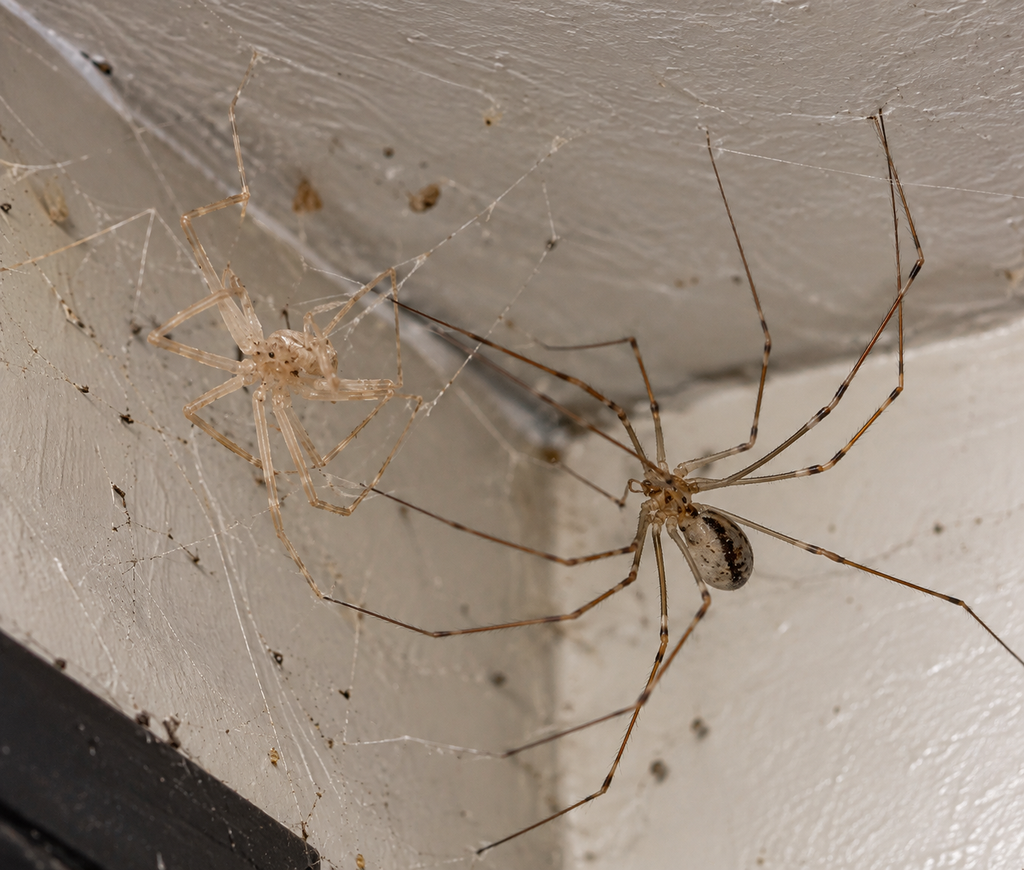
There is something unsettling about finding a spider in the corner of a room and then noticing what appears to be a second, lifeless spider hanging nearby.
The obvious story almost writes itself: the larger spider caught the smaller one and ate it.
That explanation is certainly possible. Spiders prey on other spiders, and cannibalism occurs in a number of species. But there is another explanation that is easy to miss if you have never witnessed a spider molt.
The apparent victim may not be another spider at all.
It could be an empty exoskeleton left behind during molting — essentially a remarkably convincing shell of the spider that is still alive beside it.
Why spiders have to leave their old bodies behind
Unlike humans and other vertebrates, spiders do not have an internal skeleton supporting their bodies. As arthropods, they possess an external skeleton, or exoskeleton, composed of a specialized cuticle containing materials including chitin and proteins.
This protective structure works extremely well, but it creates a problem.
It cannot simply stretch indefinitely as the spider grows.
Instead, a growing spider periodically produces a new cuticle underneath the existing one. During a molt, the old covering separates and the spider works its way out.
The Australian Museum explains that the newly exposed cuticle is initially soft. Until it hardens, the spider is comparatively vulnerable and may remain relatively inactive.
What gets left behind is known as an exuvia, or shed exoskeleton.
And an exuvia can look astonishingly alive.
Why a shed exoskeleton can be mistaken for another spider
Spider molts do not necessarily resemble the loose, papery skin people may associate with a shedding snake.
A spider’s discarded exoskeleton can retain much of the animal’s recognizable shape. The legs may remain intact, the outline of the body can still be visible, and the entire structure may remain suspended in the web.
From across a room, it can look like a second spider.
The illusion becomes particularly convincing when the living spider remains close to its old exoskeleton. Instead of seeing one animal before and after a molt, an observer sees what appears to be two separate individuals.
Molting is a normal part of spider development and begins early in life. The Australian Museum notes that shed skins can even be found in egg sacs after spiderlings undergo their first molt.
So when a pale, motionless spider-shaped object suddenly appears beside a living spider, there is no need to assume that a fight took place.
It may simply be evidence that the resident spider has grown.
But spiders really do eat other spiders
The molting explanation comes with an important warning: not every apparently dead spider in a web is an exuvia.
Spiders are predators, and other spiders can absolutely become prey.
Some species specialize in hunting spiders, while predation and cannibalism also occur under various circumstances in species that are not dedicated spider hunters.
This matters particularly when considering the long-legged spiders commonly encountered inside buildings.
Researchers have experimentally studied predatory interactions involving several cosmopolitan house spiders, including Pholcus phalangioides, the long-bodied cellar spider. A study published in the Journal of Economic Entomology, for example, examined interactions between common house spiders and the brown recluse, Loxosceles reclusa.
So the seemingly dramatic explanation — one spider ate another — is biologically plausible.
The important point is that appearance alone does not establish which explanation is correct.
A spider-shaped object in a web might be a molt.
It might also be the remains of prey.
Exuvia or dead spider: what should you look for?
A recently shed exoskeleton is an empty shell. It may therefore appear unusually pale, dry, lightweight or somewhat translucent.
Under close inspection, its hollow nature can become much more obvious than it appears from several feet away.
Prey remains may look different. They can be damaged, distorted or wrapped in silk, depending on the spider and circumstances. They also have no reason to match the resident spider particularly closely in size or proportions.
There is another familiar clue: dead spiders are often found with their legs curled underneath their bodies.
The reason involves some fascinating spider biomechanics.
Why do dead spiders curl their legs?
A spider does not operate its legs exactly like a human moves an arm or leg.
Muscles are important, but internal fluid pressure also contributes to extending certain leg joints. The Australian Museum describes the spider’s body as functioning in part as a pressurized hydrostatic system.
Once a spider dies, normal control of that system is lost. Flexor muscles contribute to pulling the legs inward, producing the familiar curled posture often seen in dead spiders.
It is a useful observation, but not a perfect diagnostic test.
A discarded exoskeleton can be held in an unusual position by strands of silk, while the body of captured prey may have been manipulated during the attack and feeding process.
The position of the legs can therefore provide a clue, but it cannot solve every case.
What is actually left after a spider eats another spider?
This is another reason prey remains can sometimes be confused with a molt.
Spiders do not eat solid food by chewing it in the way humans do. In predatory spiders, digestion largely begins outside the digestive tract.
Digestive fluids containing enzymes help break down the prey’s tissues, allowing liquefied material to be taken into the spider’s digestive system. This process is generally described as extraoral digestion.
Harder external structures are not consumed in the same way, so recognizable remains can sometimes be left behind after feeding.
Venom plays an important role in prey capture and immobilization in many spiders, although spiders are diverse and it would be inaccurate to suggest that every species uses precisely the same feeding strategy.
The important distinction is that the remains of a meal do not necessarily disappear completely.
Finding something that still resembles a spider therefore does not automatically mean that it is a molt.
How long does a spider molt take?
There is no single answer because spiders differ enormously in size, biology and life stage.
In large spiders such as tarantulas, the Australian Museum reports that the actual molt can take less than an hour in young individuals and several hours in large adult females. Those numbers should not be applied directly to a small house spider; they illustrate how much molting time can vary between spiders.
What happens afterward is equally important.
A freshly molted spider emerges with a soft new cuticle. It needs time for that new exoskeleton to harden, and during this period it is particularly vulnerable.
That can also explain another puzzling observation: a spider sitting unusually still beside something that looks like a dead spider may actually have just completed a molt.
The motionless spider-shaped object beside it could be the body covering it occupied only hours earlier.
A photograph can provide clues, but not always an answer
A photograph showing a long-legged spider beside a paler spider-shaped structure can certainly be consistent with molting.
But “consistent with” is different from “proves.”
Without sufficient detail, it may be impossible to determine whether the second structure is an exuvia, prey remains or another dead spider. Species identification can also be unreliable when a photograph does not clearly show the anatomical features needed for identification.
Members of the family Pholcidae are particularly relevant because several species are familiar inhabitants of human buildings. Pholcus phalangioides, for example, is described by Penn State Extension as an extremely long-legged spider commonly found in protected areas of structures, including basements and garages.
A photograph can therefore support a reasonable hypothesis without necessarily providing a definitive diagnosis of what happened in the web.
A tiny mystery that reveals an extraordinary piece of biology
The scene is easy to misread.
Yesterday there seemed to be one spider in the corner. Today there appear to be two, and one of them is motionless.
Perhaps one killed the other.
That genuinely happens.
But sometimes there was no fight, no victim and no second spider.
The animal simply grew.
To do so, it produced a new external skeleton, escaped from the old one and left behind an empty replica of itself — complete enough to convince an unsuspecting observer that another spider had died.
It is a reminder that some of the strangest examples of animal biology do not require a rainforest expedition or a wildlife documentary.
Sometimes they are quietly taking place in the corner of a room.
Sources and further reading
Information on spider anatomy, exoskeletons, molting and feeding biology was checked against educational resources from the Australian Museum.
Australian Museum — Spider structure
Australian Museum — Egg sacs, spiderlings and dispersal
Information about the long-bodied cellar spider and its occurrence inside buildings was checked against Penn State Extension.
Penn State Extension — Longbodied Cellar Spider
Research concerning predatory interactions among common house spiders was checked against the scientific literature indexed by PubMed.
PubMed — Predation by cosmopolitan spiders upon Loxosceles reclusa