
Ask where the Danube begins and the answer sounds easy enough: Germany’s Black Forest.
That is broadly correct.
But try to identify the exact point where one of Europe’s great rivers is born and the answer becomes surprisingly complicated.
There is a famous spring traditionally presented as the “source of the Danube.” There are two rivers whose meeting point marks the beginning of the waterway actually called the Danube. And farther upstream, another spring has a strong claim to being the hydrological source of the entire river system.
Then there is the name itself.
Long before Germany, Austria, Hungary or Romania existed as modern states, ancient peoples already had names for this enormous river. Those names preserve traces of a linguistic history stretching back thousands of years.
So the Danube has more than one fascinating beginning: one written in geography and another hidden in language.
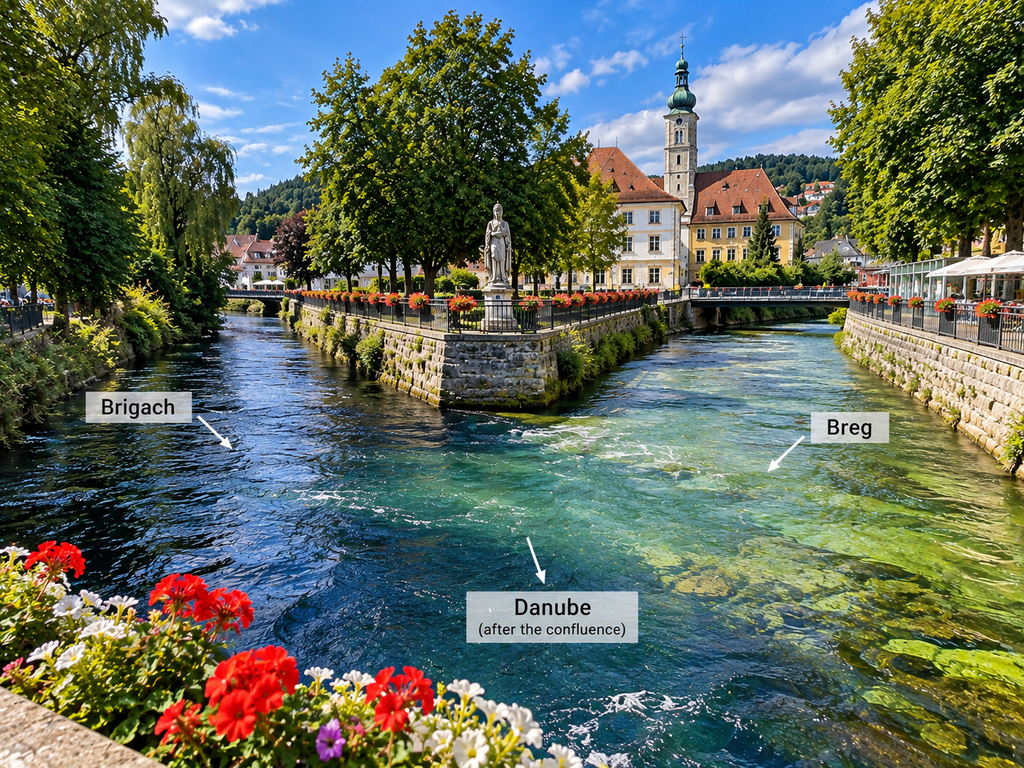
Two Rivers Meet — and the Danube Appears
In southwestern Germany, two relatively small rivers flow through the Black Forest region.
They are the Breg and the Brigach.
Near Donaueschingen, their waters meet. Downstream from this confluence, the combined river is called the Donau — the Danube.
The International Commission for the Protection of the Danube River (ICPDR) identifies the Breg-Brigach confluence at Donaueschingen as the beginning of the Danube under that name.
That gives us our first definition.
If we ask:
Where does the river actually begin to be called the Danube?
Donaueschingen provides the answer.
But if we ask where the longest upstream branch begins, we have to keep traveling.
Follow the Danube Upstream and You Reach the Breg
Imagine beginning near the Black Sea and traveling backward along the river system.
Eventually, at Donaueschingen, the Danube separates into the Breg and Brigach.
Which one should you follow?
The Breg is the longer headstream.
ICPDR documentation concerning the Upper Danube gives it a length of roughly 46 kilometers. Its source lies near the Martinskapelle, close to Furtwangen in the Black Forest.
For that reason, when the river system is traced along its principal upstream branch, the Breg is generally treated as the Danube’s main headstream.
Its source therefore has a strong claim to being the hydrological source of the Danube system.
This is why saying that the Danube rises in the Black Forest is not wrong at all.
It is simply a broader geographical answer to a question that can be defined in several ways.
But Donaueschingen Has Another “Source of the Danube”
The story would already be interesting enough if it ended there.
It doesn’t.
Donaueschingen is also home to the Donauquelle, literally the “Danube Source.”
For centuries, this spring has been traditionally associated with the birthplace of the river. Today it is a monumental landmark and one of the best-known sights connected with the Danube’s origins.
Yet the water emerging there does not simply become the Danube and continue uninterrupted toward the Black Sea.
The spring feeds the small Donaubach, which connects with the Brigach. The Brigach later meets the Breg, and only after that confluence does the river carry the Danube name.
The Donauquelle therefore represents something slightly different: the Danube’s historic and symbolic source.
This gives us three overlapping ideas:
the Black Forest as the river’s geographical region of origin,
the Breg source as the source of its principal headstream,
and the Breg-Brigach confluence as the point where the Danube begins under its familiar name.
The Donauquelle adds a fourth layer: centuries of cultural tradition.
Why Can One River Have Several “Sources”?
The problem is not unique to the Danube.
Our mental picture of a river often begins with a single spring emerging from a mountainside. A tiny stream grows larger, crosses a continent and eventually reaches the sea.
Real drainage systems can be considerably messier.
Springs create streams. Streams merge. Tributaries join larger rivers. At each junction, geographers and hydrologists have to decide which upstream branch represents the continuation of the main river.
Length can matter. So can discharge, drainage area, historical usage and naming conventions.
That means the “source” of a major river is not always a single universally obvious spot on a map.
Sometimes it depends on the question being asked.
Even the Danube’s Length Changes Depending on the Starting Point
This ambiguity has a practical consequence.
Published figures for the Danube’s length are not always identical.
If the measurement begins at the Breg-Brigach confluence, the result differs from a measurement that continues upstream along the Breg.
ICPDR material gives approximately 2,780 kilometers for the Danube when measured from the confluence toward the Black Sea. Including the roughly 46-kilometer Breg produces a river system of approximately 2,826 kilometers.
Neither number makes sense without knowing the convention behind it.
This is an important lesson whenever river lengths are compared: the question is not only “How long is it?” but also “Where did the measurement begin?”
The Name Is Older Than the Modern Map of Europe
Geography tells us where the Danube begins.
Language takes us much farther back.
The Romans knew the river as Danuvius or Danubius. Ancient Greek writers also used Istros, later appearing in Latin as Ister or Hister, particularly in connection with the lower Danube.
The Oxford Classical Dictionary notes this distinction between Danuvius and Ister in the ancient geographical tradition.
For people living thousands of years ago, the enormous waterway was not necessarily understood from the beginning as the single, continuous river that appears so clearly on a modern map.
Knowledge accumulated gradually.
But the linguistic ancestry behind the Danube name appears to reach even deeper into the past.
Danube, Don, Dnieper and Dniester Share an Ancient Linguistic Connection
The name Danube belongs to a remarkably old family of river names.
Historical linguists connect it with the reconstructed Indo-European element dānu-, associated with the idea of a river or flowing water.
A related word occurs in ancient Iranian languages, including Avestan, where dānu- referred to a river or stream.
Its descendants or linguistic relatives appear in the names of several major waterways.
The Don belongs to this family.
So do ancient forms associated with the Dnieper and Dniester.
This does not mean that one modern river was named after another. The relationship goes much farther back.
Their names preserve traces of an ancient linguistic element used for rivers long before the modern languages and national borders of Eastern Europe existed.
The American Heritage Dictionary’s Indo-European roots material connects Danube with this dānu- family and also identifies related river names including Don, Dnieper and Dniester.
Suddenly, a modern map begins to look like a linguistic archaeological site.
Words can survive where civilizations, borders and languages have changed around them.
What About the Romanian Name “Dunărea”?
Romanian adds another interesting complication.
It might be tempting to draw a simple evolutionary line from Latin Danubius directly to Romanian Dunăre.
The linguistic history is not secure enough to make that claim so confidently.
Different explanations have been proposed for the precise development of the Romanian form, and the pathway to modern Dunăre is more debated than the broader history of the ancient Danube-name family.
That distinction matters.
Historical linguistics often works by reconstructing earlier forms from surviving evidence. Some relationships are strongly supported; others remain open to competing interpretations.
What can be stated with considerably greater confidence is that ancient Danuvius/Danubius and several modern European names for the river belong to an extremely old naming tradition ultimately connected with the language of rivers and flowing water.
Sometimes acknowledging what remains uncertain makes the history more interesting, not less.
A German Saying Captures the Geography in One Sentence
There is a traditional German phrase associated with the river’s beginning:
“Brigach und Breg bringen die Donau zuweg.”
Loosely translated:
“Brigach and Breg bring the Danube into being.”
It neatly describes what happens at Donaueschingen.
Two modest rivers meet, and downstream from their confluence one of Europe’s defining waterways appears on the map.
But now we know that the full story stretches both upstream and backward through time.
Follow the water upstream and the trail leads toward the Breg source in the Black Forest.
Follow the name backward and the journey leads through Rome and the ancient world toward linguistic roots that predate the modern map of Europe.
So Where Does the Danube Really Begin?
There is no need to force all of this into a single answer.
The Black Forest is its geographical region of origin.
The Breg is its longer principal headstream.
The Breg-Brigach confluence at Donaueschingen marks the beginning of the river under the Danube name.
The Donauquelle represents the traditional and symbolic source associated with the river for centuries.
Each answer describes a different kind of beginning.
And perhaps that is the most interesting fact of all.
A river that eventually crosses and connects so much of Europe does not emerge fully formed from one dramatic spring.
It is assembled gradually from smaller waters.
Even its name carries layers left by people who lived along European rivers thousands of years before us.
The Danube therefore has no shortage of beginnings.
It has a geographical one, a hydrological one, a historical one — and a linguistic story almost as long and winding as the river itself.
Sources
International Commission for the Protection of the Danube River (ICPDR) — official information and technical documentation on the German and Upper Danube basin.
Oxford Classical Dictionary — historical information concerning Danuvius and Ister in the ancient world.
The American Heritage Dictionary of the English Language — Indo-European root history associated with Danube and the dānu- river-name family.
Hochschwarzwald Tourismus GmbH — regional information concerning the Breg source near Furtwangen and the origins of the Danube.