
At first, the story sounds almost too perfectly dramatic to be true.
A boat carrying nine people capsizes on a Texas lake. Most of the passengers manage to get out, but three very young children remain trapped beneath the overturned hull. Adults are calling for help. Then a father boating nearby realizes what is happening, dives into the water and begins pulling children out. Two require resuscitation.
All three survive.
There is one detail, however, that makes many readers stop and question the entire story: if the other people on the boat managed to escape, how were three small children left underneath it? Where did everyone else go?
That question is reasonable. But the problem is not that the accident was invented.
The accident really happened.
What became misleading was the way a complicated rescue was compressed into a few dramatic sentences for social media.
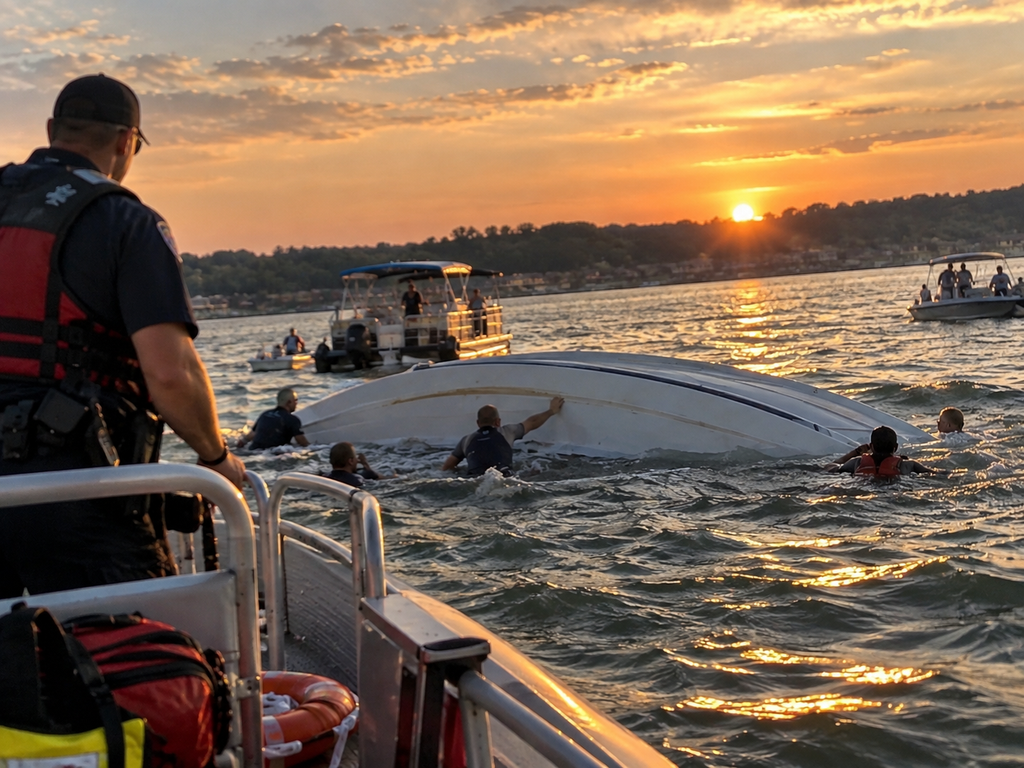
A Fourth of July outing turned into an emergency
The accident occurred on July 4, 2026, at Alvarado Park Lake in Texas.
Authorities said nine people were aboard the vessel when it overturned. Three young children became trapped beneath it, while the other occupants were able to get out from underneath the capsized boat.
The incident and subsequent rescue were reported by multiple American news organizations, including CBS Texas and The Washington Post.
That distinction — getting out from under the boat — matters enormously.
Some viral accounts reduce it to a phrase such as “the others made it out.” Without context, that can sound as though six people simply swam to shore while three children were abandoned underwater.
Contemporary reports describe something very different.
People were still at the accident scene. They were desperately trying to attract attention and get help.
Jason Horne wasn’t simply a random father who jumped into the lake
Jason Horne was spending the holiday on the water with his 12-year-old daughter, Emilie, when they noticed something was wrong nearby.
There were people around the overturned boat, and they were signaling for help.
As Horne approached, he learned that children were still underneath the vessel.
But there is another piece of context frequently lost when the story is retold online: Horne wasn’t an inexperienced bystander attempting an extraordinarily dangerous rescue.
He was an off-duty firefighter and paramedic with the Midlothian Fire Department.
His daughter contacted 911 while Horne went into the water.
That professional background helps explain what happened next.
He had to search where he could barely see
Reaching a person underneath a capsized boat is not as straightforward as simply diving beneath the surface.
Horne went underwater and searched largely by touch.
During his first attempt, he felt a life jacket. He pulled the child down and out from beneath the obstruction and brought him to safety.
The boy was breathing.
But another child was still missing.
Horne went back underneath.
This time he felt a leg.
He pulled out a little girl who was in much worse condition: she was unresponsive and wasn’t breathing. Horne placed her on the exposed portion of the overturned boat and began resuscitation.
She started breathing again.
And then came the realization that there was still another child to find.
The third rescue wasn’t quite as simple as viral posts suggest
This is another point where the internet version tends to turn a chaotic rescue into a cleaner hero narrative.
Some retellings make it sound as though Horne simply dove beneath the boat three times and personally emerged with one child after another.
The fuller accounts show that other people were involved.
Horne continued searching for the third child, while people at the scene worked to manipulate the overturned vessel. The final child, a 3-year-old boy, was discovered entangled in the anchor rope.
He was in critical condition and had no pulse.
Horne performed CPR as efforts were made to get the boy to emergency personnel. The child’s vital signs returned, and he was eventually flown to a hospital for treatment.
That doesn’t make Horne’s actions any less extraordinary.
It makes the story more accurate.
So where were the parents?
This is probably the biggest question created by the viral version of the story.
There is no credible evidence that the children’s parents simply saved themselves and stood safely on shore while a stranger rescued their children.
Reports from the scene describe people desperately signaling for assistance and telling Horne that children remained underneath the boat. Other people also participated in efforts around the capsized vessel.
There are also important things the available reporting does not establish.
We don’t know precisely what every adult aboard the boat was doing during every minute of the emergency. We don’t know everyone’s swimming ability, whether anyone was injured or disoriented during the capsize, or what attempts had already been made before Horne arrived.
Filling those gaps with assumptions would turn fact-checking into another form of storytelling.
What we can say is much simpler: the people who had escaped from beneath the vessel had not mysteriously disappeared. They were part of an unfolding emergency at the scene.
Why couldn’t someone simply swim underneath and grab the children?
From dry land, that solution sounds obvious.
Underwater, it is anything but.
An overturned boat can create a confusing environment where visibility is poor and orientation is difficult. Ropes, lines and equipment introduce another hazard because both a victim and a rescuer can become entangled.
The third child’s situation demonstrates that danger particularly clearly: he had become caught in the anchor line.
Horne’s training therefore matters when evaluating the story. He wasn’t merely willing to enter the water; he also had years of experience responding to emergencies and knew how to perform lifesaving resuscitation once the children were brought out.
The life jackets are an important part of this story
The children were wearing life jackets.
That detail receives far less attention online than the dramatic dives, but it may have been enormously important.
Horne reportedly encountered the first child by feeling his life jacket while searching beneath the vessel. He later emphasized how important the flotation devices had been.
A life jacket cannot prevent someone from becoming trapped underneath an overturned vessel, nor can it free a child tangled in a rope. But properly fitted flotation devices are a fundamental layer of protection for children around recreational boats.
In an accident where seconds matter, seemingly ordinary safety precautions can become the difference between having another chance and having none.
How can someone who isn’t breathing survive a drowning incident?
Another aspect of the story can sound unbelievable to people unfamiliar with drowning emergencies.
A child who is pulled from the water unconscious and not breathing is in an extremely serious condition, but that does not mean resuscitation is necessarily futile.
Drowning causes respiratory impairment from submersion or immersion. As oxygen deprivation progresses, a person can lose consciousness and eventually suffer cardiac arrest.
This is also why resuscitation after drowning differs in an important respect from the sudden cardiac arrests people often associate with CPR.
Current American Heart Association and American Academy of Pediatrics guidance emphasizes CPR that includes rescue breaths following cardiac arrest from drowning, because oxygen deprivation is central to the emergency.
The children in Texas happened to have an enormous advantage: an experienced paramedic was close enough to begin lifesaving measures almost immediately.
All three children survived
The children involved were 3 and 5 years old.
All three survived, according to subsequent reporting. The child who had been in the most critical condition was transported by helicopter to Cook Children’s Medical Center in Fort Worth, while the others also received hospital care.
The families largely remained outside the media spotlight afterward.
Horne and his daughter were later recognized for their actions. Emilie’s role is easy to overlook in retellings focused entirely on the dramatic underwater rescue, but staying behind and contacting emergency services was itself an important part of the response.
Why does a true story end up sounding fake online?
This case illustrates something broader about viral storytelling.
Real emergencies are messy.
Several people are doing different things simultaneously. Information is incomplete. Someone is calling 911. Someone else is trying to move a boat. People are shouting. A rescuer is searching underwater with almost no visibility. Emergency crews are traveling toward the scene.
Social media rewards a much cleaner narrative.
Nine people were on a boat.
The boat flipped.
Six escaped.
Three children were trapped.
One man arrived.
He saved all three.
Every sentence may contain a piece of the truth, yet putting the story together this way can produce an impression that is misleading.
The people who “made it out” hadn’t necessarily gone anywhere. Other bystanders helped. Horne was not an ordinary passerby with no emergency training. And the final rescue involved more people and more complexity than a single dramatic dive.
Paradoxically, removing those details makes the story seem less believable, not more.
The real story didn’t need embellishment
Strip away the social-media polish and what remains is remarkable enough.
A boat carrying nine people capsized on a Texas lake during the Fourth of July. Three small children became trapped beneath it. Nearby happened to be an off-duty firefighter-paramedic who recognized the emergency and entered the water while his daughter called 911. Other people at the scene helped. Children who were unresponsive received immediate resuscitation. Emergency crews took over.
And all three children survived.
There is no need to turn everyone else into passive spectators or transform a complicated group rescue into the work of a lone superhero.
In fact, the more complete account contains a useful lesson about viral stories themselves.
Sometimes a story online sounds fake not because the event never happened, but because reality has been edited until it no longer sounds real.