
Long before Hollywood, fame and red carpets, Ben Affleck was a teenager walking home from high school in Cambridge, Massachusetts, when an ordinary afternoon suddenly became frightening.
He noticed two older boys nearby.
Something about them made him uneasy enough to consider running. He decided against it and kept walking.
The boys passed him, but then turned back. According to Affleck’s recollection, they grabbed him, produced a knife and demanded his money.
He was around 14 years old.
And he was scared.
Then something happened that neither side seemed to have expected.
Affleck looked more closely at the boys and realized they weren’t strangers after all.
He knew them from baseball.
More importantly, they recognized him too.
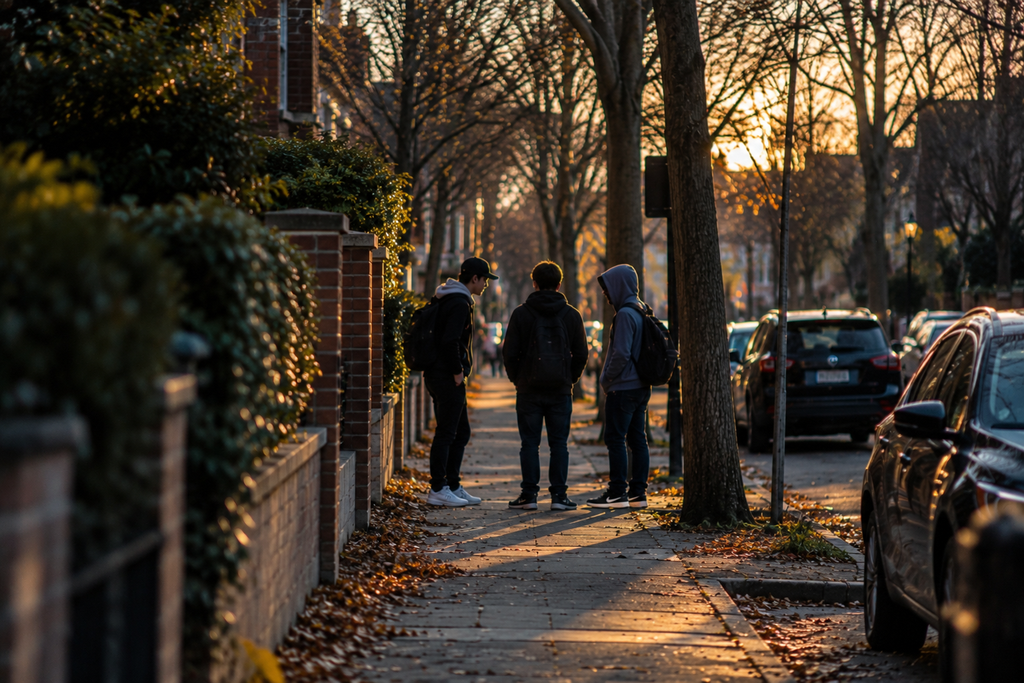
There was no clever escape plan
The detail matters because shortened versions of the story can make it sound as though the young Affleck talked his way out of danger.
That isn’t how he describes it.
He did not tell them who he was, remind them that they had met before or negotiate his release. Recognition appears to have happened naturally in the middle of the confrontation.
Affleck recalled realizing that he knew the boys from baseball. They were older kids from the area whom he had encountered before.
Then they recognized him.
Their demeanor changed.
According to Affleck, the threatening encounter suddenly shifted into something strangely familiar, with a reaction along the lines of, “Oh yeah, what’s up?”
He remembers thinking that he was probably “off the hook.”
Within seconds, the dynamic had changed. A teenager who had moments earlier been an anonymous target was now someone they knew.
Affleck walked away without being physically harmed.
Did they still take his money?
There is a small but important ambiguity in the story.
Some retellings suggest that once the boys recognized Affleck, the robbery effectively ended. Yet Affleck later referred to one of them as the boy who had robbed him.
That means it is safer not to claim that recognition prevented the robbery altogether.
What can reasonably be said is that recognizing one another appears to have stopped the encounter from escalating further and Affleck emerged physically unharmed.
It may sound like a minor distinction, but it matters when a decades-old personal memory is transformed into a viral headline.
The verified story is already dramatic enough without improving it for effect.
What Affleck says happened to one of the boys years later
There is another disturbing chapter to his account.
Affleck says that approximately three or four years after their encounter, one of the boys killed someone with a knife and subsequently spent 20 years in prison.
That statement needs context.
Recent reporting confirms that Affleck made the claim, but the individual has not been publicly identified in coverage of the interview. Without a name and corresponding court records, the later crime cannot be independently tied to the unidentified teenager based solely on the information currently available.
The distinction is straightforward but important: we can verify what Affleck said; that is not the same as independently verifying the criminal history of the person he was describing.
Nor does the later alleged crime prove that Affleck narrowly escaped being killed that afternoon.
It is tempting to connect those two events and imagine an alternate ending, but doing so would be speculation.
What happened to the teenage Affleck requires no embellishment. Someone confronted him with a knife, demanded money, and the situation changed after both sides realized they knew each other.
His mother didn’t know
For many parents, what happened afterward may be more surprising than the confrontation itself.
Affleck went home.
And he didn’t tell his mother.
There was no immediate account of the knife, the fear or the encounter with the two older boys.
When his mother eventually learned what had happened and asked why he had never told her, Affleck’s explanation was remarkably ordinary.
He didn’t want her to worry.
That one detail changes the meaning of the story.
Adults often assume there are certain experiences children will inevitably tell them about. Being threatened with a weapon would surely qualify.
Yet adolescents don’t always decide what to disclose according to the seriousness adults assign to an event.
Sometimes they remain silent precisely when parents would most want them to speak.
What parents know often depends on what teenagers choose to reveal
Developmental researchers have spent years studying how parents learn about their adolescents’ lives.
Parents can ask questions, establish rules and monitor where their children are going. But research on parental knowledge has highlighted another important source of information: adolescents themselves.
In other words, parents often know what is happening because their children voluntarily tell them.
A longitudinal study involving 874 adolescents between 12 and 16 examined parental support, parents’ efforts to obtain information, secrecy and adolescent disclosure. Greater perceived parental support predicted greater subsequent disclosure and less secrecy.
That finding highlights an important difference.
A parent can ask questions.
But asking a question and being the person a teenager genuinely wants to answer are not necessarily the same thing.
Silence does not always mean a lack of trust
There are many reasons adolescents keep information to themselves.
They may anticipate punishment. They may be embarrassed. They may fear disappointing a parent or believe that adults will overreact. As independence grows, teenagers also begin to draw stronger boundaries around what they consider their personal lives.
But Affleck’s explanation illustrates another possibility.
Sometimes the young person may believe that silence is an act of protection.
A teenager can think: Mom already has enough to worry about. I’m okay now. Why upset her?
From the teenager’s perspective, that reasoning may even feel mature.
The problem is that when the secret involves violence, coercion, abuse or another genuine threat, the child may be handling alone exactly the kind of experience for which adult support matters most.
And the parent may continue through the evening without realizing anything unusual happened.
“How was your day?”
“Fine.”
Few exchanges between parents and teenagers are more ordinary.
Yet Affleck’s story illustrates just how much can theoretically fit inside that single word.
A teenager can experience bullying, intimidation, harassment, peer pressure or something genuinely frightening and still come home, eat dinner, complain about homework and say the day was “fine.”
That doesn’t mean every short answer should become a reason for suspicion.
Teenagers need privacy.
Growing independence is not a problem parents are supposed to eliminate. Having conversations, friendships, thoughts and experiences that aren’t automatically shared with family is part of growing up.
The more meaningful distinction is between privacy and safety.
A teenager does not need to report every conversation or personal thought. But violence, threats, blackmail, abuse, coercion and situations involving genuine danger belong to a different category.
For those moments, knowing that a trusted adult is available can matter enormously.
Trust is built before the difficult conversation arrives
Parents frequently tell children, “You can tell me anything.”
The sentence matters.
What happens during all the smaller conversations may matter even more.
Young people learn what disclosure feels like by watching how adults respond when they admit something uncomfortable. They notice whether a mistake is heard before it is punished, whether embarrassment is treated with compassion and whether asking for help immediately produces anger.
None of this means parents must abandon rules, consequences or expectations.
Support is not the same as approval.
It means creating enough emotional safety that admitting a problem does not feel more frightening than hiding it.
No parenting strategy can guarantee that an adolescent will reveal everything. Nor should total disclosure be the goal.
The objective is something more realistic: when the information truly matters, the young person knows where to take it.
Decades later, the story looks different from the parent’s side
Affleck is no longer the 14-year-old trying not to worry his mother.
He is a father.
And adulthood changes the perspective from which an experience like this is remembered.
The celebrity element is ultimately the least interesting part of the story. Remove Ben Affleck’s name and what remains could belong to countless families.
A teenager noticed danger.
He considered running.
He was confronted.
A knife appeared.
He became frightened.
Then he recognized the people threatening him.
They recognized him too.
The situation changed, and he made it home unharmed.
His mother knew none of it.
According to Affleck, he wasn’t silent because he didn’t care what she thought. His reasoning was almost the opposite.
He didn’t want to frighten her.
Perhaps that is why the most useful question raised by this story isn’t whether parents know everything their teenagers are doing.
They almost certainly don’t. And complete access to a teenager’s private world shouldn’t be the measure of a healthy relationship anyway.
A better question may be much simpler:
If something happened tomorrow that genuinely frightened your teenager, would coming home and telling you feel safer than keeping it secret?