
It lasted only a few seconds.
A woman was walking across a London bridge when a jogger approached from the opposite direction. As they were about to pass each other, the runner appeared to move toward her and shove her sideways.
She fell into the road.
An approaching bus was suddenly heading directly toward her.
The driver swerved just in time.
The disturbing encounter was captured on CCTV and would eventually be watched around the world. The unidentified runner became known in the British press by a name that turned the incident into one of London’s strangest modern mysteries: the “Putney Pusher.”
For years, investigators could not publicly establish who he was.
Then, almost nine years after the attack, police made a dramatic new arrest. The man detained was Nicholas Brandram, a London banker and former British Army officer whose family tree could be traced back to Queen Victoria.
It sounded like the ending to an extraordinary mystery.
It wasn’t.
Three months later, Brandram was found dead. He had never been charged over the Putney Bridge incident. His family strongly rejected the suggestion that he was the man in the CCTV footage, while police said their investigation remained open.
That distinction matters, because headlines suggesting that the mysterious jogger had finally been identified tell a much simpler story than the evidence allows.
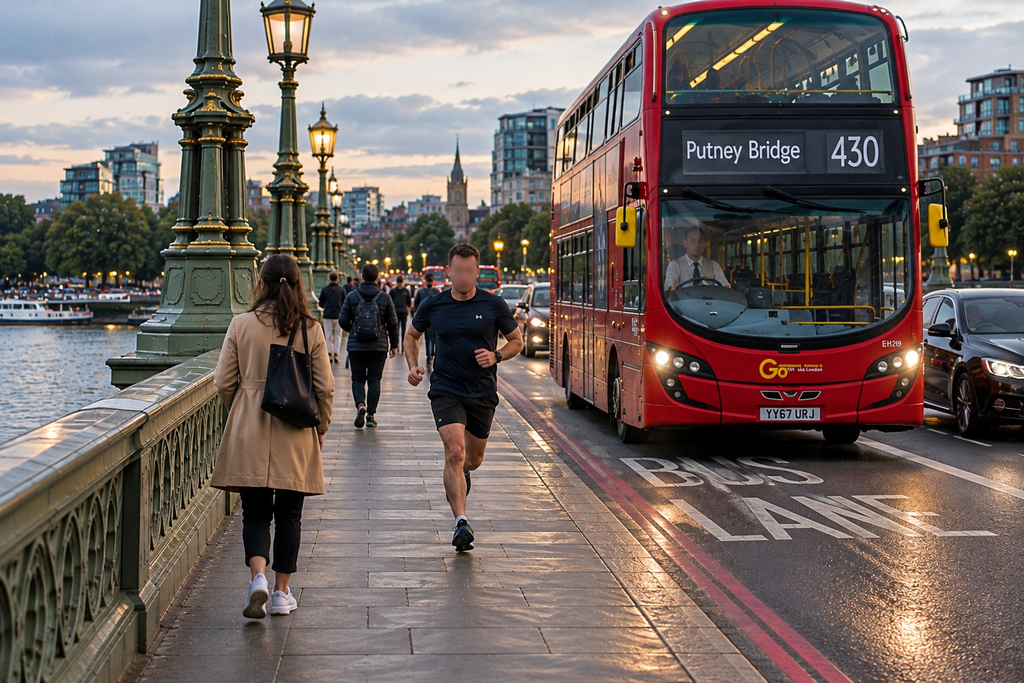
The few seconds that nearly ended in disaster
The incident happened on the morning of May 5, 2017, on Putney Bridge in southwest London.
A 33-year-old woman was walking along the pavement as a male jogger approached her from the opposite direction.
CCTV captured what happened next.
The runner appeared to veer toward the woman and push her into the road, where she fell into the path of a Route 430 bus.
Behind the wheel was driver Oliver Salbris.
He reacted almost instantly, steering away from the woman and narrowly avoiding her. What could easily have become a fatal collision instead left her with relatively minor injuries.
But the story became even more unsettling because the encounter may not have ended there.
Police said the jogger returned across the bridge approximately 15 minutes later. The woman reportedly tried to speak to him, but he did not stop and continued running.
There was no known relationship between the two and no publicly established confrontation that might explain what had happened.
The footage therefore presented investigators with two very different questions.
The first was obvious: why did he do it?
The second would prove much harder to answer: who was he?
Millions could see the jogger, yet nobody could conclusively name him
Metropolitan Police released CCTV footage as part of an appeal for information, and the images quickly spread far beyond Britain.
At first, the existence of video evidence made the case seem deceptively straightforward. The incident had occurred in daylight in a busy part of London, and the runner was visible on camera.
But CCTV footage that shows an event is not necessarily footage capable of proving someone’s identity.
Investigators pursued numerous leads. Roughly 50 people were reportedly interviewed, and several men were arrested during the original investigation. None was ultimately charged with the attack.
The publicity also demonstrated another problem that increasingly accompanies viral criminal cases.
Once millions of people begin examining a grainy image, resemblance can quickly be mistaken for evidence.
Names were suggested online. Men who appeared similar to the runner found themselves associated with the case. But identifying someone on social media and establishing identity to an evidential standard are very different things.
By 2018, police had exhausted the available lines of inquiry and the active investigation was closed.
The man in the footage remained unidentified.
Then, in 2026, police made another arrest
The case suddenly returned to the headlines on June 15, 2026.
Metropolitan Police announced that a 44-year-old man had been arrested on suspicion of attempted grievous bodily harm in connection with the 2017 incident.
It was the most significant public development in the mystery for years.
The suspect was subsequently identified in British media as Nicholas Brandram.
His background immediately attracted attention.
Brandram had worked in banking and had previously served as an officer in the British Army, reaching the rank of captain. At the time of his arrest, he was associated professionally with HSBC Private Bank.
Then reporters discovered another biographical detail almost guaranteed to produce headlines.
Brandram had royal ancestry.
The truth behind the “royal connection”
The phrase sounds more mysterious than the genealogy actually is.
Brandram was a grandson of Princess Katherine of Greece and Denmark, who was herself a descendant of Queen Victoria. Through that branch of the family, Brandram was therefore also descended from Queen Victoria.
It is an interesting piece of family history.
It is not evidence about what happened on Putney Bridge.
The far more important fact was what happened after Brandram’s arrest — or, more precisely, what did not happen.
He was not charged with the Putney Bridge attack.
Brandram was released while inquiries continued.
Police also dealt with separate suspicions concerning possession of Class A and Class B drugs following his arrest. Those allegations were a different matter and did not establish that he was the jogger seen in the 2017 footage.
That distinction is crucial.
An arrest means police have grounds to investigate someone as a suspect. It does not mean that person’s guilt has been established.
Three months later, the story took a tragic turn
On September 15, 2026, emergency services attended a property in Chiswick, west London.
Nicholas Brandram, aged 44, was found unresponsive and pronounced dead at the scene.
Police described the death as unexpected but said it was not being treated as suspicious.
Brandram’s family subsequently said that he had taken his own life and argued that the enormous pressure created by the investigation and his public association with the Putney case had contributed to his deteriorating state.
That account represents the family’s position and should not be confused with an official finding about all the circumstances surrounding his death.
His relatives also made another, unequivocal claim.
They said police had the wrong man.
His family says he was not the Putney Pusher
Brandram’s relatives publicly challenged the case against him.
They argued that there was no forensic evidence connecting him to the incident, no evidence placing him on Putney Bridge when the woman was pushed and no reliable basis for identifying him as the runner captured on CCTV.
The family also criticised the handling of the investigation, arguing that information surrounding the arrest eventually enabled journalists to identify him and exposed him to intense public scrutiny.
Those are serious claims.
But they remain the family’s claims rather than the conclusion of a court or an independent investigation.
The same principle must therefore work in both directions.
Brandram’s arrest did not prove that he was the attacker.
His family’s insistence that he was innocent does not, by itself, establish what happened either.
And Metropolitan Police did not announce that the mystery had been solved.
Police did not close the Putney Bridge investigation
After Brandram’s death, police indicated that work on the original case was continuing.
Investigators were reportedly still pursuing lines of inquiry and awaiting forensic examinations, some of which could take months to complete.
That is why the viral claim that the identity of the “Putney Pusher” was finally uncovered needs an important qualification.
Police had arrested a suspect.
There had been no trial in which the evidence against Brandram could be examined and challenged. There was no conviction. Indeed, he died without ever being charged over the attack.
Those aren’t technicalities.
They fundamentally change what can responsibly be said about the case.
Why the death of a suspect does not automatically solve a crime
When a suspect dies before an investigation reaches its conclusion, an unusual evidential problem emerges.
The normal criminal process cannot run its course.
Prosecutors cannot present a case in court. A defence team cannot challenge that evidence. Witnesses cannot be tested through examination and cross-examination. A judge or jury cannot reach a verdict.
What remains in public view is incomplete.
There is the 2017 CCTV footage.
There is the police investigation.
There is Brandram’s arrest in 2026.
There are the statements made by his family.
What does not exist is a verdict connecting those pieces and establishing his guilt.
It would therefore be wrong to transform a man who died while under suspicion into a man who is known to have committed the attack.
Questions are now being asked about the police investigation itself
Following Brandram’s death, Metropolitan Police made a referral to the Independent Office for Police Conduct (IOPC), the body responsible for overseeing the police complaints system in England and Wales.
The IOPC said it was assessing the circumstances to determine whether any further action was required.
The existence of such a referral should not itself be interpreted as evidence of police misconduct. Metropolitan Police said the referral was mandatory because Brandram had previously been in contact with police.
Nevertheless, the two sides now offer sharply different perspectives.
Brandram’s family portrays him as an innocent man placed under devastating pressure after being wrongly suspected.
Police had a responsibility to investigate information concerning an extremely serious incident and had not completed that investigation before Brandram died.
Between those positions lies something that viral headlines rarely tolerate very well: uncertainty.
Why the “banker with royal blood” version is so irresistible
Strip away the legal nuances and the story almost sounds written for a television thriller.
A stranger pushes a woman toward a moving bus.
The attack is captured on camera.
The perpetrator disappears.
For almost nine years, his identity remains a mystery.
Then police arrest a banker who once served as an Army officer and happens to be descended from Queen Victoria.
Three months later, he is dead.
It is an extraordinary narrative.
And that is precisely why caution matters.
Stories become more memorable when scattered facts form a satisfying pattern. Once they do, it becomes tempting to treat the narrative itself as evidence.
But these two statements do not mean the same thing:
Police arrested a suspect almost nine years after the attack.
Police finally identified the Putney Pusher.
The first reflects what is known publicly.
The second goes beyond it.
The CCTV footage contains another uncomfortable lesson
There is a broader reason the Putney Bridge case remains fascinating.
Video feels definitive.
When we watch an incident ourselves, it creates the impression that we have witnessed the truth directly. Yet a camera can establish what happened remarkably well while remaining much less useful in establishing who did it.
The footage shows a woman being pushed.
It shows her falling into the road.
It shows the bus driver swerving.
It shows a runner continuing on his way.
What the footage has never been able to establish by itself is the man’s identity.
That gap becomes especially dangerous once a criminal investigation moves onto the internet.
A name attached to an image can persist for years. Search engines repeat it, social media posts reproduce it and old headlines remain accessible long after the qualifications surrounding the original allegation have been forgotten.
In cases such as this, the presumption of innocence is therefore more than an abstract legal principle. It is a safeguard against turning suspicion into historical fact simply through repetition.
Almost nine years later, the original question remains
We know what happened on Putney Bridge on May 5, 2017.
A male jogger pushed a woman toward the road. A bus driver reacted in seconds and avoided striking her. The incident was captured on CCTV, the footage travelled around the world, and investigators spent years trying to establish the runner’s identity.
We also know that Nicholas Brandram was arrested in 2026 in connection with that attack.
But Brandram died before the investigation reached a public conclusion and without being charged over the incident. His family rejects the suggestion that he was responsible, while the Metropolitan Police investigation has remained open.
So, nearly a decade after a few seconds of CCTV footage created one of London’s most enduring modern mysteries, the story does not end with the revelation of the Putney Pusher’s identity.
At least for now, it ends where it began:
Who was the man on Putney Bridge?