
Most parents eventually watch their children leave home and build lives of their own. For Ada Keating, life unfolded differently. Her son Tom never married, and mother and son remained part of each other’s everyday lives for decades.
Then, when Tom was 80, circumstances finally separated them.
In 2016, he moved into Moss View Care Home in Huyton, near Liverpool, because he required additional care. Ada was already in her late nineties.
For a woman who had spent most of her son’s eight decades close to him, visiting occasionally was not quite the same as sharing daily life. The following year, at the age of 98, Ada made an unusual decision.
She moved into Moss View too.
Their reunion eventually attracted international attention, producing photographs and headlines that continue to circulate online years later. But behind the viral claim about a “98-year-old mother moving into a nursing home to care for her 80-year-old son” is a more nuanced—and arguably more meaningful—story.
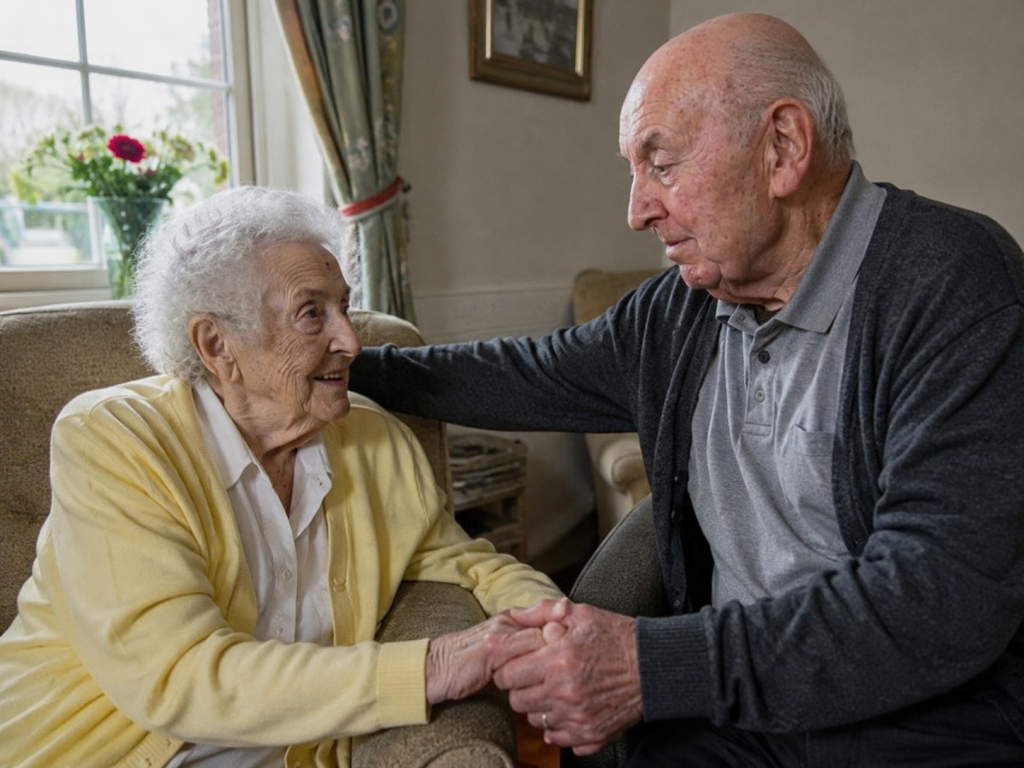
A Mother and Son Who Had Shared a Home for Decades
Ada Keating was born in 1918 and had worked as a nurse. She and her husband, Harry, had four children: Tom and daughters Barbara, Margi and Janet.
Tom worked as a painter and decorator. He never married and continued living with his parents. After Harry died, Tom and Ada remained together.
It was therefore not simply a case of an elderly parent suddenly deciding that her adult son needed looking after. Sharing a home had been their normal way of life for many years.
That changed when Tom’s increasing care needs meant he could no longer remain at home.
His move to Moss View in 2016 created a separation neither of them had previously experienced in quite the same way.
Ada eventually found a solution that allowed them to be together again.
At 98, Ada Joined Her Son
By the time Ada moved into Moss View, Tom had already been living there for about a year.
The age difference between them made the story irresistible to newspapers and, later, social media: an 80-year-old “child” reunited with his 98-year-old mother.
Yet the popular version can create a slightly misleading impression.
Ada did not move into the home to become Tom’s medical caregiver. Moss View had professional staff to provide the assistance residents required, and at 98, Ada herself could benefit from living in a supported environment.
What she could continue providing was something much less clinical.
She could be his mother.
Their Ordinary Routine Was What Made the Story Extraordinary
Accounts from the care home described a relationship built not around grand gestures but around familiar routines.
Ada would greet Tom in the morning and say goodnight to him before bed. They spent time together and watched television. Like many mothers and sons, they could also disagree from time to time.
Ada even described what happened when she occasionally went out, such as for a visit to the hairdresser. When she returned, Tom would be waiting for her and would welcome her with open arms.
It is difficult to imagine a clearer illustration of how little certain family bonds depend on age.
Tom was no longer a young man waiting for his mother to return home.
He was 80 years old.
And he was still happy to see Mum come through the door.
“You Never Stop Being a Mum”
Of all the things Ada said when their story became public, one sentence came to define it:
“You never stop being a mum.”
The simplicity of the remark is probably one reason the story has survived for so long online.
Parenthood is usually portrayed through childhood milestones: first steps, first days of school, scraped knees, graduations and children eventually leaving home. Far less often do we see what the same relationship can look like six, seven or eight decades later.
Ada and Tom offered a rare glimpse of that other end of the story.
A child can grow old.
A mother can approach her hundredth birthday.
Yet somewhere underneath the changing roles, the original relationship can remain remarkably recognizable.
Even the Care Home Staff Found Their Situation Unusual
When the story was reported in 2017, Moss View manager Philip Daniels described having a mother and son living together at the care home as something rarely seen.
Staff members could observe the closeness between Ada and Tom every day, while other members of the Keating family continued visiting them.
For their relatives, there was another important source of reassurance: Ada and Tom could remain together while living somewhere equipped to meet their respective care needs.
That detail matters because it changes the meaning of the story.
Ada was not a frail 98-year-old woman expected to shoulder the physical responsibility of caring for an elderly son by herself. Professional caregivers were there for both of them.
What the institution could not replace was their relationship.
The Viral Story Is True, but the Headline Needs Context
Over the years, photographs of Ada and Tom have repeatedly resurfaced on social media. They are often accompanied by a brief explanation saying that Ada entered a nursing home specifically to “look after” her son.
The central events are genuine. Tom entered Moss View in 2016, and his mother subsequently joined him there at the age of 98. Their unusually close relationship was documented by the care home and reported by British and international media.
The interpretation requires a little more care.
Ada wasn’t performing the work of nurses and professional caregivers. She was living alongside her son, supporting him through the companionship and affection that had characterized their relationship long before either of them needed residential care.
Distinguishing between those two things does not diminish the story.
It makes it more human.
What Does Motherhood Look Like After Eight Decades?
Perhaps the most striking aspect of Ada and Tom’s story is that neither of them appeared to regard their closeness as particularly extraordinary.
For outsiders, their ages were remarkable: 98 and 80.
For them, this was simply Mum and Tom.
Time had changed almost everything around them. They had lost loved ones, grown old themselves and eventually reached a stage when both needed support from others. Roles that once seemed permanent had inevitably shifted.
But some of the smallest rituals survived.
A greeting in the morning.
Time spent sitting together.
Waiting for someone to come home.
A goodnight before bed.
Ada could no longer protect her son from every difficulty life might bring, nor was she expected to. At Moss View, there were professionals to provide the care that age had made necessary.
What she could still give him was her presence.
And after nearly 80 years of being his mother, Ada Keating summed up the reason in a sentence that needed no explanation:
You never stop being a mum.