
By the time she received an experimental treatment, the woman was in her eighties and had been living with Alzheimer’s disease for nearly a decade.
Her family had already witnessed the slow, relentless progression that has become tragically familiar to millions of people around the world.
At first, the changes had been subtle. Conversations became harder to follow. Memories slipped away. Everyday tasks required increasing assistance. Over time, however, the disease tightened its grip.
For roughly five years, her speech had been reduced to isolated words and fragments of sound. She struggled with walking and swallowing. Basic daily activities required constant support. Urinary incontinence had become a permanent part of life. Emotional expression was limited, and meaningful social interaction had largely disappeared.
From a medical perspective, her condition appeared to fit the expected course of advanced Alzheimer’s disease: progressive decline with little realistic expectation of significant recovery.
Then something unexpected happened.
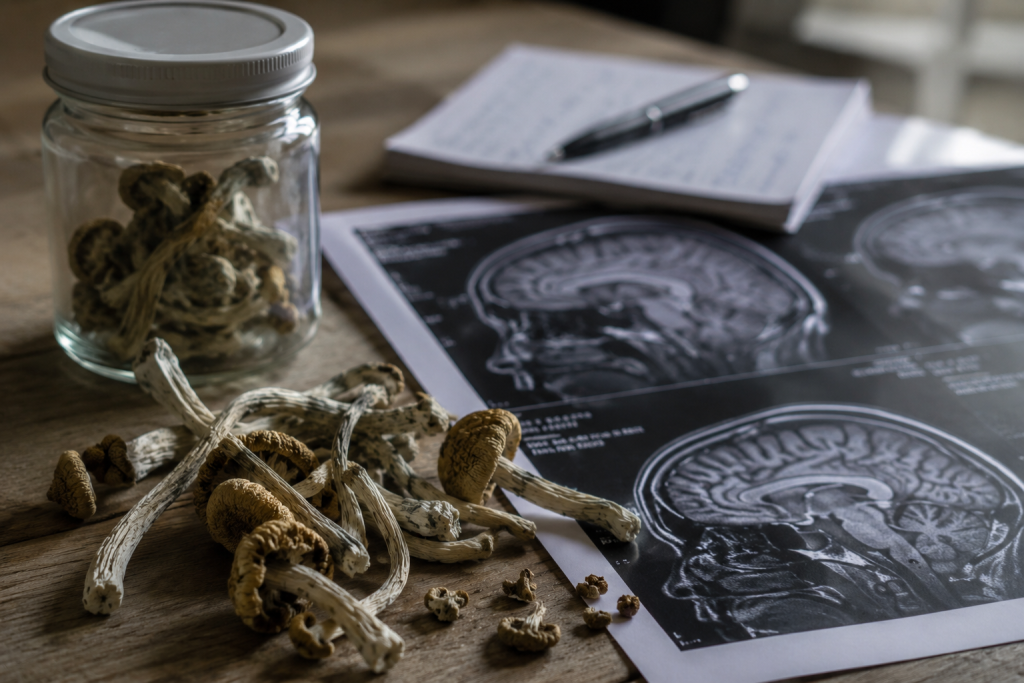
Following the administration of a high dose of psilocybin-containing mushrooms, the woman began speaking again.
Not a few isolated words.
Not simple yes-or-no responses.
According to the published case report, she spent hours talking about her life, recalling personal memories and engaging in coherent conversations. In the days that followed, additional changes emerged. She maintained eye contact, responded to humor, dressed herself without assistance, and regained bladder control, including during the night. Some of these improvements reportedly persisted for weeks.
The observations were remarkable enough to attract international attention.
For headlines, it sounded like a medical breakthrough.
For neuroscientists, it raised a far more complicated question.
If certain abilities could reappear, even temporarily, what did that reveal about the brain’s capacity to function despite severe neurodegenerative disease?

The Disease That Slowly Erases a Person
Few illnesses inspire as much fear as Alzheimer’s disease.
While many medical conditions threaten the body, Alzheimer’s attacks something far more personal: memory, identity, and the ability to connect with the people and experiences that define a life.
The disease was first described in 1906 by German neurologist Alois Alzheimer, who presented the case of a patient named Auguste Deter. She had developed profound memory loss, confusion, and behavioral changes. After her death, examination of her brain revealed abnormalities that medicine had never documented before.
More than a century later, researchers understand far more about the biological processes involved.
The brains of Alzheimer’s patients typically accumulate beta-amyloid plaques between neurons and abnormal tau protein tangles within them. Together, these changes disrupt communication between brain cells and contribute to their gradual destruction.
Yet despite decades of research and billions of dollars invested in treatment development, Alzheimer’s remains one of medicine’s most stubborn challenges.
Recent therapies have shown some ability to slow disease progression in certain patients. What they have not demonstrated is the ability to restore functions that have already been lost.
That is precisely why the case of this elderly woman captured the attention of scientists.
Not because it proved the existence of a cure.
But because it appeared to challenge long-standing assumptions about what advanced Alzheimer’s patients are still capable of.
A Substance With a Complicated History
The compound at the center of this story has traveled a long and unusual path.
Long before scientists began studying it, psilocybin-containing mushrooms were used in spiritual and ceremonial practices by Indigenous cultures in parts of Central America. Historical records from the colonial era describe rituals involving these mushrooms centuries before modern neuroscience existed.
Western scientific interest emerged during the mid-twentieth century.
Researchers became fascinated by the compound’s ability to alter perception, consciousness, and cognition. During the 1950s and 1960s, scientists explored potential therapeutic applications for a variety of psychiatric conditions.
Then came the backlash.
As psychedelic substances became associated with social unrest and counterculture movements, government restrictions dramatically reduced scientific research. For decades, serious investigation into compounds like psilocybin nearly disappeared.
The field remained largely dormant until the early twenty-first century.
Research institutions such as Johns Hopkins University and Imperial College London helped revive scientific interest in psychedelics under carefully controlled clinical conditions. Studies began examining their potential role in treating severe depression, end-of-life anxiety, addiction, and post-traumatic stress disorder.
Alzheimer’s disease was rarely part of those discussions.
Until now.
The Experiment That Surprised Researchers
The case report published in 2026 was conducted by researchers in Brazil and involved only a single patient—an important detail that cannot be overstated.
This was not a large clinical trial.
It was not a randomized study.
It was not evidence that psilocybin is an effective treatment for Alzheimer’s disease.
It was a single documented case.
The patient received an oral dose of five grams of a highly potent psilocybin mushroom variety known as Enigma.
During the acute phase, researchers reported heavy sweating, a prolonged sleep-like state, and concerns about elevated body temperature.
What happened next drew attention.
Approximately nineteen hours after administration, the woman began speaking spontaneously about events from her life.
Over the following days, researchers and family members documented improvements that extended beyond language. She regained urinary continence, showed greater independence in daily activities, displayed stronger emotional engagement, and became more socially interactive.
One month later, some benefits were reportedly still present.
Researchers then administered a second, lower dose of three grams.
Following this session, additional improvements were observed, including increased verbal expression, spontaneous humor, and improved mobility.
For a disease characterized by relentless decline, these observations were difficult to ignore.
The Detail That Fascinated Neurologists
While most media coverage focused on memory and speech, many specialists were intrigued by something else entirely.
The return of bladder control.
Urinary continence depends on a sophisticated network involving multiple brain regions and neural pathways. In advanced dementia, loss of bladder control is often viewed as a sign of extensive neurological impairment.
The fact that this function appeared to improve—even temporarily—prompted researchers to consider whether some neural systems might remain structurally intact despite severe dysfunction.
In other words, perhaps certain abilities are not completely erased.
Perhaps they become inaccessible.
That distinction lies at the heart of the scientific debate surrounding this case.
What Might Have Happened Inside the Brain?
The honest answer is that nobody knows for certain.
Psilocybin is converted in the body into psilocin, a molecule that primarily interacts with serotonin receptors, particularly the 5-HT2A receptor.
Over the past two decades, brain imaging studies have shown that psilocybin can temporarily alter communication patterns between different neural networks.
Regions of the brain that normally operate somewhat independently may become more interconnected. Existing communication pathways can reorganize in unusual ways. Researchers often describe this as a temporary increase in neural flexibility.
These findings have inspired a provocative hypothesis.
It is possible that, in some cases of advanced Alzheimer’s disease, certain cognitive functions are not entirely destroyed. Instead, they may remain trapped within disrupted neural networks that can no longer coordinate effectively.
If that interpretation is correct, psilocybin may not have repaired the brain.
It may have briefly allowed access to abilities that were still present beneath layers of neurological dysfunction.
At present, however, this remains speculation.
No study has demonstrated that psilocybin regenerates lost neurons, reverses Alzheimer’s pathology, or halts the neurodegenerative process.
Why Many Scientists Remain Cautious
Extraordinary observations often generate excitement, but they also demand skepticism.
Researchers emphasize that this case should not be interpreted as proof that psilocybin treats Alzheimer’s disease.
The patient’s diagnosis was not confirmed using all of the modern biomarkers commonly employed in contemporary Alzheimer’s research. The study lacked a control group. Standardized cognitive assessments before and after treatment were limited. Alternative explanations cannot be completely ruled out.
Most importantly, the improvements were temporary.
The authors themselves acknowledge that they did not observe evidence of reversed neurodegeneration.
For many neurologists, the case is fascinating precisely because it raises questions rather than providing answers.
A Question More Important Than the Result
The true significance of this case may not lie in what it proves.
Its importance may lie in what it forces scientists to reconsider.
For decades, the dominant view has been that functions lost during advanced Alzheimer’s largely reflect irreversible destruction of the neural systems that support them.
But what if reality is more complicated?
What if some capabilities survive longer than expected?
What if certain neural networks remain present but inaccessible?
What if the brain retains hidden reserves that current medicine barely understands?
No one can answer those questions yet.
What researchers do know is that an elderly woman who had spent years speaking very little unexpectedly began sharing stories from her life after receiving psilocybin.
That observation alone is not enough to change medical practice.
It is not enough to claim a breakthrough.
But it is enough to justify further investigation.
And throughout the history of medicine, some of the most important discoveries have begun exactly this way—not with certainty, but with a single patient who challenged what experts thought they knew.