
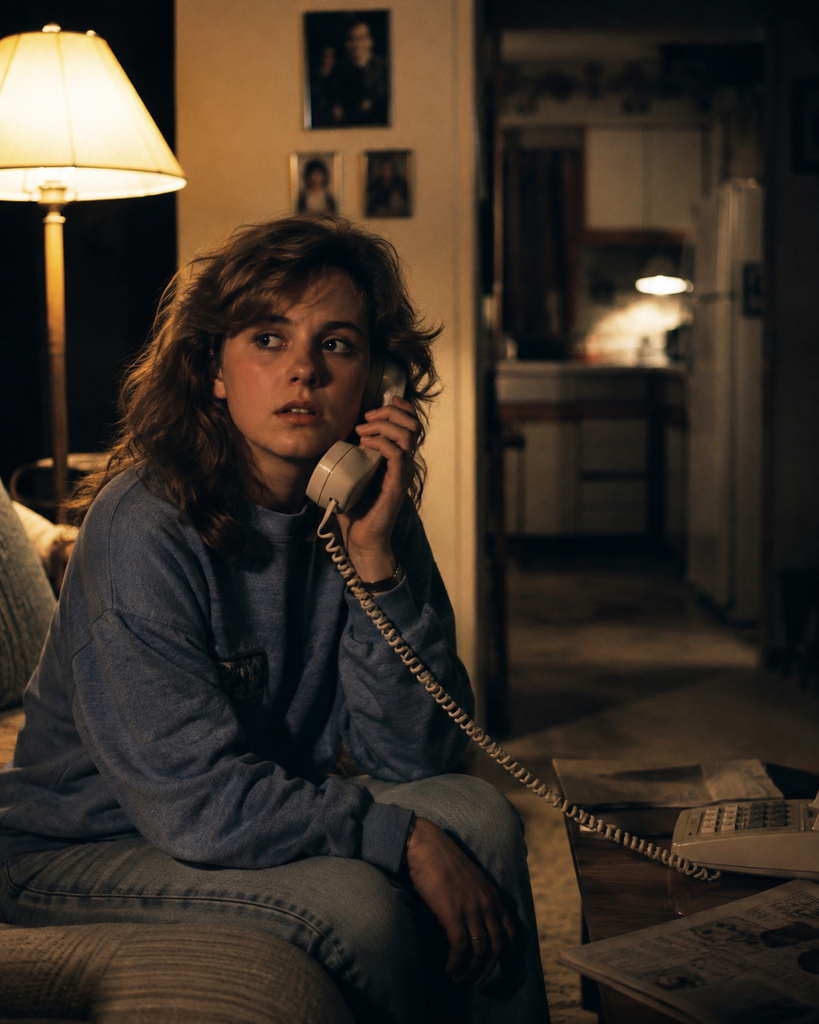
At approximately 1:45 a.m. on October 13, 1984, Ben McCall received a phone call from his girlfriend, 20-year-old Angela “Angie” Samota.
Only about 15 minutes earlier, Angela had stopped by his apartment to say goodnight. According to testimony later presented in court, she had seemed relaxed and playful when she left.
Now something was different.
One of the first things Ben remembered her saying was:
“Talk to me.”
Angela sounded uneasy. There were noises in the background, and after Ben repeatedly asked what was happening, she explained that she had allowed a man into her apartment because he wanted to use the bathroom and the telephone.
At one point, Ben could hear her directing the stranger toward the bathroom. She also asked Ben whether there was a pay phone at a nearby store and relayed that information to the man.
Then Angela told Ben she would call him back.
She never did.
That brief conversation would later become one of the most important pieces in reconstructing the final minutes of her life.
A 20-Year-Old Student With a Promising Future
Angela Samota was a junior at Southern Methodist University in Dallas, Texas. She was studying electrical engineering and computer science and was also working part-time at Texas Instruments.
She belonged to the Zeta Tau Alpha sorority and was remembered by those close to her as outgoing, intelligent and energetic.
One of her closest friends was Sheila Wysocki, a former college roommate who would eventually become central to the effort to reopen Angela’s case.
In October 1984, Angela was dating Ben McCall, who worked in construction. On the evening of October 12, she went out with friends Ana Kadala and Russell Buchanan.
Court records describe stops at Bennigan’s, Studebaker’s and the Rio Room. This is worth noting because some viral retellings of the case claim Angela spent the evening at the State Fair of Texas. The chronology presented in court does not support that version.
After the group separated, Angela drove Ana back and eventually headed home.
Before returning to her own apartment, however, she stopped briefly at Ben’s residence at around 1:30 a.m.
Nothing appeared unusual.
Roughly 15 minutes later, she called him.
The Call That Changed Everything
Ben later testified that Angela opened the conversation with the words “Talk to me.”
She seemed nervous, and he could hear activity in the background.
After he asked what was going on, Angela told him that she had let a man into her apartment so he could use the bathroom and telephone.
This detail is not simply part of an internet legend that developed decades later. It appears in the judicial record of the case.
Ben could hear Angela giving the man directions to the bathroom. She then asked whether a nearby store had a public telephone and passed the information along.
Shortly afterward, Angela said she would call Ben back and ended the call.
When she failed to do so, Ben began calling her.
There was no answer.
He drove toward her apartment while continuing to try to reach her.
Her Phone Was Ringing Inside the Apartment
When Ben arrived, Angela’s car was still outside.
He went upstairs and knocked on her door.
No response.
The front door was locked. The rear entrance was also secured.
Ben called again and could hear Angela’s telephone ringing inside the apartment.
He briefly checked the nearby store they had discussed during the phone call, apparently hoping that Angela or the stranger might be there.
Neither was.
At 2:17 a.m., Ben contacted police.
Police Did Not Break Down the Door
One detail commonly repeated in online versions of the case is that officers forced their way into Angela’s apartment.
Court records describe something different.
Officers arrived at the complex at around 2:40 a.m. Because the apartment was locked and there was not yet an obvious sign from outside that required forced entry, police obtained a key from the property manager.
They entered using that key.
Inside the living room, investigators noticed one of Angela’s black shoes.
The other was in the bedroom.
Angela was there as well.
She had been killed.
What the Autopsy Revealed
Angela had been stabbed 18 times in the chest.
Evidence presented in court showed that all 18 wounds penetrated her left lung, while eight reached her heart. Some of the blows were delivered with enough force to penetrate the sternum.
She also had injuries to her hands that were consistent with defensive wounds.
The investigation further established that she had been sexually assaulted.
Biological material collected during the postmortem examination would eventually become the evidence that solved the case.
But in 1984, forensic science could not extract from that evidence the same level of identifying information available today.
Signs the Attacker May Have Tried to Remove Evidence
Investigators documented several details suggesting that the killer may have attempted to clean up after the attack.
The telephone in the kitchen appeared to have been wiped. Blood was found in the bathtub, and some of the evidence suggested the surface had been wet.
Diluted blood was also found in the kitchen, consistent with the possibility that someone with blood on their hands may have washed them before touching nearby surfaces.
These clues helped investigators understand what may have happened inside the apartment.
They did not tell them who had done it.
The Investigation Focused on People Angela Knew
As is common in homicide investigations, police initially examined the people closest to the victim.
Ben McCall was investigated, but biological testing excluded him as the source of the relevant material collected during Angela’s examination. Searches of his home and vehicle did not produce incriminating evidence.
Police also focused heavily on Russell Buchanan, one of the friends who had been with Angela earlier that night.
The problem was that the forensic methods available in the 1980s were far less discriminating than modern DNA testing.
Certain serological results meant Buchanan could not initially be excluded as a possible source of biological material. That did not mean there was evidence proving he was responsible.
He was never charged.
Investigators examined other men connected to Angela as well.
Eventually, the leads ran out.
The case went cold.
A Friend Who Refused to Let the Case Disappear
Sheila Wysocki never accepted that Angela’s murder should simply remain unsolved.
For years, she continued contacting authorities and asking for the investigation to be revisited.
Her determination eventually went much further than repeated phone calls. Wysocki became a licensed private investigator, partly because she wanted to better understand the investigative system and push more effectively for movement in Angela’s case.
In 2006, she connected with Dallas detective Linda Crum, who worked on cold cases.
That renewed effort led investigators back to the physical evidence preserved from 1984.
Crucially, the biological samples still existed.
Why DNA Changed the Case
It is easy to describe this story by saying that investigators simply “could not test DNA” in 1984, but the reality is more complex.
Forensic laboratories could analyze certain biological characteristics at the time, but those methods were much less powerful for individual identification.
Over the following decades, DNA profiling became vastly more precise. By the 2000s, preserved biological evidence from old cases could sometimes produce genetic profiles capable of distinguishing one individual from virtually everyone else.
Angela’s evidence had survived long enough for that technological shift to matter.
In 2008, investigators obtained a DNA sample from Donald Andrew Bess Jr., who was already incarcerated in Texas.
They compared his profile with the male DNA recovered from the evidence preserved in Angela’s case.
The result transformed the investigation.
An Extremely Rare DNA Profile
According to the judicial record, Donald Bess’s DNA matched the male profile obtained from the biological evidence.
An expert estimated the frequency of that profile at roughly one in 2.69 quadrillion within the relevant reference population.
That figure requires careful interpretation.
It does not mean there was a “one in 2.69 quadrillion chance that Bess was innocent,” nor does it directly measure his probability of guilt.
In forensic genetics, such a statistic describes how unusual it would be for a randomly selected unrelated individual from the relevant population to share the same genetic profile.
DNA evidence is then considered together with the rest of the circumstances in a case.
Here, the genetic evidence placed Bess in direct connection with biological material collected from Angela after the assault.
In May 2008, prosecutors charged him with her murder.
Nearly 24 years after Angela’s death, investigators finally had a suspect they could scientifically link to the crime.
Who Was Donald Bess?
Donald Andrew Bess was 36 years old when Angela was murdered.
He already had a serious criminal history involving sexual and violent offenses.
He had been released on parole in March 1984, approximately seven months before Angela’s death.
He later returned to prison following another sexual assault.
By the time investigators connected him to Angela’s case through DNA in 2008, he was already serving a life sentence.
One major question, however, has never been fully answered.
How did Bess come into contact with Angela that night?
There is no definitive evidence showing whether he had seen her earlier, followed her, approached her randomly or arrived at her apartment under some other circumstance.
There is also no indication that Angela knew who he was.
What is established is what Angela herself told Ben during the final phone call: a man was inside her apartment after she had allowed him in to use the bathroom and telephone.
A Window of Only About 30 Minutes
The timeline makes the case especially unsettling.
Angela was at Ben’s apartment at approximately 1:30 a.m.
At around 1:45, she called him from her own home and told him a man was inside.
At 2:17, Ben called police.
That leaves a remarkably narrow period in which the assault and murder occurred.
The events that changed several lives unfolded within only a few dozen minutes.
Donald Bess Goes on Trial
Bess was tried in 2010.
DNA evidence was central to the prosecution, but jurors also heard the broader context of the case: Angela’s final phone call, the timeline, the medical evidence, the preserved biological samples and the circumstances surrounding Bess’s identification.
He was convicted of capital murder and sentenced to death.
Bess challenged the conviction, but the verdict and sentence were upheld on appeal.
He Was Never Executed
Donald Bess remained on death row in Texas, but his execution never took place.
He died in custody in October 2022 at the age of 74. Local reporting said he suffered cardiac arrest, while prison authorities described the death as resulting from natural causes.
Angela Samota would have been 58 years old that year.
What the Viral Story Gets Right — and What It Changes
The social-media version of Angela Samota’s story is based on a real case, and some of its most disturbing details are authentic.
Angela really did call Ben and tell him there was a man in her apartment who wanted to use the bathroom and telephone.
She really did begin the conversation by telling him, “Talk to me.”
And she really did say she would call him back.
Those details are supported by Ben McCall’s testimony in the court record.
Other elements frequently repeated online are less accurate.
The judicial chronology does not place Angela at the State Fair of Texas that night, despite the claim appearing in some viral posts.
Police also did not smash down her apartment door. They entered using a key obtained from the property manager.
Most importantly, the exact circumstances that brought Donald Bess to Angela’s door remain unknown.
The final phone call tells us that he was inside her apartment.
It does not tell us how he found her.
When Time Helped Solve a Murder
Time usually works against investigators.
Memories fade, witnesses disappear, evidence deteriorates and unsolved cases become progressively harder to resolve.
Angela Samota’s case demonstrates the opposite possibility as well.
Evidence collected in 1984 survived long enough for advances in forensic genetics to reveal information that investigators at the time could not obtain.
But technology alone did not reopen the evidence box.
Sheila Wysocki continued asking questions long after the original investigation stalled. Detective Linda Crum revisited the preserved evidence. Modern DNA analysis finally provided the link that had been missing for decades.
That is why Angela Samota’s case is more than the story of a murderer identified nearly a quarter of a century later.
It is also the story of a young woman who sensed that something was wrong and, in those final uncertain minutes, reached for a person she trusted.
At 1:45 in the morning, Angela Samota called her boyfriend and said:
“Talk to me.”
It would take almost 24 years before investigators could finally identify the man who had been standing inside her apartment.