
We went to the park with the kids, a typical afternoon—sunshine, fresh air, a few hours of running around. At one point, the “park footballer” nonchalantly kicked a ball… right in front of my child. My child started crying immediately. Maybe it wasn’t intentional, but for them, it was a wound. I got upset because I could see that vulnerability from a mile away: what’s “just a game” for some can hurt deeply for others.
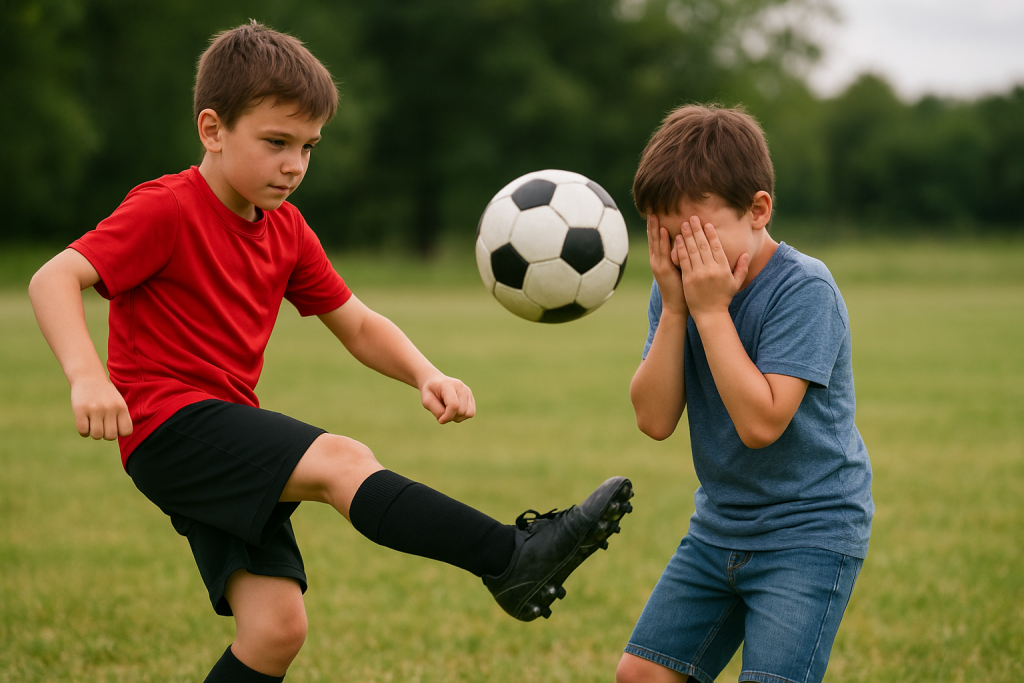
I went to the mother of the child who kicked the ball to talk calmly, clarify, ask for a “let’s cooperate” approach, and resolve the situation. But her question left me speechless:
“But what did your child do to make mine kick the ball at them?”That question showed me that, unconsciously, she was looking for a justification for her child’s behavior.
The reaction of the child who got hurt is completely natural: children experience what happens to them intensely and don’t yet have the cognitive or social filters to minimize minor aggressions. Crying and withdrawing are signs of vulnerability and the need for validation. On the parental level, the mother’s question is a form of rationalization and projection: the parent tries to reduce the conflict between their image as a “good parent” and their child’s action.
In contrast, parents who react responsibly and clearly (for example, calling immediately, taking concrete steps) convey values of empathy, accountability, and self-control to both their child and the community.
That question reminded me that it’s not just the adult eyes that observe these scenes, but also the mindset that justifies minor aggression: “What? They’re just kids, it’s normal.” I’ve met parents who respond like this, or say, “I’ll talk to them at home and call you back.” And even if it sounds good, often nothing actually happens.
Then there are parents who react differently—I remember when I found out that a classmate was instigating other kids to say that mine was making noises during class. I called the child’s father and explained the situation. He replied immediately: “I don’t raise my child that way. I’ll talk to them now, and I promise it will stop.” And it did: he spoke directly with the child, and the problem was resolved.
Between these three reactions—denial/justification, empty promises, and responsible intervention—lie my sleepless thoughts. My natural reflex, my instinct, is to invite the child into a discussion, either face-to-face or on the phone, so the other parent can see that I’m not hiding anything, that I’m not trying to shield the child from consequences. I don’t call them to humiliate, but to make the situation clear and ensure the lesson is transparent.
And I ask myself honestly: am I wrong to do this? Some parents may see this confrontation as harsh or humiliating, but for me, it’s a way to demonstrate responsibility and teach the child what it means to acknowledge mistakes.
Calling the child into a discussion, in front of another parent or even by phone, isn’t humiliation—it’s a strategy of transparency and social accountability. It helps the child understand the consequences of their behavior and develop moral courage. Without this transparency, vague promises or minimization of actions can lead to neglecting empathy and perpetuating problematic behavior.
So, what do we actually do when faced with these situations?
- Calm your child. Immediate comfort is the priority. Listen, soothe, and don’t minimize the crying.
- Gather information calmly. Talk to witnesses or the other child without accusations: “What happened?”
- Approach the parent calmly. State the facts and invite dialogue with the children present. The goal: clarity and accountability, not blame.
- Invite the child into the discussion for transparency. Explain that it’s not humiliation but a desire to understand what happened and to show the other parent that nothing is hidden.
- If the parent minimizes, ask for a concrete action. “Can we make sure they apologize or that it doesn’t happen again?”
- Educate your child at home. Set limits, teach empathy, and how to stay safe.
- If the situation repeats, escalate. School, playground, community. Repeated neglect becomes a real problem.
In the end, the question for all parents (and for myself) remains: do you want your child to grow up in a community where mistakes are hidden and justified, or in one where they are acknowledged, corrected, and learned from? I choose the second. It’s better to err while trying to make things right than to remain indifferent.