
There are places we walk through every day without realizing that, just a few centimeters below the surface, an entire world is quietly unfolding. It makes no noise, leaves almost no visible trace, and follows its own rhythm, completely independent of ours. In one such place, researchers documented a phenomenon that reshapes how we think about even the most ordinary green spaces.
At East Lawn Cemetery, spring doesn’t begin only with grass and flowers. At the same time, thousands of bees emerge from the soil, turning a calm landscape into a highly active ecosystem that most people would never notice unless they knew exactly where to look.
Not a colony, but an extraordinary concentration
What scientists from Cornell University observed here is not a colony in the traditional sense, but a dense aggregation of solitary bees, primarily from the genus Andrena, often called mining bees. The distinction matters. These insects do not have a queen, they do not divide labor, and they do not build shared structures. Each individual operates entirely on its own.
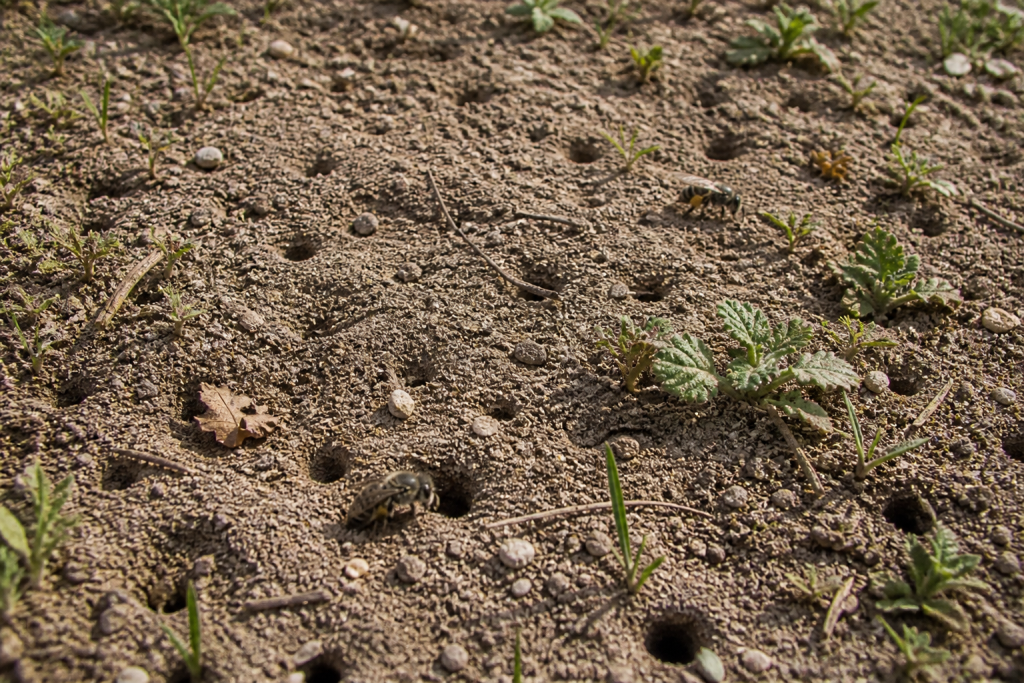
And yet, the collective effect is striking. Across a relatively small area, the ground becomes dotted with an immense number of tiny openings. Seen up close, the surface can look almost perforated, as if punctured thousands of times. Each opening marks the entrance to a tunnel dug by a single female.
Numbers that are hard to picture
Based on nesting density, researchers estimate that hundreds of thousands of active burrows can exist within roughly 1.5 acres. When you factor in the full life cycle—eggs, larvae, emerging adults—the total number of individuals associated with the site can reach into the millions during a single season.
The key nuance is that this is not a coordinated population. There is no shared structure or collective behavior. Instead, it is the outcome of countless independent choices that all point to the same location, simply because the conditions are right.
Why so many choose the same place
Solitary bees are far more selective than they appear. They favor well-drained, sandy or loose soils, areas with good sun exposure, and environments that remain relatively undisturbed over time. Urban green spaces that are not heavily altered can provide exactly these conditions.
Some species are known to return to the same sites year after year. This isn’t due to memory in a human sense, but rather because the environmental signals remain consistent: soil composition, temperature, moisture, and nearby food sources all continue to align with their needs. Over time, this leads to repeated use of the same habitat.
Life underground: precise and self-contained
Each female constructs a tunnel that can extend several tens of centimeters into the soil, sometimes deeper depending on the species and ground structure. From this main shaft, she creates small side chambers, each intended for a single egg.
Inside every chamber, she deposits a carefully measured supply of food—a mixture of pollen and nectar—sufficient for the larva to develop on its own. Once the egg is laid and provisioned, the rest of the life cycle unfolds quietly underground, often over many months. In some cases, the new adults remain dormant until the following favorable season.
A lesser-known detail is that males typically emerge earlier in spring and wait for females to appear. Their lifespan is short, while females carry the full responsibility of building nests and ensuring the next generation.
What they look like—and how they behave around people
Most of these bees are smaller than, or roughly comparable in size to, Apis mellifera, the well-known honey bee. They generally range between about 6 and 15 millimeters in length, with appearances that vary from dark and subtle to slightly more colorful, sometimes with a soft, fuzzy texture.
They do have a stinger, but their behavior is very different from social bees. Females are capable of stinging, yet they are notably non-aggressive and will typically do so only if directly handled or threatened. Because they do not defend a hive or a colony, they lack the strong defensive instinct associated with honey bees.
Another important difference is that they do not die after stinging. Unlike honey bees, whose barbed stingers can become lodged in the skin of mammals, solitary bees have smoother stingers that allow them to withdraw without fatal injury. In everyday situations, however, the likelihood of being stung by one is extremely low.
A role far greater than it seems
Even though they do not produce honey and do not live in colonies, these bees are highly effective pollinators. Some species within the genus Andrena are specialized to visit particular types of plants, making them essential for those plants’ reproduction.
Their way of collecting and transferring pollen differs from that of honey bees, and in certain contexts, this makes them even more efficient. A site that supports such a large number of individuals is not just unusual—it is a sign of a functioning, balanced ecosystem.
Why these stories are often simplified
Online, phenomena like this are frequently described as “bee cities,” a metaphor that helps people visualize the scale but can be misleading. There is no central organization, no shared infrastructure, and no coordinated system behind it.
Even so, the reality does not need exaggeration to be impressive. Millions of independent insects converging on the same location, simply because it meets their biological needs, is remarkable in its own right.
What this really reveals
Perhaps the most compelling takeaway is not the size of the population, but the fact that such systems exist unnoticed. A place that appears quiet and static on the surface can conceal a complex, active network just beneath it.
Nature does not always present itself in obvious ways. Sometimes its most intricate processes happen out of sight, quietly sustaining the balance of life in places we rarely think to look.