
What if a damaged spinal disc could be treated without replacing it or surgically removing part of it?
The idea sounds remarkably simple. A physician guides a needle into the affected disc and injects a biological material designed to reach small defects in the tissue and seal them. The material could potentially provide a temporary framework for healing while helping to contain the damaged area.
On social media, the concept has acquired a much catchier description: a biological glue for damaged spinal discs.
It sounds futuristic, but the science behind the idea is real.
The material is fibrin, a substance our bodies naturally use during blood clotting and wound repair. Fibrin-based sealants are already used in medicine, and researchers have investigated injecting fibrin into human intervertebral discs.
What remains uncertain is the most exciting part of the claim.
Being able to place fibrin inside a damaged disc is one thing. Demonstrating that it can actually repair or regenerate that disc is something very different.
And when researchers tried to answer that second question with better-controlled clinical trials, the story became considerably more complicated.
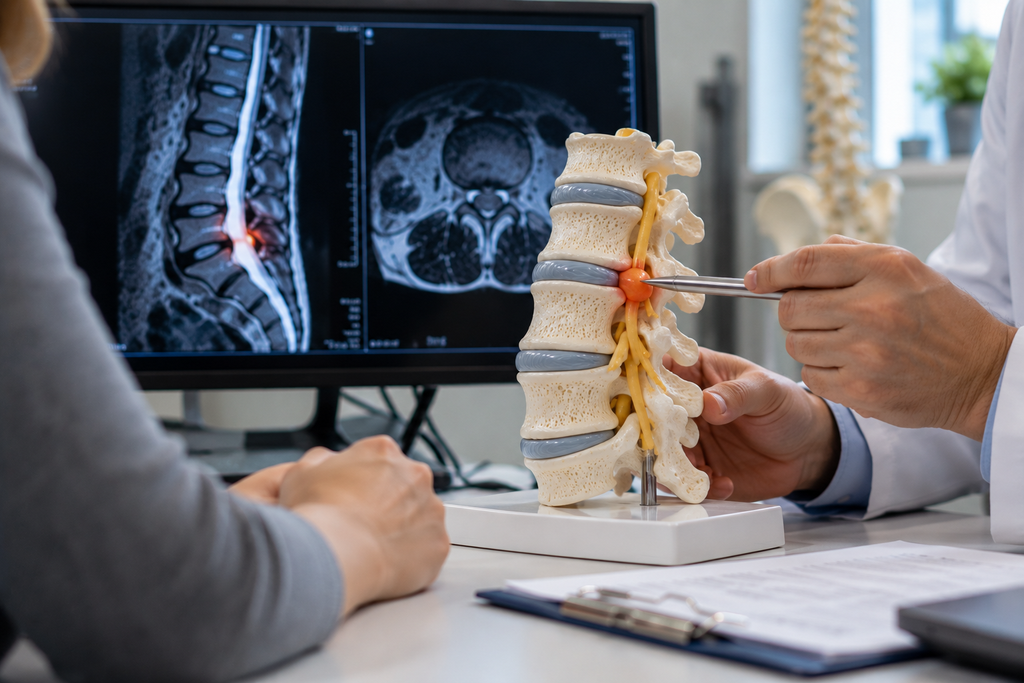
Fibrin isn’t an experimental substance invented for the spine
Whenever we are injured and begin to bleed, the body activates a complex sequence of reactions that eventually converts soluble fibrinogen into fibrin.
Fibrin molecules form a mesh that helps stabilize a blood clot. This temporary framework also plays a role in the body’s response to tissue injury.
Medicine has taken advantage of these properties through products known as fibrin sealants.
The U.S. Food and Drug Administration has approved several fibrin-based products for specific medical uses. TISSEEL, for example, is used as an adjunct to hemostasis in certain surgical situations when conventional techniques are ineffective or impractical. Its official prescribing information specifies particular indications and methods of use.
That distinction is important.
When someone says that “fibrin is FDA approved,” it can create the impression that every medical application involving fibrin has also been approved and clinically validated.
It hasn’t.
Approval of a fibrin sealant for particular surgical indications does not, by itself, establish that injecting fibrin into an intervertebral disc is an effective treatment for chronic back pain or disc regeneration.
Why would anyone want to glue a spinal disc in the first place?
The word “disc” makes the structure sound simpler than it really is.
An intervertebral disc contains a hydrated inner region known as the nucleus pulposus, surrounded by a tough, layered structure called the annulus fibrosus.
Damage can occur within that outer ring. Tears and defects may develop, and in a herniated disc, material from inside the disc can move through a defect and potentially irritate or compress nearby nerves.
Researchers have therefore spent years investigating whether defects in the annulus could be repaired.
The approaches being explored range from sutures and mechanical closure devices to hydrogels, scaffolds and biological materials.
Fibrin belongs to that last category.
A review of clinical research on annulus fibrosus repair that included studies available through July 2025 identified 62 eligible clinical studies. Most involved mechanical devices or suturing techniques, while only three evaluated biomaterial approaches, including fibrin. The authors described biomaterials as promising but emphasized limitations such as small studies and insufficient long-term evidence.
So the idea of repairing the outer structure of a disc is not pseudoscience.
The real question is whether the particular method actually works in people.
A tiny human study produced remarkably encouraging results
One of the early studies that helped generate interest involved just 15 adults with chronic discogenic lower-back pain.
They received an intradiscal injection of a product called BIOSTAT BIOLOGX Fibrin Sealant.
The results looked impressive.
Before treatment, the participants’ average lower-back pain score on a 0–100 visual analogue scale was 72.4.
At 26 weeks, it had fallen to 31.7.
Average scores remained substantially below baseline during later follow-up, measuring 35.4 at 52 weeks and approximately 33 at 104 weeks. Measures of disability also improved.
It is easy to understand why results like these generate excitement.
A group of people with chronic back pain received an injection, and months later they reported dramatically less pain.
But there was a major problem.
There were only 15 participants, and there was no control group.
The study could tell researchers that patients improved after receiving the treatment.
It couldn’t establish that they improved because of the fibrin.
That requires a different kind of experiment.
When researchers performed the more rigorous test, the picture changed
A larger randomized study subsequently enrolled 220 participants.
This time, 164 participants received fibrin while 56 received an intradiscal saline injection.
Now researchers had something critically important: a comparison group.
If fibrin itself was producing a substantial therapeutic effect, outcomes should have been meaningfully better among patients who received fibrin than among those who underwent the control procedure.
That isn’t what happened.
At 26 weeks, the trial failed to demonstrate a statistically significant advantage for fibrin on its primary composite outcome. The study was stopped for lack of efficacy.
One secondary result is particularly revealing.
About 42.1% of participants receiving fibrin experienced at least a 30% reduction in pain.
That sounds encouraging until we look at the control group.
There, 50% of participants receiving saline achieved the same level of pain reduction.
The difference was not statistically significant.
This doesn’t mean saline injections regenerate spinal discs.
It means the trial did not show that fibrin provided the additional benefit that would be necessary to attribute the improvement specifically to fibrin.
And it illustrates one of the most important principles in clinical research.
“I felt better after the treatment” and “the treatment made me better” are not the same claim
Patient experiences matter enormously in medicine, but they cannot answer every scientific question.
Imagine someone who has lived with severe back pain for years. They undergo a procedure, and six months later their pain is dramatically better.
Their improvement is real.
But what caused it?
Chronic pain can fluctuate. Other treatments may be occurring at the same time. Patients often seek a new intervention when their symptoms are particularly severe, and some symptoms may subsequently move back toward their usual level. The procedure itself can also produce nonspecific effects.
This is why researchers use randomized control groups.
Suppose 100 people receive an experimental treatment and 50 subsequently improve. Without a comparison group, a 50% response rate can look extraordinary.
But suppose a comparable group receives the same type of procedure without the experimental ingredient and 50% of those patients improve as well.
The meaning of the first result changes completely.
This is also why patient testimonials, however sincere, cannot substitute for controlled clinical trials.
What about Discseel?
Another fibrin-based approach is marketed under the name Discseel and involves intra-annular fibrin administration.
An observational study followed 827 people with chronic lower-back pain, including patients who had already undergone other treatments.
Improvements were reported.
Average lower-back pain scores declined from 5.8 before treatment to 3.7 at six months, 3.6 at one year, 3.5 at two years and 3.4 at three years.
Again, those numbers are interesting.
But again, study design matters.
There was no randomized control group, and follow-up data had important limitations.
A systematic evidence review conducted for the U.S. Department of Veterans Affairs consequently judged the evidence concerning Discseel’s effects on pain, disability, quality of life and adverse events to be very uncertain.
That does not prove the procedure is ineffective.
It means something more precise: the available evidence cannot reliably tell us how much of the observed improvement was caused by the treatment itself.
An independent evidence review put the research into perspective
In 2025, the U.S. Department of Veterans Affairs Evidence Synthesis Program published a systematic review specifically examining fibrin intervertebral injections for back and neck pain.
For BIOSTAT BIOLOGX, the randomized trial involving 220 participants did not demonstrate improvements in pain or pain interference compared with saline.
For Discseel, the available evidence came from an uncontrolled observational study, leaving substantial uncertainty about both benefits and harms.
The reviewers concluded that large, randomized, double-blind trials are needed to determine the efficacy of these treatments with greater confidence.
This context rarely fits into a short social-media video.
But without it, an experimental idea can very easily begin to look like an established regenerative treatment.
Sealing a crack isn’t necessarily the same as regenerating a disc
There is another problem with the “biological glue” analogy.
It encourages us to picture a spinal disc like a cracked object: find the crack, apply glue, seal it, and the object is repaired.
A degenerating disc is much more complicated.
Disc degeneration can involve changes in the extracellular matrix, loss of proteoglycans and water, altered cellular behavior, inflammation and changes in the mechanical properties of the tissue.
An annular defect may be only one component of that process.
Even if researchers eventually demonstrate that a biomaterial can reliably seal such a defect, another question remains:
Has the disc actually regenerated?
Reducing pain is not the same outcome as restoring disc tissue.
Sealing an annular defect is not necessarily the same as reversing degeneration.
And an improvement on a pain questionnaire does not, by itself, prove that a previously damaged disc has become biologically healthy again.
Demonstrating genuine regeneration would require convincing evidence that important aspects of the disc’s structure and function had been restored.
Research into annulus fibrosus repair and regenerative biomaterials continues, but clinical evidence for these biological approaches remains much more limited than the dramatic phrase “disc regeneration” might suggest.
“Biological” doesn’t mean risk-free
There is another detail that can disappear when a treatment is described simply as natural or biological.
Getting fibrin into an intervertebral disc requires an invasive procedure.
In the original 15-person pilot study, adverse events were reported in nine participants. Two episodes of lower-back muscle spasm and one case of discitis were considered related to the procedure or product.
Discitis is inflammation of an intervertebral disc and may be associated with infection, so it isn’t a trivial complication.
The larger randomized trial reported serious adverse events in both the fibrin and saline groups without a statistically significant difference between them. The existing evidence therefore doesn’t justify portraying fibrin as uniquely dangerous, but neither does the word “biological” make an intradiscal procedure inherently harmless.
What should patients ask when they encounter treatments like this?
The most useful question may not be, “Does fibrin work?”
It is more specific:
Exactly what product and procedure are being proposed, and what is that product authorized to do?
A statement such as “fibrin is FDA approved” isn’t enough. Medical products receive authorization for defined indications and methods of use. Approval somewhere in medicine isn’t proof that every other application of the same material has been validated.
Another important question is whether there is a randomized controlled trial of the specific procedure being offered, rather than studies of fibrin generally or of a different technique.
Patients should also ask what clinics mean when they describe a procedure as successful.
Does success mean less pain?
Better physical function?
Avoiding surgery?
A visible change on MRI?
Or actual biological regeneration of the disc?
Those outcomes are not interchangeable.
Finally, any proposed intervention has to be considered alongside its alternatives, because a compelling animation showing fibrin filling a tear cannot determine whether that procedure is appropriate for the particular cause of one person’s back pain.
So is the viral “biological glue” claim true?
The most accurate answer isn’t simply yes or no.
Fibrin is real. Fibrin sealants are real medical products. Their adhesive properties are real. Fibrin has been injected into spinal discs in human clinical research, and some patients have reported substantial improvements afterward.
The leap occurs when those facts are turned into the conclusion that doctors can now inject fibrin and regenerate damaged human spinal discs.
Current clinical evidence does not establish that.
Most importantly, when BIOSTAT BIOLOGX was tested in a randomized trial involving 220 participants, fibrin failed to demonstrate superiority over saline on the primary outcome, and the trial was stopped for lack of efficacy.
Discseel has produced observational results that justify further investigation, but the independent Veterans Affairs review rated the available evidence as highly uncertain.
The real breakthrough may still be ahead
None of this makes the underlying idea uninteresting.
Quite the opposite.
One of the ambitions of regenerative medicine is to move beyond treating the consequences of damaged tissue and find ways of restoring the tissue itself. Researchers are exploring biomaterials, hydrogels, scaffolds, cells and other strategies that might eventually make biological disc repair possible.
Fibrin may ultimately have a role in such a treatment. It may work better in combination with other materials or biological components. Another technology may eventually accomplish what researchers hoped fibrin could do on its own.
We simply don’t know yet.
And that may be the most interesting lesson behind the viral videos.
Some medical claims online aren’t fabricated. Instead, they take a genuine scientific idea and move the conclusion several steps ahead of the evidence.
The concept of a biological glue for spinal discs is a near-perfect example.
The research is real. The biological rationale is fascinating. The possibility deserves further study.
But there is still an important distance between “this could help repair a disc” and “we have demonstrated that it does.”