
In the summer of 1895, crowds gathered at Coney Island to experience what was being advertised as one of the most daring attractions ever built. It was called Flip Flap Railway, and it featured something no amusement ride had attempted before—a full vertical loop.
The ride quickly became famous, but not entirely for the reasons its creators had hoped. Many passengers stepped off complaining of severe neck pain, dizziness, and lingering discomfort. Engineers eventually realized that speed itself wasn’t the real problem. The human body was reacting to the way acceleration was being applied.
That lesson would reshape roller coaster engineering forever.
More than a century later, the same question still resurfaces whenever a tragic incident makes headlines: Can a roller coaster actually kill someone through G-forces alone?
The answer, according to decades of engineering research and medical evidence, is far more nuanced than many people assume.
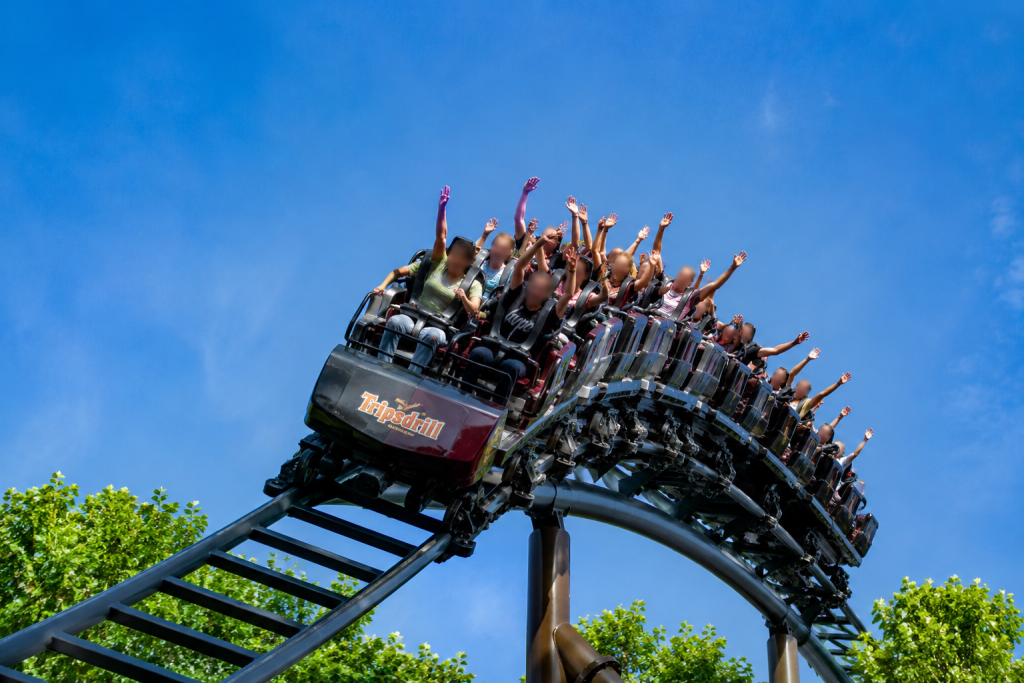
When Early Roller Coasters Pushed Human Limits
The first generation of roller coasters was built during an era of experimentation. Designers had little understanding of biomechanics, no computer simulations, and few safety standards. They learned largely through trial and error.
Flip Flap Railway became one of the best-known examples of those early mistakes. Unlike modern roller coasters, its loop was perfectly circular. As the train entered the bottom of the loop, riders experienced an abrupt surge in acceleration. Modern analyses estimate that passengers were exposed to roughly 6 to 8 Gs—enough to cause significant discomfort and, in some cases, minor injuries.
The problem wasn’t simply how fast the train traveled. It was how quickly the human body was forced to change direction.
Engineers responded by abandoning circular loops in favor of the teardrop-shaped loops still used today. This new design spreads acceleration more gradually throughout the maneuver, dramatically reducing stress on the body while preserving the thrill of the ride.
It remains one of the most important breakthroughs in roller coaster safety.
What Are G-Forces, Really?
People often describe the sensation on a roller coaster as being caused by “centrifugal force,” but engineers measure these effects in G-forces, which represent acceleration relative to Earth’s gravity.
Simply standing on the ground exposes every person to 1 G. Modern roller coasters typically generate between 3 and 5 Gs, but only for brief moments lasting a few seconds.
For comparison, fighter pilots may experience 7 to 9 Gs during combat maneuvers, relying on specialized flight suits and training techniques to keep enough blood flowing to the brain. When acceleration becomes both intense and prolonged, blood can pool in the lower body, reducing oxygen delivery to the brain and eventually causing a temporary loss of consciousness.
That distinction is crucial. The human body can tolerate relatively high G-forces for very short periods, but maintaining those forces for much longer is an entirely different physiological challenge.
What Science Has Found
In the early 2000s, several reports of strokes and brain hemorrhages occurring after roller coaster rides raised concerns about whether these attractions might pose hidden neurological risks.
Researchers at the University of Pennsylvania set out to investigate. By measuring the accelerations produced by modern roller coasters and analyzing the resulting motion of the head and neck, they compared the data with known injury thresholds.
Their findings were reassuring. While riders certainly experience powerful sensations, the measured forces remained well below the levels associated with traumatic brain injuries in healthy individuals.
The researchers also emphasized an important point that is often overlooked: G-force alone is not what determines injury risk. Direction of movement, rotational acceleration, exposure time, and the rider’s underlying health all play significant roles.
Why Have People Died After Riding Roller Coasters?
This is where public perception often differs from medical reality.
Over the years, a small number of people have suffered strokes, brain hemorrhages, heart attacks, or other medical emergencies shortly after leaving a roller coaster. In many news reports, the ride itself appeared to be the obvious cause.
Subsequent medical investigations frequently told a different story.
Many of the individuals involved were found to have previously undiagnosed conditions, including cerebral aneurysms, vascular malformations, or serious cardiovascular disease. In such cases, the intense physical and emotional stress of the ride may have acted as a trigger rather than the underlying cause of the medical event.
Other fatalities associated with roller coasters have resulted from entirely different circumstances, including mechanical failures, riders being ejected from trains, or violations of established safety procedures.
The Attraction That Sparked Global Debate
One of the most widely discussed cases involved Mission: SPACE at Disney.
Unlike a traditional roller coaster, the attraction uses large centrifuges to simulate the forces experienced during a spacecraft launch, exposing riders to approximately 2.5 Gs.
After two separate visitors died following the experience, the attraction received worldwide media attention. Medical investigations, however, concluded that both individuals had significant pre-existing health conditions that contributed to their deaths.
The incidents nevertheless prompted Disney to introduce a less intense version of the attraction and strengthen its medical warnings for guests.
The Roller Coaster Designed to Be Fatal
Perhaps the best-known example of a ride intended to kill through G-forces is the Euthanasia Coaster, a conceptual design created by Lithuanian designer Julijonas Urbonas.
The proposal envisions riders experiencing approximately 10 Gs for nearly a minute—long enough to deprive the brain of adequate blood flow and oxygen. According to the concept, passengers would lose consciousness before dying from cerebral hypoxia.
Despite its popularity online, the Euthanasia Coaster has never been built. It was conceived as an artistic and philosophical exploration of technology, ethics, and mortality rather than as an actual amusement ride.
Its existence has nevertheless fueled the misconception that ordinary roller coasters expose riders to comparable forces, which they do not.
What More Than a Century of Experience Has Taught Us
Ironically, it was the shortcomings of the earliest roller coasters that ultimately made modern ones far safer.
Every curve, loop, and drop on today’s rides is carefully engineered to keep acceleration within limits considered safe for the vast majority of healthy riders. Modern computer simulations, structural testing, and decades of biomechanical research have replaced the trial-and-error approach that characterized the industry’s earliest years.
This is also why investigators rarely assume that G-forces alone are responsible when a fatal incident occurs. Instead, they examine medical history, mechanical performance, operational procedures, and every other factor that may have contributed.
After more than a century of engineering advances and countless millions of rides worldwide, the evidence points to a consistent conclusion: for a healthy person, a properly designed and maintained modern roller coaster is not expected to produce G-forces capable of causing death on their own.
The real risks almost always lie elsewhere—in hidden medical conditions, equipment failures, or situations that fall outside the normal operation of the ride itself.