
A homemade drink is making the rounds on social media with an extraordinary promise: mix a few inexpensive ingredients into water and you may be able to run for far longer without feeling tired.
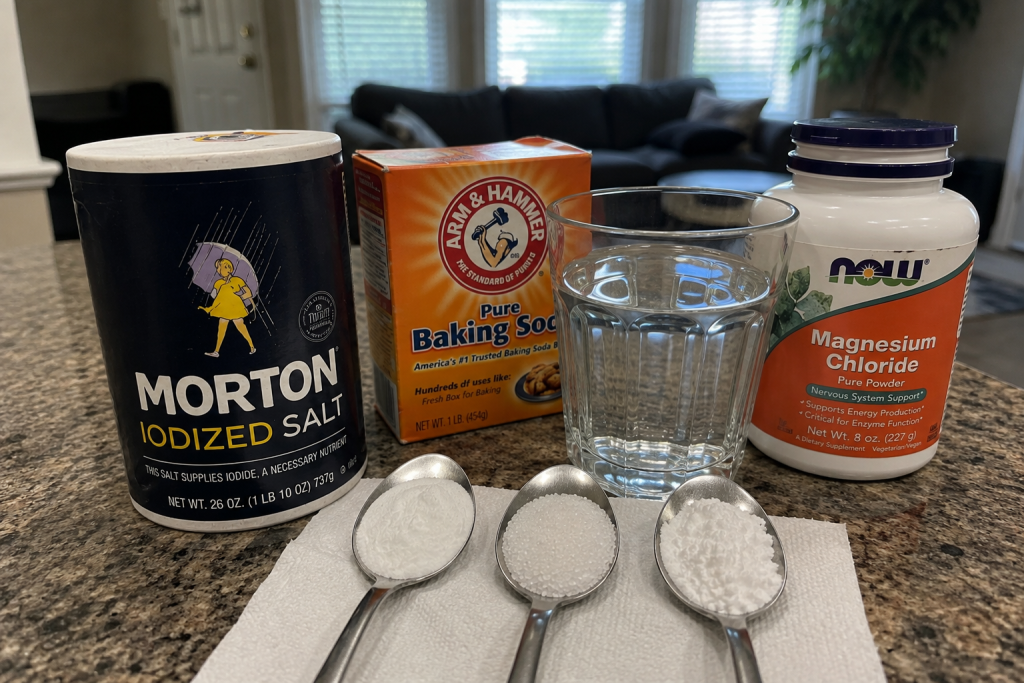
The recipe usually combines baking soda, table salt and magnesium chloride. None of these ingredients is particularly exotic, and all three have legitimate physiological roles. That makes the claim sound surprisingly plausible.
There is, however, a considerable difference between saying that certain minerals or compounds can influence exercise performance and claiming that one drink can somehow switch off fatigue.
Sports science tells a much more interesting story.
Why the idea sounds scientifically convincing
The viral recipe typically calls for roughly half a teaspoon of baking soda, a teaspoon of salt and around 1.5 grams of magnesium chloride mixed with water.
At first glance, the combination seems logical. Sodium is an important electrolyte. Magnesium contributes to normal muscle and nerve function. Sodium bicarbonate has even been studied as an ergogenic aid — a substance capable of improving athletic performance under particular circumstances.
But endurance is not controlled by a single chemical reaction.
Fatigue during exercise can involve declining carbohydrate availability, changes in muscle metabolism, rising body temperature, fluid loss, cardiovascular strain and signals coming from both the muscles and the central nervous system.
A glass of mineral-rich water cannot simply override all of those processes.
Baking soda actually has a place in sports science
This is where the viral claim becomes particularly interesting, because sodium bicarbonate isn’t pseudoscience.
Bicarbonate helps regulate acid-base balance. During very intense exercise, changes associated with hydrogen-ion accumulation contribute to declining muscular performance. Increasing extracellular bicarbonate availability can improve the body’s buffering capacity.
Researchers have therefore investigated sodium bicarbonate supplementation for decades.
Evidence suggests that appropriately dosed sodium bicarbonate can provide a small but meaningful performance benefit during certain forms of high-intensity exercise. This is one reason it occasionally appears in the supplementation strategies of competitive athletes.
That does not mean that adding an arbitrary spoonful to water produces the same effect.
Research protocols generally use doses calculated according to body weight and carefully consider when the bicarbonate is consumed. Individual responses also vary considerably.
And there is a rather inconvenient side effect.
The performance boost can come with an unhappy stomach
Sodium bicarbonate is notorious in sports nutrition for causing gastrointestinal problems.
Depending on the dose and the individual, it can lead to bloating, abdominal pain, nausea, vomiting or diarrhea.
For an athlete preparing to race, an intervention that theoretically improves performance but causes urgent gastrointestinal symptoms clearly isn’t much of an advantage.
This is why athletes who use bicarbonate supplementation typically experiment with it during training rather than trying it for the first time immediately before an important event.
It also illustrates the problem with copying sports-nutrition strategies from short social-media videos: the dose, timing and individual tolerance matter just as much as the ingredient itself.
What about the teaspoon of salt?
Salt introduces another element of truth.
We lose sodium through sweat, and replacing sodium can become important during prolonged exercise, particularly when someone is sweating heavily or exercising for hours in hot conditions.
But more sodium is not automatically better.
A level teaspoon of ordinary table salt contains roughly 2,300 milligrams of sodium. That’s a substantial amount to consume in a single homemade drink and roughly comparable to the commonly cited daily sodium limit in US dietary guidance.
An athlete completing a long endurance event under demanding conditions has very different hydration requirements from someone jogging around the neighborhood for half an hour.
For many recreational workouts, drinking large quantities of additional salt simply isn’t necessary.
Magnesium is essential, but that doesn’t make it an instant performance enhancer
Magnesium is involved in numerous biological processes, including energy metabolism, muscle contraction and normal nerve function.
A genuine magnesium deficiency can interfere with normal physiological function. Correcting a deficiency therefore matters.
The leap made in many viral wellness claims is assuming that because a nutrient is essential, taking extra must improve performance.
Human physiology doesn’t work that way.
If someone’s magnesium status is already adequate, consuming additional magnesium immediately before exercise hasn’t been shown to magically unlock extra endurance.
Magnesium supplements can also cause gastrointestinal symptoms, particularly at higher supplemental doses. Depending on the formulation and quantity, diarrhea can become an unwanted side effect.
Combining magnesium with bicarbonate immediately before running could therefore produce a memorable workout for entirely the wrong reason.
Why might someone genuinely feel better after drinking it?
Personal testimonials shouldn’t necessarily be dismissed as fabricated.
Someone can drink a homemade electrolyte mixture and genuinely feel better afterward without the drink possessing extraordinary endurance-enhancing properties.
Imagine exercising outdoors on a hot day, sweating heavily and starting the session slightly dehydrated. Drinking water and replacing some electrolytes could improve how that person feels.
That is basic hydration physiology rather than evidence of a secret athletic formula.
Expectation may also influence perceived effort. The placebo effect has been documented in sports research: believing that an intervention will improve performance can sometimes alter how difficult exercise feels or even influence measurable performance.
A convincing personal experience therefore isn’t the same thing as proof that a recipe works universally.
Sports drinks aren’t simply expensive salt water
This also raises an obvious question: if athletes need fluids, sodium and other nutrients, why not make a concentrated electrolyte mixture at home?
Because properly formulated sports drinks are designed around specific concentrations.
Depending on their intended purpose, they can contain water, sodium and carbohydrates in proportions intended to support hydration and fuel prolonged exercise. During longer endurance events, carbohydrates become particularly important because maintaining carbohydrate availability can help sustain performance.
Simply adding large amounts of salt and minerals to water doesn’t reproduce that formulation.
For ordinary short workouts, meanwhile, many healthy people don’t need a sports drink at all. Water and normal meals are often sufficient.
Could the viral drink be harmful?
For a healthy adult, accidentally drinking a small amount of these ingredients is unlikely to represent the dramatic danger sometimes suggested in online discussions. That doesn’t make the recipe appropriate for everyone.
A large sodium load may be unsuitable for people with certain cardiovascular or kidney conditions, while bicarbonate and supplemental magnesium can cause significant gastrointestinal problems. Supplements may also be inappropriate in particular medical circumstances or alongside certain medications.
Anyone with a chronic condition should therefore be especially cautious about adopting concentrated electrolyte or bicarbonate recipes from social media without professional advice.
What actually helps you become a better endurance runner?
The answer isn’t nearly as viral, but it is much more reliable.
Endurance develops through progressive training and physiological adaptation. Adequate carbohydrate availability becomes increasingly important during prolonged exercise. Hydration needs depend on exercise duration, environmental conditions and individual sweat losses. Recovery and sleep influence the body’s ability to adapt to training.
Elite athletes may add carefully planned nutritional strategies or evidence-based supplements on top of those foundations.
They don’t replace them.
A supplement that provides a few percent improvement under very specific laboratory or competitive conditions is fundamentally different from something that allows an untrained person to run indefinitely.
So, does this drink really prevent fatigue?
No drink can make a human body run forever without becoming tired.
The viral recipe is more convincing than many internet health hacks because it combines several ingredients that genuinely matter in human physiology. Sodium bicarbonate has legitimate research behind its use in particular sporting situations. Sodium matters for fluid balance, especially during prolonged exercise and substantial sweating. Magnesium is an essential mineral.
Each of those statements can be true while the viral conclusion remains false.
The quantities, timing, type of exercise, duration, environmental conditions and individual athlete all matter.
That is perhaps the most useful lesson hidden inside this trend. Misinformation doesn’t always begin with completely fabricated science. Sometimes it begins with real science stripped of its context.
And turning three legitimate physiological facts into the promise that you’ll be able to „run forever” is a perfect example.