
Did cats choose us, or did we choose them? It’s a simple question on the surface, yet it reveals something essential about our relationship with these animals, which, unlike many others, were never fully domesticated in the traditional sense, but instead gradually adapted to living alongside humans while maintaining a strong sense of independence.
The earliest evidence of this connection dates back roughly 9,000 to 10,000 years, to the Near East, during a time when humans began forming settled communities and storing grain. With stored food came rodents, and with rodents came a highly efficient and naturally equipped predator: the cat. This was not a forced domestication, but rather a quiet, mutually beneficial arrangement in which humans gained protection for their food supplies and a reduced risk of disease, while cats gained consistent access to prey and a relatively safe environment.
Over time, the role of cats evolved beyond practicality. In ancient Egypt, they were not only protected but also revered, associated with the goddess Bastet, and harming a cat was considered a serious offense. Even today, the genetic differences between domestic cats and their wild counterparts remain relatively small, which helps explain why many of their instincts and behaviors still feel so untamed and, at times, unpredictable.
One of the most common questions people ask is whether cats feel gratitude. The answer is not straightforward, largely because cats do not express attachment in the same way dogs do. However, research suggests that cats do form meaningful bonds with their human caregivers. Studies have shown that cats can display attachment patterns similar to those observed in young children, recognizing their owner’s voice and scent and seeking proximity in situations that feel safe or uncertain. The fact that a cat chooses to stay close even when it does not need food can be interpreted as a form of trust rather than dependence.
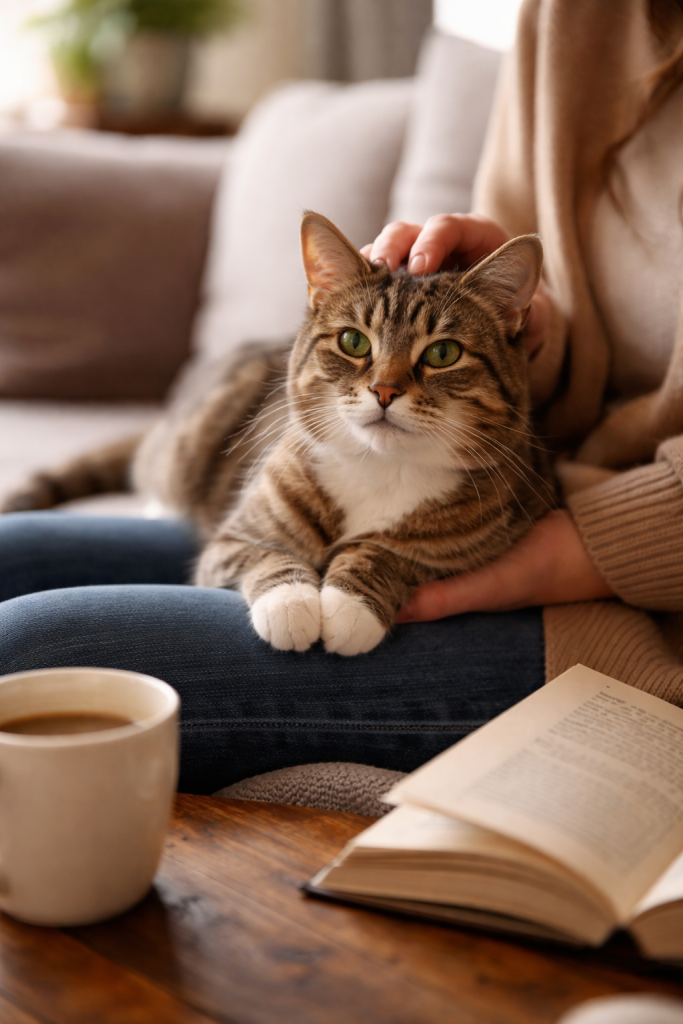
Although often described as distant, cats continue to play an important role in modern human life. Interaction with cats has been associated with reduced stress levels, lower blood pressure, and improved emotional well-being. Spending time petting a cat may help lower cortisol levels, the hormone linked to stress, and can contribute to a general sense of calm, although individual experiences may vary.
Beyond their calming presence, there are documented cases in which cats have reacted in unexpected ways during critical situations. In California, a cat named Tara intervened when a dog attacked a child, chasing the dog away. In Russia, a cat named Masha stayed beside an abandoned infant, helping keep the baby warm and drawing attention until help arrived. These situations are not typical, but they illustrate that cats can respond to their environment in complex and sometimes surprising ways.
From a scientific perspective, cats are equally fascinating. One of their most recognizable behaviors is purring, often associated with comfort, but also studied for its potential biological effects. The frequencies of a cat’s purr, typically ranging between 25 and 150 Hz, have been linked in some research to processes related to tissue maintenance and healing, although this area continues to be studied. Cats also have unique sensory traits, including the inability to perceive sweetness due to missing specific taste receptors, and a strong reliance on smell rather than taste when evaluating food.
When it comes to health, cat allergies are often misunderstood. The reaction is not caused by fur itself, but by a protein called Fel d 1, found in a cat’s saliva and skin. When cats groom themselves, this protein spreads onto their fur and can become airborne, leading to symptoms such as sneezing, itchy eyes, or respiratory discomfort in sensitive individuals. While some breeds may produce lower levels of this protein, there are no truly hypoallergenic cats.
Interestingly, although much less common, cats can also develop allergies. These may be triggered by environmental factors such as dust, pollen, mold, or even human skin particles. Symptoms in cats can include itching, skin irritation, or hair loss, and in some cases, respiratory issues similar to asthma.
The relationship between cats and humans has never been based on obedience, but rather on coexistence and choice. Perhaps that is what makes it so unique. Cats do not offer constant or predictable affection, yet when they do, it feels genuine and unforced. They may not respond every time they are called, and they do not seek approval in the way other animals might, but they choose to stay, to sit nearby, to rest close, or to purr quietly in your presence.
Cats may never have been fully domesticated, but over time, they have become an integral part of human life in a way that remains both subtle and deeply meaningful.