
We often hear a simple idea repeated so often that it starts to feel like a fact: men start wars. It sounds logical, intuitive, even comforting in a way. But once you look more closely at history, that assumption becomes much less clear.
In fact, there is a well-known study suggesting something quite surprising: in early modern Europe, queens were, in certain contexts, more involved in warfare than kings. At first glance, this seems to contradict everything we think we know. But the reality is far more nuanced and has less to do with gender itself than with the conditions under which power was exercised.
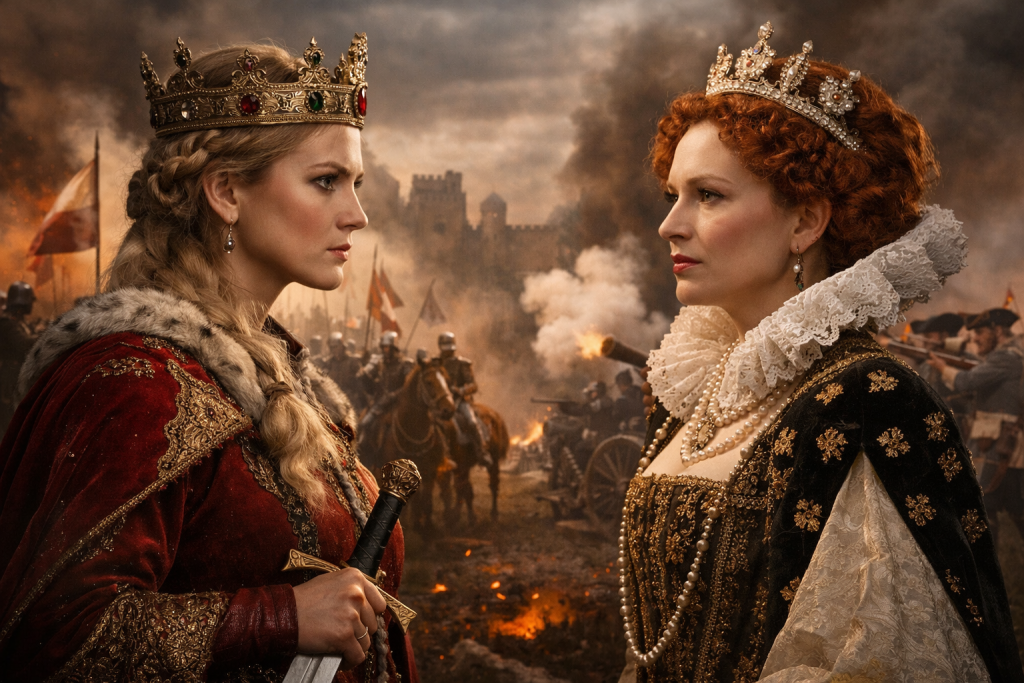
The study in question examines European monarchies between roughly 1480 and 1913 and finds that states led by queens participated in wars more frequently than those led by kings. On the surface, this appears to be a strong conclusion. However, it becomes misleading when taken out of context. The analysis is limited to a specific region and time period, and most importantly, it is based on a relatively small number of female rulers compared to a much larger number of male rulers. In such cases, a handful of examples can significantly influence the overall result.
More importantly, women did not come to power under the same conditions as men. Kings were the norm, while queens were often exceptions. In many cases, a woman ascended the throne only when there was no male heir, during times of instability, or as part of a political compromise in a system not originally designed for female leadership. This means we are not comparing leaders operating under similar circumstances, but rather very different starting points, which naturally affect political and military decisions.
One of the most revealing findings of the study is the difference between married and unmarried queens. Unmarried queens were more likely to be attacked, often because they were perceived as more vulnerable. In contrast, married queens were more likely to initiate wars. This difference is not about personality or temperament, but about access to power. A married queen often benefited from additional alliances, shared political influence, and sometimes even combined military resources through her spouse. In such situations, the ability to engage in conflict increases, and decisions reflect strategic capacity rather than inherent traits.
There was also a constant pressure to prove legitimacy. In societies where leadership was traditionally male, a female ruler often had to demonstrate strength more visibly to maintain authority. Historically, warfare was one of the most effective ways to establish and reinforce that legitimacy. Showing strength helped secure internal loyalty and discourage external threats. This pattern is not unique to women, but it applied more consistently to them due to the nature of their position.
Looking at historical examples makes this even clearer. Catherine the Great pursued an expansionist policy and led major military campaigns that increased Russia’s influence. At the same time, Elizabeth I balanced diplomacy and military action in a highly strategic way during a period of significant tension.
In more recent history, similar patterns appear. Margaret Thatcher played a decisive role in the Falklands conflict, while Indira Gandhi was a key figure in a major war that reshaped the political landscape of South Asia. In each of these cases, decisions were shaped by political context, strategic interests, and external pressures rather than gender alone.
This leads to a common misconception: the idea that women are naturally more peaceful or inherently better leaders. While some modern studies suggest that women may excel in areas such as collaboration and communication, these qualities do not automatically determine outcomes at the level of national leadership. Decisions at that level are influenced by economic interests, alliances, institutional constraints, and geopolitical realities.
In the end, history does not support simple conclusions. It does not show that women are more peaceful, nor that they are more warlike. Instead, it highlights something more important: leaders are shaped primarily by the systems in which they operate. Queens did not rule differently simply because they were women, but because the rules governing their power were different.
Perhaps the more meaningful question is not who would lead better, but what kinds of systems shape leadership decisions. Because while changing a leader may bring variation, changing the system is what truly reshapes the outcome.