
If you’ve ever seen two snails or slugs close together, you may have thought they were fighting.
They touch, circle around each other, and sometimes seem to push or “wrestle” in a slow but intense way. For such slow-moving animals, the interaction can look surprisingly dramatic.
In reality, what you’re seeing is almost never a fight.
Most of the time, it’s something completely different.
Even when several individuals are close together, they are not forming a group, but simply responding to the same environmental conditions.
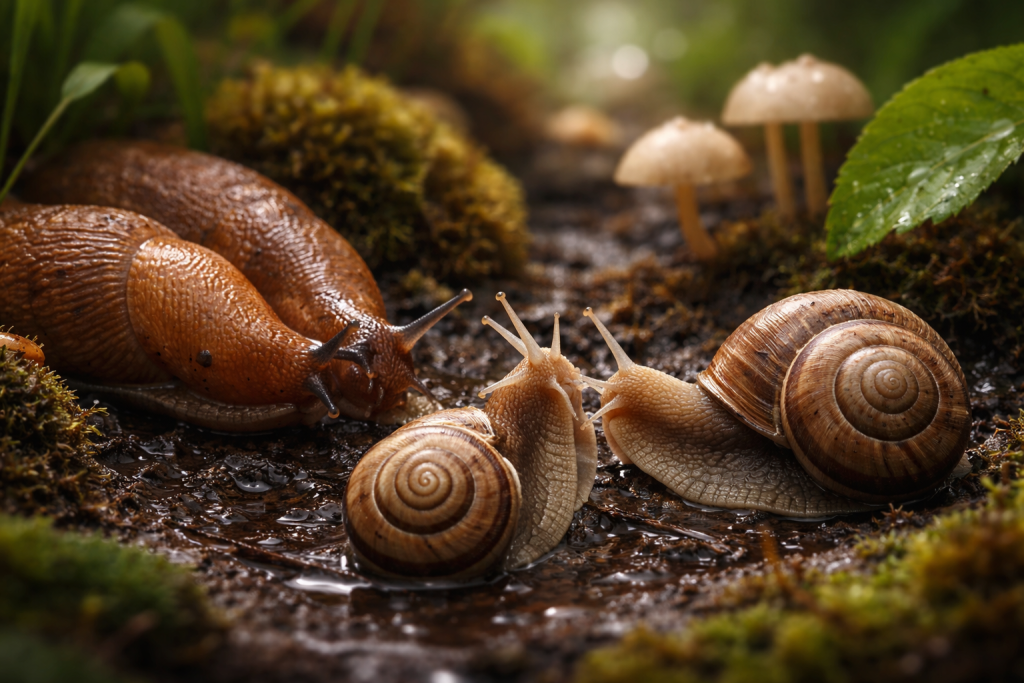
They Don’t Fight — but They’re Not Completely Passive Either
Snails and slugs are not aggressive animals.
They don’t defend territory or compete through direct conflict the way many other species do. However, when they encounter each other, they may:
- gently push
- try to reposition themselves
- explore each other and their surroundings
These interactions are slow and rarely lead to injury.
What appears to be a confrontation is usually just normal behavior.
When “Fighting” Is Actually Mating
Most snails and slugs are hermaphrodites, meaning each individual has both male and female reproductive organs.
As a result, almost any encounter between two individuals can lead to mating.
The process is more complex than it looks:
- they approach slowly
- they touch using their tentacles
- they circle around each other
- they synchronize their movements
This interaction can last for hours.
In some slug species, the process becomes even more unusual. The two individuals may suspend themselves from a branch using a thread of mucus and continue mating while hanging.
From the outside, it may look like a struggle. In reality, it is a coordinated biological process.
“Love Darts” — A Real but Surprising Behavior
In some snail species, mating involves the use of a small, calcareous structure often referred to as a “love dart.”
One individual inserts this structure into the other.
It is not a weapon in the traditional sense and is not meant to cause serious harm. Its role is to increase reproductive success.
However, without context, this behavior can appear aggressive.
How They Reproduce
After mating, both individuals can lay eggs.
A single snail may lay:
- dozens
- sometimes even hundreds of eggs
The eggs are typically placed in:
- moist soil
- under leaves
- sheltered environments
Hatching usually occurs within 2 to 4 weeks, depending on temperature and humidity.
What the Young Look Like
Newly hatched snails are already formed:
- they have a small shell
- they are fully independent
- they begin feeding immediately
There is no stage in which they are cared for by parents.
Do Snails and Slugs Live Together?
Snails and slugs are not social animals.
They do not form families, groups, or long-term connections, and they do not cooperate with one another.
However, they are often found in the same place because they are attracted to similar conditions such as moisture, shade, and food.
For example, after rain or in a well-watered garden, multiple individuals may gather in the same area.
This can create the impression that they are living together or interacting socially.
In reality, they are simply responding to the same environment, not to each other.
Where They Live and How They Survive
Snails and slugs prefer:
- moist environments
- shaded areas
- soil rich in organic matter
To survive, they:
- are mostly active at night
- produce mucus to reduce water loss
- hide in soil or under objects
In unfavorable conditions, such as drought or cold, they can enter a state of inactivity to conserve energy.
Why Their Behavior Seems So Unusual
Their behavior appears unusual mainly because everything happens slowly.
Movements are extended, and interactions last much longer than in most animals. What might take seconds in other species can take hours in snails and slugs.
This slower pace makes their behavior seem more intense than it actually is.
Lesser-Known Facts
- Snails have thousands of microscopic teeth used to scrape food
- Their tentacles can detect light, smell, and vibrations
- Mucus helps protect their bodies, not just movement
- Some species can survive long periods without food
- They are most active after rain
Final Thoughts
Snails and slugs do not fight in the traditional sense.
What looks like a confrontation is usually mating or normal interaction.
Their lives may seem simple, but they involve complex biological processes that are easy to misunderstand.
Sometimes, what appears to be a fight is simply nature working in a very different way than we expect.