
Every summer, social media fills with videos showing strawberries soaking in bowls of salt water. Minutes later, tiny white larvae appear to crawl out of some of the fruit, leaving millions of viewers wondering whether strawberries are still safe to eat.
The videos are certainly eye-catching, but they rarely tell the whole story.
The reality is more complicated than a simple yes or no. While some strawberries can occasionally contain insect larvae, this is far from being a common characteristic of every berry you buy. Understanding why it happens can help separate scientific facts from online myths.
Why can larvae sometimes be found inside strawberries?
The tiny larvae seen in some viral videos usually come from an insect called the spotted-wing drosophila (Drosophila suzukii).
Unlike the common fruit flies that gather around overripe produce in your kitchen, this species targets healthy fruit while it is still growing on the plant.
Native to East Asia, the insect has spread throughout Europe and North America over the past two decades. Today it is considered one of the most significant pests affecting soft fruit crops, causing substantial losses for commercial growers.
Female flies have a specialized egg-laying organ capable of piercing the skin of ripe fruit. Eggs are deposited beneath the surface, where the larvae hatch and begin feeding on the fruit’s flesh.
Why are soft fruits especially vulnerable?
Soft fruits provide ideal conditions for larval development because they contain large amounts of moisture and natural sugars.
Strawberries are not the only fruit affected. The same insect may also attack:
- raspberries;
- blackberries;
- blueberries;
- cherries;
- sweet cherries;
- certain grape varieties;
- some types of plums.
For farmers, controlling this pest has become one of the biggest challenges in fruit production.
Are these the same “worms” found in cherries?
Not exactly.
Although people often refer to them as worms, they are actually insect larvae.
The larvae commonly found in cherries usually belong to a different species, the European cherry fruit fly (Rhagoletis cerasi), while strawberries are more often affected by the spotted-wing drosophila.
The result may look similar, but the insects responsible are different.
Can you tell if a strawberry contains larvae?
Unfortunately, not always.
Because the larvae develop inside the fruit, healthy-looking strawberries may show no obvious signs at all.
In some cases, however, you might notice:
- fruit that softens unusually quickly;
- small dark or sunken spots;
- flesh that breaks down earlier than expected;
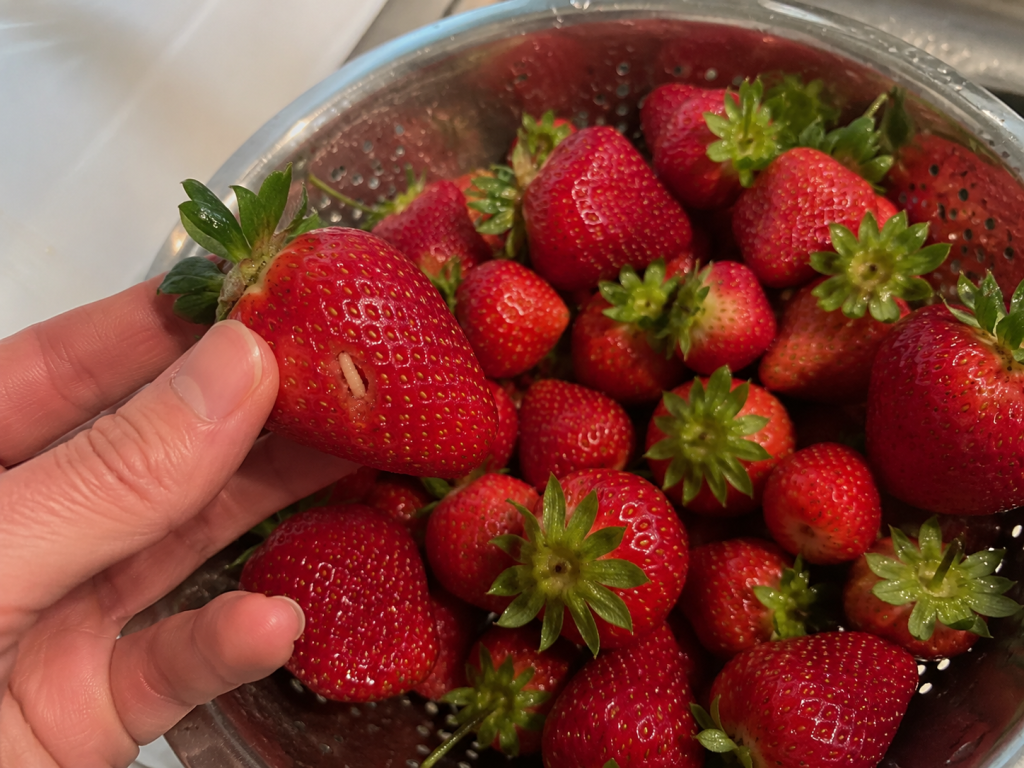
- tiny puncture marks where eggs were laid.
These signs are not unique to insect damage, so they cannot confirm an infestation on their own.
Does the salt water test actually work?
Partially.
Salt water does not create larvae, nor does it magically reveal insects that were never there.
If larvae are already inside the fruit, soaking strawberries in salt water may encourage some of them to emerge. If the fruit is not infested, nothing will happen.
This explains why viral videos can be misleading. People usually upload the most dramatic examples rather than the many bowls where no larvae appear at all.
Myth or fact?
Every strawberry contains worms.
False. Only a small percentage of fruit may be affected, depending on growing conditions, weather, location and pest pressure.
Salt water removes every larva.
False. It may expose some larvae, but it is not a guaranteed method.
Swallowing a larva can lead to a parasitic infection.
False. These larvae are not human parasites and cannot survive inside the digestive system.
Store-bought strawberries are more likely to contain larvae than homegrown fruit.
There is no scientific evidence supporting this claim. Infestation depends on environmental conditions and pest activity rather than where the fruit is sold.
How do growers reduce the problem?
Fruit producers use several strategies to minimize damage caused by spotted-wing drosophila.
These include monitoring crops with specialized traps, harvesting fruit frequently, removing damaged berries, using protective netting in some situations and applying integrated pest management techniques when necessary.
The goal is to keep pest populations under control rather than eliminate every insect from an outdoor environment, something that is virtually impossible.
Is it dangerous if you accidentally eat one?
For healthy individuals, accidental ingestion is generally not considered a medical concern.
These larvae are insects, not intestinal parasites. They cannot reproduce inside the human body and are broken down during normal digestion.
The greater concern is eating fruit that is spoiled, moldy or improperly stored, regardless of whether larvae are present.
What’s the best way to prepare strawberries?
Experts recommend a few simple practices:
- rinse strawberries thoroughly under clean running water;
- discard berries that are damaged, moldy or unusually soft;
- refrigerate them soon after purchase;
- eat them while they are still fresh.
These basic food safety habits are far more important than viral internet trends.
Why do these videos spread so quickly?
Content that surprises or disgusts people tends to perform exceptionally well on social media.
A single clip showing larvae emerging from a strawberry can attract millions of views, while millions of perfectly normal strawberries are never filmed.
As a result, isolated examples can easily create the impression that the problem is widespread when, in reality, they represent only one possible outcome.
The bottom line
Yes, strawberries can occasionally contain insect larvae, just as some other soft fruits can. However, this does not mean that every strawberry is infested or that strawberries should be avoided altogether.
Understanding how these insects interact with fruit crops provides a much clearer picture than a viral video ever could. Choosing fresh berries, washing them properly and buying from reliable sources remain the most practical steps for consumers.
In the end, a little scientific context goes much further than a few shocking seconds on social media.