
I came across a Facebook post recently that didn’t really seem to be looking for a clear answer—it was clearly meant to spark reactions. The question itself was simple, almost trivial: if you accidentally break something in a store, are you supposed to pay for it?
As you’d expect, people didn’t hesitate for long. Within minutes, the comments split into two camps. Some insisted that if you break it, you pay for it. Others argued that stores have insurance or built-in loss margins for exactly these situations. But what stood out wasn’t the difference in opinions—it was how quickly the conversation turned into something else entirely. Insults, sarcasm, harsh judgments… all over a simple accident.
What struck me most wasn’t who was right, but how few people made a distinction between an honest mistake and intentional damage. Or how many assumed that, somehow, store employees would end up paying for the loss themselves. Just as common was the belief that stores are directly “losing money” in these situations, without understanding that most large retailers actually plan for these incidents through shrinkage allowances, internal policies, or insurance coverage.
It reminded me of something that happened to me about 15 years ago, in a store outside my home country. I accidentally dropped and broke a bottle right at the checkout. I still remember how surprised I was—not only did no one ask me to pay for it, but an employee immediately came over, cleaned everything up, and brought me a replacement. No frustration, no awkward tension, no feeling like I had done something terrible.
More recently, I had a similar experience in a large grocery chain—something like a Kroger or Safeway. I picked up a carton of eggs from the shelf, and it slipped out of my hands. A couple of eggs broke. I found an employee, apologized, and explained what happened. The response was calm and simple: “It’s okay, just grab another one.” Out of instinct, I chose to take the damaged carton and pay for it anyway, but their reaction said a lot about how situations like this can be handled.
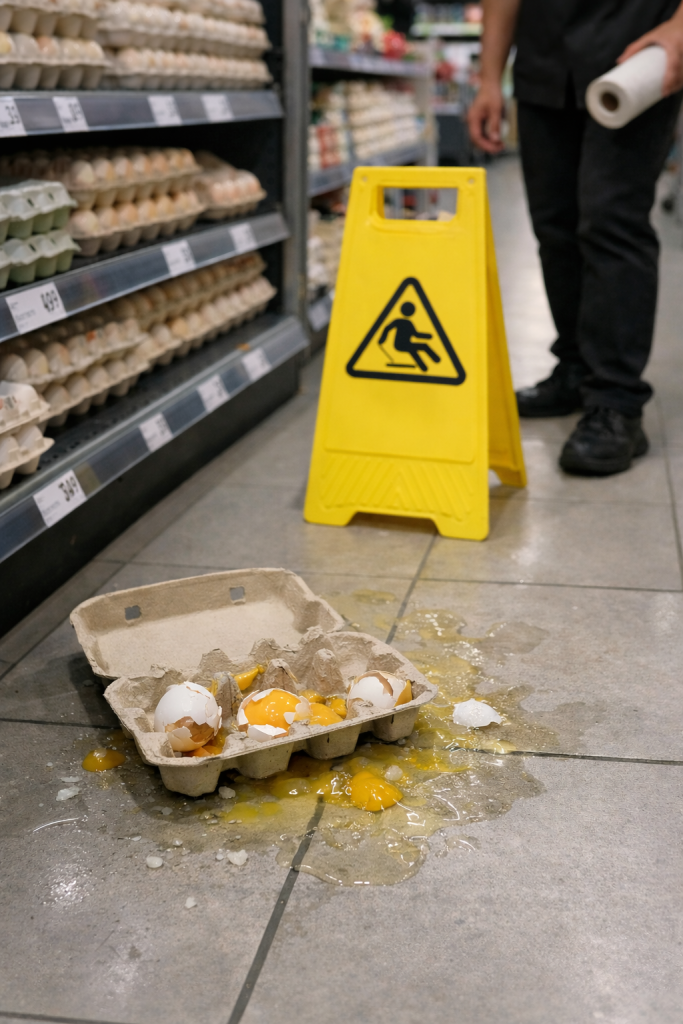
And this is where an important distinction comes in—one that often gets overlooked. Not all stores operate the same way. A small neighborhood shop, where the owner is personally running the business, may feel the impact of repeated losses much more directly. For them, even small, frequent damages can add up in a meaningful way. On the other hand, large retail chains typically anticipate these kinds of incidents. They build them into their operations, their pricing, and their risk management systems. That doesn’t mean it “doesn’t matter,” but it does mean it’s handled differently.
This is where the confusion begins. People talk as if there’s one universal rule that applies everywhere, when in reality, it depends on context—how it happened, where it happened, and how the situation is handled in the moment.
Because beyond policies and legal frameworks, there’s something more subtle at play: personal responsibility. If you accidentally drop something or damage it without intent, the natural reaction is to let someone know and acknowledge what happened. Not because you’re forced to, but because that’s how trust works in everyday interactions.
At the same time, the idea that “it’s all insured, so it doesn’t matter” can become just as problematic if taken too far. At that point, it’s no longer about an accident—it becomes a lack of accountability. On the other extreme, treating every small mistake as something that must be immediately punished creates a tense, overly rigid environment where simple human errors are blown out of proportion.
Maybe that’s why the most reasonable situations are the ones where no one tries to take advantage. The customer doesn’t hide what happened or walk away silently, and the store doesn’t turn a small accident into a public lesson. There’s balance on both sides.
Because in the end, this isn’t really about a broken carton of eggs or a spilled bottle. It’s about how we react when things don’t go perfectly—and how quickly we judge others for mistakes that could just as easily happen to us.
Maybe the real question isn’t just “Who should pay?” but “How do we choose to behave when something goes wrong?”
Because that answer says far more about us than any store policy ever could.