
Severe facial burns often leave doctors with difficult choices. Saving a patient’s life is one challenge. Helping them recover their appearance is another.
For generations, skin grafts have been the standard solution. They can restore damaged tissue, but they rarely recreate the skin exactly as it was before. Differences in color, texture, and scarring are common, especially when the face is involved.
When 18-year-old Kaitlin Jeffrey arrived at a Canadian burn center after a devastating accident, one surgeon wondered whether there might be another way.
A Split-Second Accident
In December 2025, Kaitlin was attending a fraternity house party in London, Ontario, when a dangerous chain of events unfolded. Rubbing alcohol was thrown toward a burning torch, creating a sudden burst of flames that engulfed her face and hair.
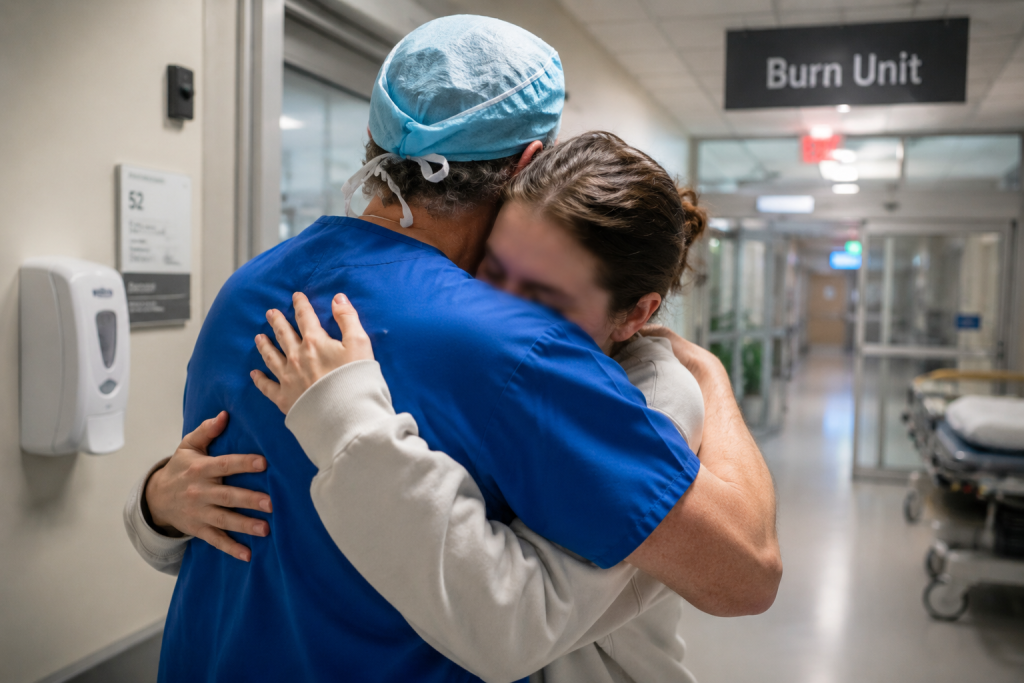
She was rushed to a local hospital before being transferred to the specialized burn unit at Hamilton Health Sciences, where physicians began assessing the extent of her injuries and planning her treatment.
The burns were serious, and traditional skin grafting would normally have been the next step.
Looking Beyond Conventional Treatment
Dr. Marc Jeschke, an internationally recognized burn specialist, believed there was a chance to approach the injury differently.
His concern wasn’t only about healing the damaged tissue. He was also thinking about what Kaitlin’s life would look like months and years later. Facial skin grafts can be lifesaving, but they often leave permanent visual differences that can affect a person’s confidence long after the physical wounds have healed.
Rather than immediately choosing surgery, he sought emergency approval to use an experimental therapy that had never before been administered to a burn patient.
The Science Behind the Treatment
The therapy relied on exosomes—microscopic particles naturally released by cells as a way of communicating with one another.
Instead of acting like replacement cells, exosomes carry biological signals that may encourage tissue repair, reduce inflammation, and support the body’s own healing processes. Researchers around the world have been studying their potential for years, but their use in treating severe burns remained largely unexplored.
Kaitlin received approximately one trillion exosomes imported from the United States. The treatment was delivered in two separate sessions several days apart, targeting the injured areas of her face.
At the time, no one knew exactly how much of a difference the therapy would make.
A Recovery That Surprised Even Specialists
As the weeks passed, the medical team noticed something remarkable.
Doctors compared Kaitlin’s healing with another student who had been injured in the same fire but received conventional treatment. According to the physicians involved, the improvement in Kaitlin’s facial recovery was significantly better than expected.
About six months after the accident, much of her skin had regained a natural appearance, with minimal visible scarring.
Looking back on her recovery, Kaitlin described the outcome with a single word: “miracle.”
Her surgeon later explained that his goal had never been perfection. It was simply to help her regain skin that looked and functioned as closely as possible to what she had before the fire. In her case, that goal came remarkably close to becoming reality.
A Promising Step, Not a Proven Cure
While Kaitlin’s recovery has attracted worldwide attention, medical experts caution against drawing broad conclusions from a single case.
One successful outcome does not establish a new standard of care. Larger clinical studies will be needed to determine whether exosome therapy is consistently safe, effective, and capable of improving recovery for other burn patients.
Even so, this case offers a glimpse into how regenerative medicine may reshape the future of burn treatment.
For decades, survival has been the primary objective for patients with severe burns. Advances like this suggest that, in the future, medicine may be able to focus not only on saving lives, but also on helping people reclaim the appearance, confidence, and sense of normality they feared they had lost forever.