
If earthworms disappeared overnight, nothing dramatic would happen at the surface. There would be no immediate alarm, no breaking news. But quietly, the soil would begin to degrade. It would become more compact, less fertile, and less capable of supporting plant life. Over time, the effects would extend to agriculture, ecosystems, and food production.
Earthworms are among the most underestimated organisms on Earth. They are rarely appreciated, often avoided, and frequently associated with something unpleasant. Yet without them, one of the most important natural systems—soil—would not function the same way.
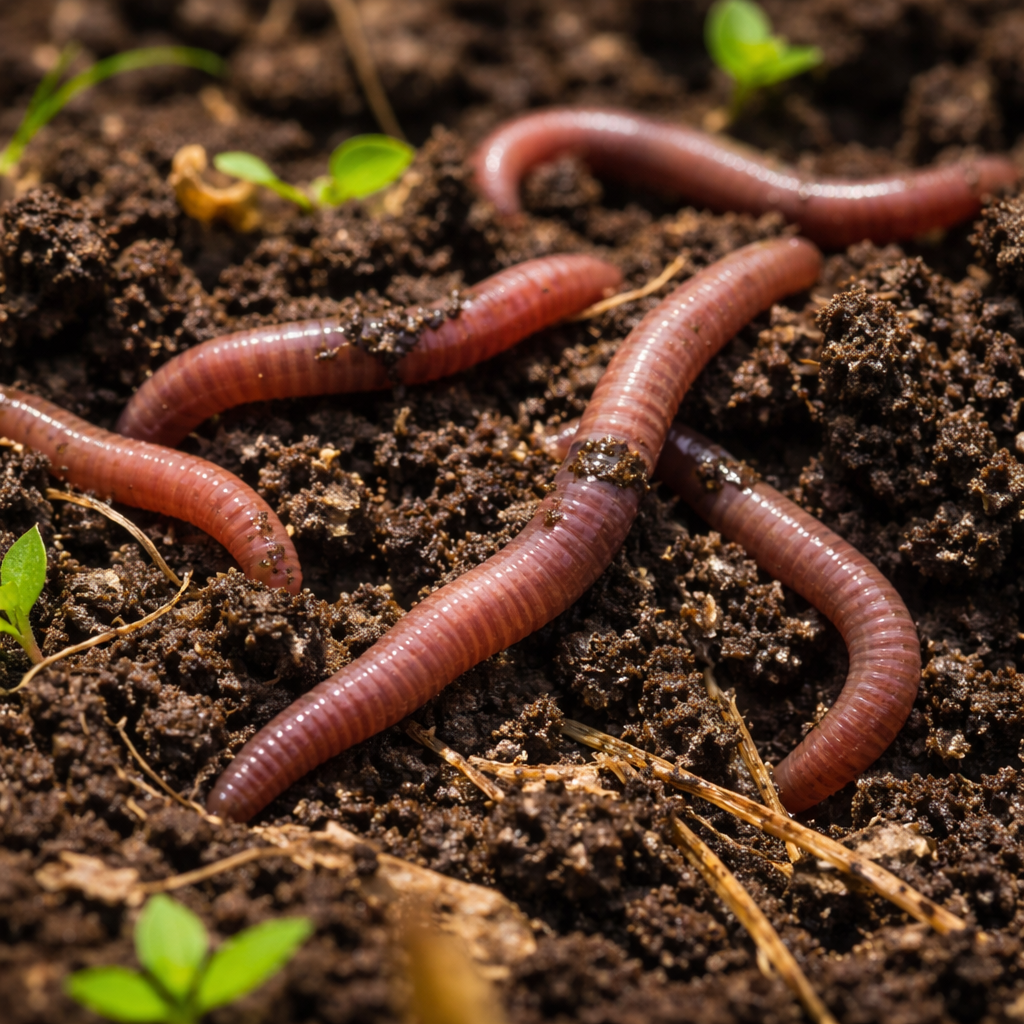
Why earthworms are essential for soil health
Earthworms feed on decomposing organic matter such as leaves, dead roots, and microorganisms. As they process this material, they produce nutrient-rich castings that improve soil fertility and make nutrients more available to plants.
As they move through the soil, they create channels that improve aeration and water infiltration. This allows plant roots to grow more efficiently and helps the soil retain moisture. Research shows that soils rich in earthworms tend to be more productive and more resilient during dry periods.
In healthy soils, earthworms can process large amounts of soil each year. Over long periods of time, a significant portion of topsoil may pass through earthworms, contributing to the continuous renewal of fertile soil.
Do earthworms live in groups or alone?
Unlike social insects such as ants or bees, earthworms do not form colonies and do not have any hierarchical structure. There is no queen, no leadership, and no coordinated system.
Each earthworm lives independently, creating its own burrows and searching for food on its own. However, in favorable conditions—especially in moist, nutrient-rich soil—many earthworms may be found in the same area.
This is not a form of cooperation, but simply a shared response to a suitable environment. Even so, their individual activity creates a collective benefit. Their burrows form a natural network that improves soil structure, airflow, and water movement.
How earthworms reproduce and grow in number
Earthworms are hermaphrodites, meaning each individual has both male and female reproductive organs. However, they still require a partner to reproduce.
After mating, each earthworm produces small cocoons in which fertilized eggs develop. Several young worms can emerge from a single cocoon. Under favorable conditions—adequate moisture, temperature, and food—populations can grow relatively quickly.
Are earthworms harmful or can they be eaten?
Earthworms are not toxic to humans. They contain protein and other nutrients and have been consumed in certain cultures or survival situations.
However, because they live in soil, they may carry bacteria or parasites. For this reason, they should not be consumed raw. Proper cleaning and thorough cooking are necessary for safety.
Their role in the food chain
Earthworms are an important food source for many animals, including birds, amphibians, and small mammals. They contribute to the balance of ecosystems.
At the same time, they are not predators. They do not hunt or attack other organisms. Their diet consists entirely of decomposing organic material and microorganisms, making them key contributors to nutrient recycling.
How long have earthworms existed on Earth?
Earthworms belong to an ancient group of animals that has existed for approximately 500 million years. They have survived major environmental changes and continue to play an essential role in terrestrial ecosystems.
How earthworms were studied and why it matters
Although known for centuries, the importance of earthworms was scientifically demonstrated in the modern era. Charles Darwin studied them extensively and showed that they play a major role in soil formation.
His research changed how these organisms are understood, highlighting their importance in maintaining healthy ecosystems.
Are there different types of earthworms?
Yes, and the differences between them are important. Some species live near the surface and break down organic matter quickly. Others create deep vertical burrows that stabilize soil structure. There are also species that occupy intermediate layers.
This diversity allows soil ecosystems to function efficiently, with each type of earthworm contributing in a specific way.
More complex behavior than it seems
Although earthworms do not have eyes, they can detect light and vibrations. They respond to environmental changes and can quickly retreat into the soil when disturbed.
They are also known to pull leaves into their burrows and store them for later consumption, a behavior that reflects a level of organization adapted to their environment.
Earthworms breathe through their skin, which requires constant moisture. This is why they often surface after heavy rain, when oxygen levels in the soil decrease.
Earthworms as indicators of soil health
The presence of earthworms is widely considered a sign of healthy soil. Their absence may indicate issues such as pollution, excessive chemical use, or soil compaction.
In agriculture and environmental science, earthworm populations are often used as natural indicators of soil quality.
Why people intentionally raise earthworms
Earthworms are cultivated in a process known as vermicomposting. In this system, they break down organic waste into nutrient-rich compost used as a natural fertilizer.
At the same time, their activity improves soil structure by increasing aeration and supporting microbial life. In some cases, earthworms are introduced into degraded soils to support long-term restoration.
The smallest and the largest earthworms
Earthworm size varies significantly between species. Some are only a few millimeters long and are barely visible.
At the other extreme, there are giant species, such as those found in Australia, which can grow over one meter in length. These rare examples highlight the diversity within this group.
Myth or reality: can an earthworm become two?
A common myth suggests that if an earthworm is cut in half, it will turn into two worms. In reality, only the front portion may survive under certain conditions and regenerate partially. The rear portion does not survive.
A quiet system that supports life
Earthworms may not attract attention, but their role is essential. They help maintain soil fertility, structure, and biological activity.
They are a reminder that some of the most important natural processes happen quietly, beneath the surface, supporting life in ways we rarely notice.