
Few natural remedies have inspired as much hope—and as much controversy—as Essiac tea. For nearly a century, it has been promoted as a herbal formula capable of helping people with cancer, while critics argue that its reputation has been built more on personal testimonials than on scientific evidence.
The story begins in rural Canada, where a nurse named René Caisse devoted much of her life to caring for seriously ill patients. Her herbal blend eventually became known around the world, not only because of the claims surrounding it, but also because it sparked one of the longest-running debates between alternative medicine and evidence-based healthcare.
Today, Essiac is still sold in many countries as a dietary supplement, and stories about its alleged healing powers continue to circulate widely on social media. But what do we actually know about its history, and what has modern research discovered?
A Time When Cancer Offered Few Treatment Options
To understand why Essiac gained such extraordinary attention, it helps to look at the medical landscape of the early twentieth century.
In the 1920s, cancer treatments were extremely limited. Surgery was often the only option, radiation therapy was still developing, and chemotherapy had not yet become part of standard medical practice. For many patients, a cancer diagnosis carried little hope.
Against this backdrop, news of a herbal remedy that might offer another chance spread quickly.
Who Was René Caisse?
René M. Caisse was born in Ontario, Canada, in 1888. She worked as a registered nurse and became known for treating patients suffering from serious illnesses.
According to her own account, everything changed after she met an elderly woman who claimed to have survived breast cancer decades earlier with the help of a traditional herbal preparation learned from an Indigenous healer.
Inspired by that story, Caisse refined the herbal mixture and began offering it to patients who had exhausted conventional treatment options.
She called the formula Essiac, simply reversing the letters of her surname.
What’s in Essiac Tea?
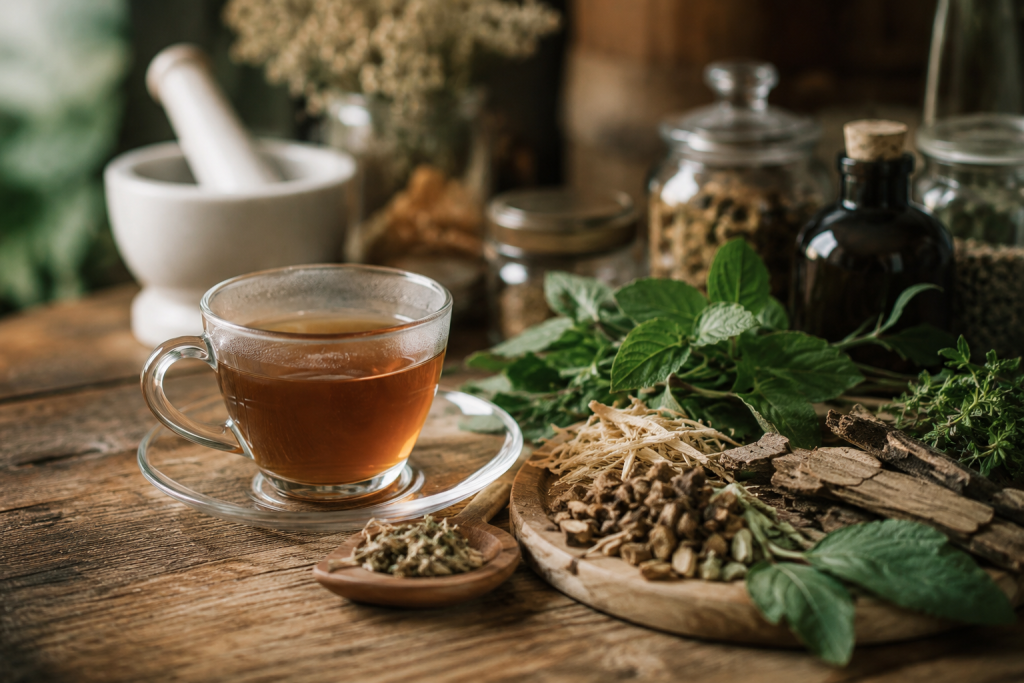
The original recipe consisted of four herbs:
- Burdock root
- Sheep sorrel
- Slippery elm bark
- Indian rhubarb
Over time, commercial manufacturers introduced modified versions containing additional herbs, but the original formula remained based on these four ingredients.
Each plant had a long history in traditional herbal medicine.
Burdock root had been used to support digestion and skin health. Slippery elm was valued for soothing irritated digestive tissues. Indian rhubarb was traditionally used as a natural laxative, while sheep sorrel was believed to promote overall wellness.
These historical uses, however, are not the same as scientific proof that the mixture can treat cancer.
The Clinic That Attracted Hundreds of Patients
As word spread about René Caisse’s work, more and more patients travelled to her small Canadian clinic.
Reports from the time describe long lines of people hoping to receive her herbal preparation. Supporters later claimed she was treating between 300 and 600 cancer patients every week, figures that continue to appear in viral posts today.
While historians generally agree that her clinic was exceptionally busy, there are no complete medical records confirming those numbers.
More importantly, the popularity of a treatment does not establish its effectiveness. Throughout history, many widely used remedies have later been shown to offer little or no clinical benefit.
Why Personal Stories Aren’t Enough
One of the main reasons Essiac remains so popular is the number of personal accounts associated with it.
Patients have described feeling stronger, experiencing less pain, or living longer than expected after drinking the herbal tea.
These experiences are meaningful to the individuals involved, but they cannot demonstrate that a treatment works.
Cancer behaves differently from one patient to another. Some people receive multiple therapies at the same time, some diagnoses later prove inaccurate, and in very rare situations spontaneous remission can occur.
For these reasons, modern medicine relies on carefully designed clinical trials rather than individual success stories when evaluating new treatments.
What Does Scientific Research Say?
Because Essiac became so well known, researchers have examined its ingredients and biological effects over several decades.
Laboratory studies have identified compounds with antioxidant and anti-inflammatory properties, which is not unusual for medicinal plants.
However, promising laboratory findings do not automatically translate into successful cancer treatments.
To date, high-quality clinical studies have not shown that Essiac can cure or effectively treat cancer in humans.
Major health organizations, including the U.S. National Cancer Institute, conclude that there is insufficient scientific evidence to recommend Essiac as a cancer therapy.
The Memorial Sloan Kettering Cancer Center, one of the world’s leading cancer institutions, has reached a similar conclusion, noting that available research does not support claims that the herbal mixture can eliminate tumors or improve survival.
Why Laboratory Results Can Be Misleading
One common misunderstanding involves studies performed in laboratory conditions.
Many substances are capable of affecting cancer cells in a petri dish. That does not mean they will become effective medicines.
The human body is far more complex. A compound must reach the tumor in sufficient concentration, remain safe for healthy tissues, and demonstrate measurable clinical benefits in carefully controlled human studies.
Many promising laboratory discoveries fail to meet these requirements once they are tested in patients.
Why the Legend Refuses to Disappear
Essiac’s enduring popularity is about more than its ingredients.
Its story follows a narrative that naturally resonates with people.
There is a compassionate healthcare professional trying to help desperate patients.
There is a simple herbal formula instead of an expensive pharmaceutical treatment.
There are dramatic recovery stories.
And there is the belief that powerful institutions refused to acknowledge the remedy.
Stories built around these themes often spread rapidly because they appeal to hope, particularly when conventional medicine cannot guarantee a cure.
Was Essiac Suppressed?
Supporters sometimes argue that Essiac was deliberately hidden because it was inexpensive and threatened commercial interests.
Historical evidence tells a different story.
The formula has never disappeared. It has remained available as a dietary supplement for decades, and researchers have had opportunities to study it.
The reason it has not become an approved cancer treatment is not because it was ignored, but because convincing clinical evidence demonstrating its effectiveness has never been produced.
Modern medicine evaluates every potential therapy using the same standards, regardless of whether it originates from a laboratory or from traditional herbal medicine.
A Story of Hope, Not Proof
René Caisse appears to have genuinely believed she was helping people, and many patients remembered her with gratitude.
That, however, does not establish that Essiac is an effective cancer treatment.
History contains many promising medical ideas that ultimately failed to withstand scientific testing. At the same time, numerous modern medicines originated from natural plants—but only after rigorous research confirmed that they were both safe and effective.
Hope may inspire scientific discovery, but evidence determines whether a treatment becomes part of modern healthcare.
Conclusion
Nearly one hundred years after its creation, Essiac remains one of the best-known herbal formulas associated with cancer care. Its history reflects a period when treatment options were limited, patients searched desperately for hope, and a Canadian nurse became the center of a medical controversy that still attracts attention today.
The historical facts are clear: René Caisse existed, she developed and promoted Essiac tea, and thousands of people sought her help. What has not been demonstrated is the claim that the herbal mixture cures cancer or that an effective treatment was deliberately suppressed.
Essiac’s legacy serves as a reminder that compelling stories and genuine hope are not substitutes for scientific evidence. In medicine, lasting breakthroughs are ultimately measured not by how widely they are believed, but by whether they can consistently improve patients’ lives under rigorous scientific scrutiny.