
A few seconds inside a Singapore food court were enough to trigger a police investigation, a medical emergency, and a much wider debate about children’s boundaries, generational differences, and how quickly a confrontation can become dangerous.
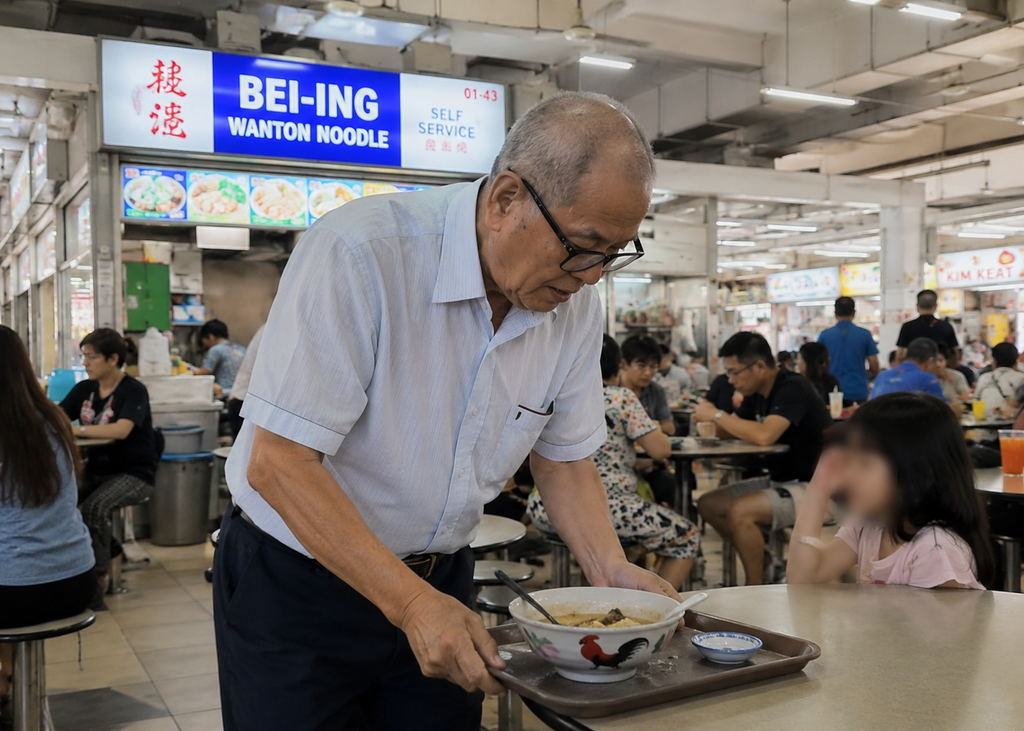
The man at the center of the story was 73-year-old Yeo Song Khoon, a longtime hawker associated with Bei-Ing Wanton Noodle at Roxy Square. CCTV footage from August 15, 2026, shows him walking through the dining area, briefly touching a young girl on the head as he passed her table.
Moments later, the girl’s father returned, confronted him, and Yeo ended up falling heavily to the floor.
At first, the incident appeared to have ended there.
It had not.
Yeo Already Had Serious Mobility Problems Before the Incident
One detail matters enormously when understanding what happened next: Yeo was not fully mobile even before that afternoon.
His family said that roughly two decades earlier, he had been involved in a road accident that left him with longstanding problems affecting his legs and hips. Local reports stated that he had implants in both hips and that his legs were of unequal length, contributing to a pronounced limp and chronic difficulty walking.
That history also helps explain something visible in the CCTV footage. Yeo can be seen moving slowly through the food court and using tables or surrounding furniture for support.
Those mobility problems were not caused by the confrontation on August 15. They had existed for years.
The back fracture diagnosed afterward, however, was a different issue.
What Happened at Roxy Square
The confrontation took place on August 15 at Roxy Square, along East Coast Road in Singapore.
As Yeo moved past a table where a family was sitting, he briefly placed his hand on a little girl’s head. A woman beside the child immediately moved his hand away.
The girl’s father, who had already stepped away from the table, noticed the interaction and returned.
The CCTV footage then shows the situation escalating. After confronting the elderly man, the younger man made physical contact with him and Yeo fell to the ground.
Police later confirmed that they had identified a 40-year-old man in connection with the alleged assault and that investigations were underway.
Why Did He Touch the Child?
Yeo later gave a straightforward explanation.
He said he thought the girl was adorable and described patting children on the head as the sort of affectionate gesture older people sometimes make.
Nothing publicly reported by police or established news organizations has indicated that Yeo attempted to do anything else to the child or that the brief touch had a sexual motive.
That does not mean the parents were required to welcome the gesture.
Modern attitudes toward physical boundaries, particularly those involving children, are increasingly different from the social norms many older adults grew up with. A gesture one generation regards as harmless affection may feel intrusive to another.
Parents are entitled to tell someone not to touch their child. Children can also be taught that they have a right to personal space and do not have to accept unwanted physical contact.
But that is only one part of this story.
The second question is what constitutes a proportionate response when someone crosses such a boundary.
The Father Reportedly Apologized Afterwards
According to Yeo’s family, the confrontation did not initially seem destined to become a major case.
The child’s father reportedly apologized after the incident and offered Yeo a drink. The family also said the man explained that he had reacted because he was overly protective of his daughter.
Yeo himself initially appeared reluctant to pursue the matter.
He reportedly indicated that he did not want to cause trouble and seemed prepared to move on.
At that point, however, the extent of his injuries was not yet clear.
His Back Began Hurting Hours Later
Yeo said the pain did not become significant immediately.
Around two or three hours after the fall, he began experiencing back pain. He initially tried to manage it without hospital treatment, using medication and topical remedies.
His relatives were more concerned, partly because they knew about his pre-existing mobility problems and the hardware in his hips.
Eventually, they persuaded him to seek medical attention.
Photographs published shortly afterward showed Yeo in hospital clothing and using a wheelchair.
Medical examinations then revealed that the fall had been more serious than it first appeared.
Doctors Found a Fracture in His Back
Reports from Singapore media stated that Yeo was diagnosed with a back fracture after the incident. His family said doctors had even discussed the possibility of spinal surgery, with medication and physiotherapy among the alternatives if surgery was not pursued.
Yeo later told Channel NewsAsia that a doctor had confirmed the fracture and that his medical documents had been provided to police as part of the investigation.
That distinction is important.
There is no credible public information showing that Yeo already had this particular fracture before August 15.
What he did have was a longstanding history of problems involving his hips, legs, balance, and ability to walk following the earlier road accident.
The fracture was identified only after the new fall.
His Old Injuries Made the Family Especially Worried
Yeo’s medical history understandably made the fall more alarming.
Family members were initially concerned that the impact might have damaged or displaced the implants associated with his older injuries. For someone who already struggled with walking and relied on furniture for stability, a sudden fall represented a greater risk than it might for a healthy younger adult.
This is also why it is misleading to describe the story in either extreme.
Yeo was not in perfect physical condition before the confrontation.
But neither is there evidence that the newly diagnosed back fracture was simply an old problem unrelated to what happened that day.
The accurate version is more nuanced: he had longstanding mobility impairments from an earlier accident, then developed new back pain after the fall and was subsequently diagnosed with a fracture.
A Fall Can Be Much More Serious in an Older Adult
The case also illustrates a broader medical reality.
Falls in older adults can cause significant injuries even when the initial impact does not look dramatic. Bone density commonly decreases with age, muscle mass may decline, balance becomes less reliable, and pre-existing orthopedic problems can increase vulnerability.
A person may even be able to stand up immediately after falling and still have sustained a fracture.
That is why persistent pain, new difficulty walking, weakness, numbness, or neurological symptoms after a significant fall in an older person warrant medical evaluation.
In Yeo’s case, the delayed onset of severe pain is another reminder that the first few minutes after an accident do not always reveal the full extent of an injury.
He Returned to Work Despite the Fracture
Despite what doctors found, Yeo returned to the noodle stall remarkably quickly.
Reporters who visited Bei-Ing Wanton Noodle days later found him working again, although his movement remained limited. He continued to limp, relied on support while walking, and reportedly said his back pain was interfering with his sleep.
He also told reporters that the medication prescribed for his pain could leave him feeling disoriented.
By then, however, the incident had attracted widespread attention across Singapore.
Customers began visiting the stall not only to buy food, but also to bring fruit, gifts, and messages wishing Yeo a speedy recovery.
One Father Brought His Daughter to See Him
One particularly striking moment came when a longtime customer named Jo Ng visited the stall with his one-year-old daughter.
He specifically told Yeo that he was welcome to pat the girl on the head.
The gesture was deliberate. Ng reportedly wanted to reassure the elderly man that he should not become afraid of interacting with children because of what had happened.
Other parents also visited with their children.
Yeo, however, appeared to have taken a lesson of his own from the experience. He said that in the future, he would prefer to interact physically with a child only when the parents had clearly indicated that they were comfortable with it.
Parents Are Allowed to Set Boundaries
The public anger over Yeo’s injuries should not obscure another legitimate principle.
Parents have every right to establish boundaries around physical contact with their children.
A stranger may regard touching a child’s head as affectionate and harmless, but the parents or the child may feel differently. Teaching children that they can reject unwanted contact is entirely reasonable.
A parent can say no.
A parent can move the child away.
A parent can remove someone’s hand and make it clear that the contact is unwelcome.
None of those responses require physical violence.
That distinction became central to the debate surrounding the CCTV footage.
Protecting a Boundary and Using Force Are Not the Same Thing
The incident became controversial because two separate issues were repeatedly treated as though only one could be true.
It is possible to believe that strangers should not assume they can touch someone else’s child.
It is also possible to believe that an unwanted pat on the head does not automatically justify a physical response capable of seriously injuring an elderly person.
Those positions are not contradictory.
The footage did not show Yeo attacking the child or presenting an immediate physical threat. Based on the information made public so far, the contact was brief and limited to her head.
The appropriateness of that gesture can be debated.
The proportionality of the response can be debated separately.
Police Urged the Public Not to Turn the Case Into an Online Trial
Once the CCTV video spread across social media, speculation intensified rapidly.
People began assigning motives, attacking individuals involved in the incident, and attempting to reach conclusions before investigators had completed their work.
Singapore police confirmed that the 40-year-old man had been identified, but also cautioned the public against speculation while investigations were continuing.
That distinction matters in viral cases.
Video footage can provide powerful evidence of what happened during a particular moment, but it does not replace a full investigation. Questions of criminal responsibility, legal justification, and the precise medical relationship between an incident and an injury ultimately depend on evidence evaluated by authorities and medical professionals.
As of the latest public reporting in late August 2026, the investigation had not been publicly reported as concluded.
The Story Is More Complicated Than a Few Seconds of Video
Yeo Song Khoon’s case became widely discussed because the footage appears simple.
An elderly man touches a child’s head.
A father objects.
The elderly man falls.
But the fuller story contains details that significantly change how those few seconds are understood.
Yeo had already lived for roughly 20 years with the consequences of an earlier road accident. He had serious mobility limitations, problems involving his hips and legs, and reportedly relied on implants. He was already vulnerable to a fall.
What the available evidence does not show is that he already had the back fracture later discovered by doctors.
After the confrontation, he developed new back pain.
Medical examinations found a fracture.
And a situation that might initially have looked like an argument in a food court became a police investigation involving a potentially serious injury.
Two Things Can Be True at Once
Perhaps that is the most useful way to understand the debate surrounding this case.
A parent can have every right to object when a stranger touches their child.
An elderly person can also make an old-fashioned, poorly judged gesture without having sinister intentions.
Children can be taught strong boundaries without being taught that every violation of those boundaries must be answered with force.
And an older man can have significant pre-existing disabilities while still suffering a genuinely new injury from a later fall.
The details matter because removing them makes the story easier to judge, but less accurate.
Yeo had been living with the consequences of one accident for decades.
Then, in the space of a few seconds inside a Singapore food court, another fall added a new injury and placed him at the center of a debate reaching far beyond that single table.
What began with a hand briefly placed on a child’s head ended with a fractured back, a police investigation, and an uncomfortable question about where protection ends and disproportionate force begins.