
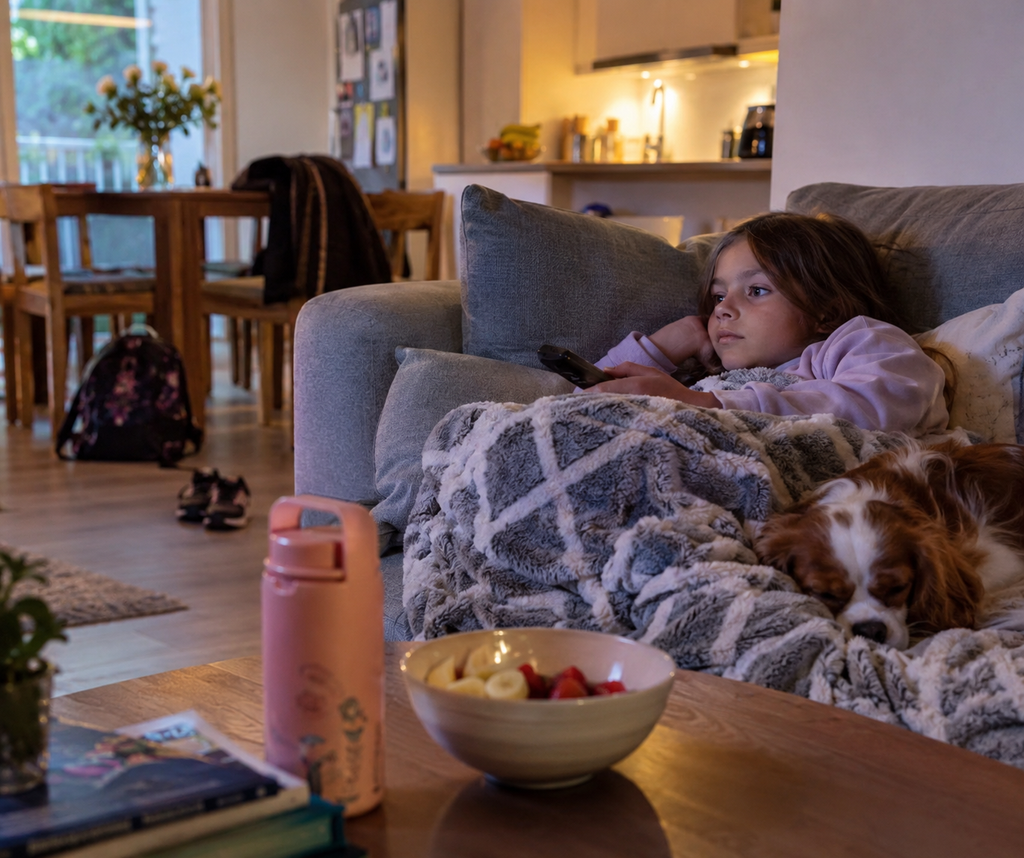
A child spends a quiet afternoon at home. No sports practice, no long walk, no running around outside. Maybe there is a book, a movie, a tablet, or simply a few hours on the couch.
Then, a short time later, comes the familiar sentence:
“I’m hungry.”
For many adults, the reaction is almost automatic. How can a child be hungry again after doing so little?
The answer is simple: the body is never truly doing “nothing.”
A child’s heart is still pumping, the lungs are still breathing, the liver and kidneys are still working, body temperature is being regulated, and the brain continues to use energy every second. On top of that, a growing body is constantly maintaining, repairing, and developing tissues.
Movement adds to that energy demand, but physical activity is only one part of the picture.
This is why the question “How many calories does a child need?” is more complicated than it first appears. Calories matter, but they are not the whole story. Healthy growth depends on adequate energy, nutrient quality, physical activity, sleep, and the child’s overall growth pattern over time.
A child’s metabolism is not simply a smaller version of an adult’s
One of the easiest mistakes to make is comparing a child’s food intake with an adult diet.
Adults primarily use energy to maintain the body they already have and to support daily activity. Children must do all of that while also supporting ongoing development.
Growth itself requires energy.
That does not mean, however, that children literally need “twice as much” energy because their bodies are growing. That idea works as a metaphor, but not as a physiological rule.
Modern energy recommendations for children take several factors into account at the same time, including age, sex, height, weight, and activity level. The 2023 Dietary Reference Intakes for Energy published by the National Academies use individualized equations rather than assigning one fixed calorie number to every child of a given age.
That is why two healthy 9-year-olds can have noticeably different energy needs.
Even a resting child is using a surprising amount of energy
Exercise is only the most visible form of energy expenditure.
A substantial proportion of daily energy is used simply to keep the body functioning. The brain, heart, lungs, liver, kidneys, muscles, and nervous system all require a continuous supply of energy.
So a child sitting on a sofa is not operating at zero energy expenditure.
The brain remains active. The cardiovascular system continues working. Digestive and hormonal processes continue. Tissues are constantly being repaired and remodeled.
Then, on top of all of that, the body must support physical movement and normal development.
Growing means far more than becoming taller
Parents usually notice growth when clothes become too small or when a child suddenly seems several centimeters taller.
But height is only the most visible part of development.
The skeleton is constantly remodeling. Muscle mass changes. Blood volume increases as the body becomes larger. Organs continue developing. The nervous system matures. Hormonal systems gradually prepare the body for adolescence and puberty.
All of these processes require raw materials.
Protein provides amino acids used in tissues throughout the body. Calcium and vitamin D contribute to bone health. Iron is essential for hemoglobin and also plays important roles in neurological function. Zinc is involved in growth, immune function, and multiple metabolic pathways.
Calories provide energy, but energy alone cannot replace nutrients.
Calories are fuel, but food is also building material
From an energy perspective, a kilocalorie is a kilocalorie.
From a nutritional perspective, however, two foods containing the same number of calories can be very different.
A snack dominated by sweets and a snack made from yogurt, fruit, and nuts might provide similar amounts of energy, yet their nutritional profiles are nowhere near the same.
One may provide mostly sugar and fat. The other can provide protein, calcium, fiber, vitamins, minerals, and healthy fats at the same time.
This is why judging a child’s diet by calories alone misses a large part of the picture.
Healthy dietary patterns are based not only on adequate energy but also on variety, balance, nutrient density, and moderation.
So how many calories does a child actually need?
There is no single number that fits everyone.
Energy needs depend on age, sex, body size, activity level, and stage of development.
For that reason, calorie charts by age should be treated as rough reference points rather than strict targets.
Current energy-requirement models are equations, not universal numbers. They attempt to estimate the amount of energy needed to support normal body function, activity, and development based on the individual child.
There is another important point: the body does not reset its energy balance perfectly every 24 hours.
A child may eat less one day and more the next. Appetite may be much stronger after sports and lower after a quiet day.
For a healthy child who is growing normally, calorie estimates are usually more useful as a general guide than as a daily limit that must be rigidly enforced.
More calories do not automatically mean more growth
The opposite misunderstanding can also occur.
If too little energy can be a problem, it does not follow that more food will automatically make a child taller or stronger.
Height is strongly influenced by genetics and hormones. Nutrition helps the body reach its growth potential, but excess calories cannot endlessly increase that potential.
The goal is not “as much food as possible.”
The goal is enough.
Enough energy to support normal function and development, without unnecessary restriction and without assuming that a constant surplus is beneficial.
Growth charts tell us more than yesterday’s dinner
If parents want to know whether a child is getting what the body needs, one meal is rarely the most useful measure.
The overall pattern matters.
In pediatrics, weight, height, and body mass index are interpreted according to age and sex, and clinicians pay particular attention to how the child follows a growth trajectory over time.
A healthy child does not have to sit exactly at the 50th percentile.
Some children are naturally smaller and others larger. What matters is the broader context and whether growth remains reasonably consistent over time.
A barely touched dinner means very little on its own. So does one unusually large appetite day.
Months and years tell us far more.
Active children need energy for recovery too
A child who practices karate, swimming, gymnastics, football, athletics, or dance is not using energy only during the actual training session.
After exercise, the body has to restore energy stores and support normal recovery. At the same time, the child is still developing.
That is one reason young athletes should not be treated like miniature dieting adults.
Sports medicine uses the term Relative Energy Deficiency in Sport, or REDs, to describe the health and performance problems that can occur when too little energy remains available for normal body function after exercise demands are accounted for.
The International Olympic Committee’s 2023 consensus statement emphasizes that persistent low energy availability can affect multiple body systems and athletic performance. Children and adolescents require particular caution because growth and development are still underway.
For most children doing recreational sport, this does not mean counting every gram of protein or buying sports supplements.
It usually means something much simpler: regular meals, enough food, adequate hydration, and enough sleep.
Hunger after exercise is not a failure
A child comes home from practice hungry, even though there was already a snack before training.
That does not automatically mean the child is overeating.
It may simply mean the body is asking for energy it has just used.
A normal meal or a simple snack containing both carbohydrate and protein can be entirely appropriate after physical activity.
The more concerning pattern would be repeatedly teaching an active child to ignore hunger simply to remain under a fixed calorie number or body weight.
Movement matters beyond organized sports
Two training sessions a week are valuable, but they do not need to be the only movement a child gets.
The World Health Organization recommends that children and adolescents aged 5 to 17 accumulate an average of at least 60 minutes per day of moderate-to-vigorous physical activity across the week.
That does not have to mean formal training.
Badminton in the park, cycling, active play, dancing, brisk walking, playground games, and running all count.
Physical activity should ideally be part of ordinary childhood, not something that exists only inside a sports club.
Then comes sleep
If food supplies energy and nutrients, sleep gives the body the conditions it needs for recovery, regulation, and development.
Growth hormone is one of the clearest examples.
Growth hormone, or GH, is not released at a constant rate. It is secreted in pulses, and sleep plays an important role in that pattern. A major pulse commonly occurs after sleep begins and is associated with deep, slow-wave sleep.
GH acts directly and through IGF-1 and is involved in growth, metabolism, and tissue-building processes.
But this physiology has also produced one of the most persistent sleep myths.
There is no magical bedtime for growth
A popular claim says that children must be asleep by a specific hour — often 10 p.m. — because growth hormone is released only during a fixed nighttime window.
Human physiology does not work that way.
Classic studies in which sleep schedules were shifted showed that sleep-related GH secretion shifted with sleep. The relationship is tied to sleep onset and sleep architecture, not to one exact number on the clock.
That does not make bedtime irrelevant.
A child who has to wake at 7 a.m. but regularly falls asleep after midnight is unlikely to obtain enough total sleep.
The real concern is inadequate sleep duration and an unhealthy sleep pattern, not the idea that the body “misses” a hormone window at a particular hour.
Children do not grow only while they sleep
The familiar phrase “children grow in their sleep” is another useful shorthand that can become misleading when taken literally.
Growth is a continuous biological process influenced by genetics, hormones, nutrition, and overall health.
Sleep is extremely important and is closely related to growth hormone secretion, but development does not happen exclusively at night.
And one late bedtime does not damage a child’s growth potential.
What matters far more is the usual pattern over weeks and months.
How much sleep does a school-age child need?
For children aged 6 to 12, the American Academy of Sleep Medicine recommends 9 to 12 hours of sleep per 24 hours on a regular basis.
For teenagers aged 13 to 18, the recommendation is 8 to 10 hours.
Adequate sleep in children is associated with better attention, learning, memory, behavior, emotional regulation, and physical and mental health.
This also means that 9 hours is the lower end of the recommended range for a 9-year-old, not necessarily the perfect amount for every child.
Some children function best with 9½ hours. Others may need 10 or 11.
Individual sleep needs vary.
Sleep and appetite are connected
Insufficient sleep does more than make children tired the following morning.
Research has linked sleep duration with appetite regulation, food choices, and body weight.
Leptin and ghrelin are often described as the “satiety hormone” and the “hunger hormone,” and some studies have found changes in these systems during sleep restriction. But the real physiology is more complicated than the popular claim that one bad night automatically lowers leptin and raises ghrelin in every child.
Sleep can influence eating behavior through multiple pathways, including brain reward systems, fatigue, metabolism, and simply having more waking hours in which food is available.
The broader point is clear: sleep and nutrition are not separate systems.
Screens matter largely because of what they can displace
Phones, tablets, and television do not directly “stop growth.”
Their impact becomes more important when screen use replaces movement or pushes bedtime later and later.
That is why the answer to a sedentary vacation day is not necessarily to sharply reduce a child’s food because “nothing was burned.”
A healthier response is to preserve some space for movement: a walk, a park visit, badminton, cycling, active play, or any activity the child enjoys.
Food should not be used as a punishment for being sedentary.
Should children be forced to clean their plates?
Not necessarily.
The American Academy of Pediatrics supports an approach in which adults decide what foods are offered and provide reasonable portions, while children retain some control over how much they eat.
Healthy children generally have internal hunger and fullness signals that should be supported rather than overridden.
A better strategy is often to offer a sensible first portion and allow the child to ask for more.
The goal is not an empty plate.
The goal is adequate nutrition while helping children preserve the ability to recognize hunger and satiety.
Some days children eat a lot. Other days, barely anything. Is that normal?
Often, yes.
Children’s appetites naturally fluctuate.
Activity, sleep, illness, heat, stress, food preferences, and developmental stages can all affect how much a child wants to eat.
Parents are therefore better served by looking at eating patterns across several days rather than judging every meal in isolation.
A small lunch followed by a good dinner is not necessarily a problem.
Neither is asking for an extra serving after a highly active day.
That is very different from a child who consistently eats very little, loses weight, slows down on the growth curve, or develops rigid or fearful behaviors around food.
When should parents speak with a pediatrician?
No single symptom proves that a child is not getting enough energy.
Still, certain changes deserve medical attention.
Unintentional weight loss, a clear slowing of growth, persistent fatigue, significant food restriction, recurrent digestive symptoms, weakness, unusually slow recovery after exercise, or frequent injuries should be discussed with a healthcare professional.
Sleep also deserves assessment if a child snores heavily, has observed pauses in breathing, wakes repeatedly, or remains unusually sleepy during the day despite spending enough time in bed.
In those situations, guessing is not helpful. Growth and fatigue can be affected by nutritional, endocrine, gastrointestinal, respiratory, and other medical conditions.
Perhaps the most important lesson is not to turn childhood into a diet
Parents are right to care about what their children eat.
But there is a major difference between paying attention and turning every meal into a calculation.
Children benefit from balanced meals, sensible limits around foods with low nutritional value, and an environment where nutritious foods are routinely available.
They do not benefit from learning at a young age that hunger should be ignored because they have “used up their calories.”
A child’s body is constantly balancing competing demands.
It must keep the brain active, the heart beating, and body temperature stable. It must support play, school, sport, recovery, and everyday movement. At the same time, it must continue developing an organism that will look very different only a few years later.
Food provides energy and nutrients.
Movement challenges and strengthens the body.
Sleep supports recovery, brain function, and hormonal regulation.
None of these can fully replace the others.
Perhaps the most accurate version of the idea that “a child’s body is working twice as hard” is this:
A child does not eat only to support what the body is doing today. The body also needs resources to maintain who the child is now while building who that child is becoming.
That does not require as little food as possible.
And it does not require as much as possible.
It requires enough nourishing food, regular movement, and sufficient sleep.
Repeated day after day, those habits matter far more to healthy development than the perfection of any single meal.
This article is for general informational purposes and does not replace individualized advice from a pediatrician or a pediatric dietitian when there are concerns about growth, weight, eating patterns, sleep, or sports performance.