
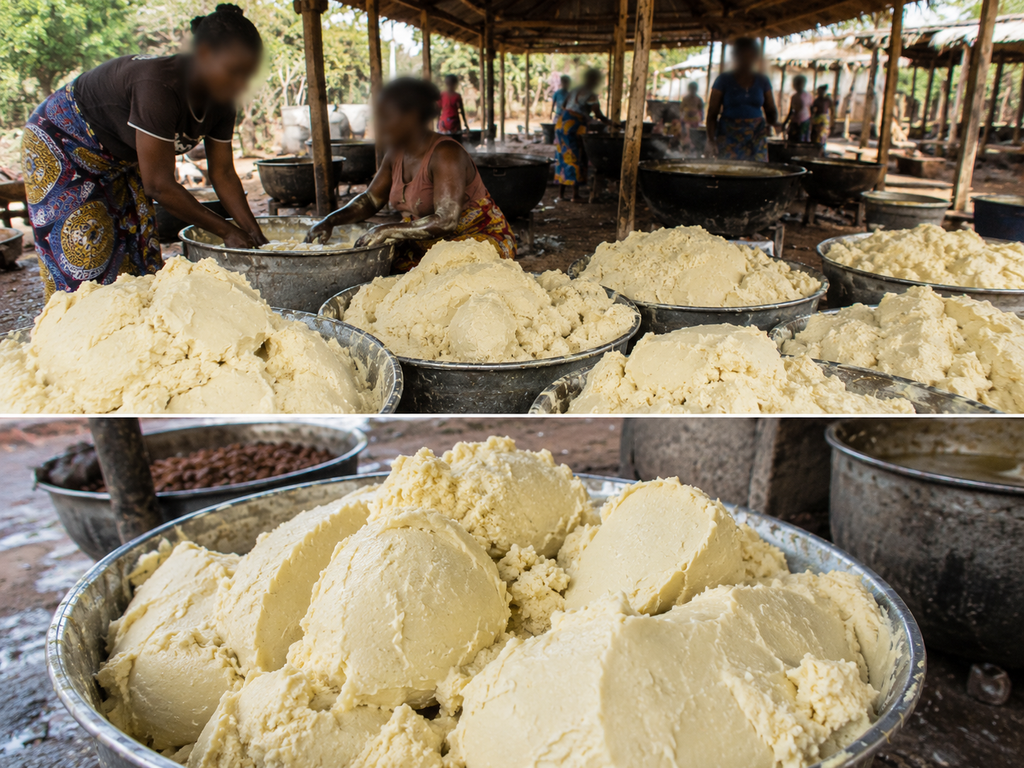
At first glance, the scene looks nothing like the beauty industry.
Large metal pots sit over heat, water is everywhere, and thick yellow masses are piled into containers while women work through each stage by hand. Without context, it would be difficult to guess that this is connected to the same ingredient found in moisturizers, lip balms, soaps, hair treatments, and high-end skincare products around the world.
But this is what traditional shea butter production can look like before refining, packaging, branding, and cosmetic formulation change its appearance completely.
Shea butter begins not in a laboratory or a factory, but with the fruit of an African tree. Turning that fruit into a smooth, usable fat involves far more processing than most consumers ever see.
The butter comes from the seed, not the fruit pulp
Shea butter is produced from the kernels of Vitellaria paradoxa, a tree native to the savanna belt of sub-Saharan Africa.
Its fruit has an edible fleshy pulp surrounding a large seed. Inside that seed is the fat-rich kernel used to make shea butter.
For communities living within the shea-growing region, the tree has long had practical value beyond cosmetics. The fruit can be eaten, while the fat extracted from the kernels has traditionally been used in cooking and food preparation as well as for personal care.
International food standards also recognize shea as an edible vegetable fat derived from Vitellaria paradoxa.
Processing starts long before the butter appears
There is no single traditional method used everywhere in Africa.
Techniques vary between countries, villages, cooperatives, and producers, but the broad stages are often similar.
After the fruit pulp is removed, the seeds must be prepared so that the kernels can be safely stored and processed. Depending on the local method, this may involve boiling, drying, shelling, sorting, crushing, and roasting.
The kernels are then broken into smaller pieces and ground.
At this point, the material does not resemble the pale butter sold in cosmetic jars. It is typically a dense, dark paste.
Only after that does one of the most unusual parts of the process begin.
Water helps separate the fat
Adding water to extract a fat may sound contradictory, but water plays a central role in many traditional shea-processing methods.
The ground kernel paste is mixed and kneaded vigorously with water. As the mixture is worked, an emulsion forms and the fat-rich portion can gradually separate from the heavier plant material.
More water may be added as processing continues, allowing the fatty fraction to rise and be collected.
That fat-rich material is then heated.
Heating drives off the remaining water and helps separate additional impurities. The liquid fat can then be decanted and filtered before it is left to cool.
As its temperature falls, it begins to thicken and solidify.
This is the stage at which it finally starts to look like the shea butter most people would recognize.
A great deal of fruit becomes a relatively small amount of butter
Traditional production is labor-intensive partly because the final yield is much smaller than the quantity of fruit collected at the beginning.
Some published estimates illustrate just how much material is lost during processing. Roughly 20 kilograms of fresh fruit may ultimately yield about 4 kilograms of dried kernels and around 1 kilogram of butter.
Those figures should not be treated as a universal formula.
Yield varies according to the tree, kernel quality, fat content, moisture, storage conditions, processing technique, and extraction efficiency.
Still, the example shows why the finished product represents only a fraction of the original harvest.
Why is shea butter solid when so many plant oils are liquid?
The explanation is largely chemical.
Shea butter is made primarily of triglycerides, with oleic acid and stearic acid usually accounting for much of its fatty-acid profile.
Their exact proportions vary with geography, genetics, environmental conditions, and processing, but these two fatty acids consistently appear among the dominant components in scientific analyses of shea.
Stearic acid is a saturated fatty acid with a relatively high melting point. Its presence in significant amounts helps explain why shea remains solid or semi-solid at ordinary room temperature.
Yet it softens quickly when warmed.
That is why a firm piece of shea butter can begin to melt almost immediately between the fingers or when spread across warm skin.
Why can shea butter be yellow, beige, cream, or almost white?
Shea butter does not have one fixed color.
Unrefined products can range from pale cream to beige and yellow, depending on the raw material, geographical origin, roasting practices, storage, and other processing conditions.
But there is another important factor: refining.
The shea butter produced immediately after traditional extraction is not necessarily the same material that goes directly into a commercial moisturizer.
Industrial refining can be used to reduce odor, change color, remove impurities, control acidity, improve consistency, and produce an ingredient that behaves more predictably in cosmetic or food formulations.
As a result, refined shea butter can look much paler and smell far less distinctive than traditionally produced unrefined butter.
Color alone therefore tells us surprisingly little about quality.
Very white shea is not automatically fake, and bright yellow shea is not automatically superior.
Is unrefined shea always better?
Not necessarily.
Most of shea butter consists of fat, but it also contains a much smaller group of compounds collectively known as the unsaponifiable fraction.
Researchers have identified substances including tocopherols, sterols, and triterpenes within this fraction.
These compounds are one reason shea has attracted scientific interest beyond its basic role as a vegetable fat.
Refining, however, can alter their concentrations.
Studies comparing crude shea with refined or fractionated products have found changes in levels of tocopherols, sterols, phenolic compounds, and other minor constituents.
That does not mean refining turns shea into an inferior or harmful product.
Refining serves legitimate technological purposes. Manufacturers may need an ingredient with a neutral smell, consistent color, predictable stability, lower impurity levels, and specific melting behavior.
“Unrefined” and “refined” therefore describe different processing histories, not a simple contest between “natural and healthy” versus “industrial and bad.”
What can shea butter actually do for the skin?
This is where cosmetic reality and cosmetic marketing often diverge.
One of the most defensible descriptions of shea butter is also one of the least dramatic: it is a useful emollient.
Emollients help soften and smooth the skin and are commonly used in formulations designed for dryness and barrier support.
Shea’s minor components have also attracted interest because some show antioxidant or anti-inflammatory activity in laboratory research.
But laboratory activity is not the same as proven clinical benefit.
A compound may behave in a certain way in cells, tissues, or experimental systems without producing the same effect when a cosmetic product is applied to human skin.
Clinical reviews of plant oils and butters have repeatedly pointed out that the amount of laboratory research is much greater than the quantity of high-quality human evidence.
Some dermatological formulations containing shea butter have shown promising results, including products studied in people with dry or atopic skin. But these formulas often contain several other active ingredients, making it difficult to attribute the entire effect to shea alone.
So it is reasonable to describe shea butter as a valuable moisturizing and emollient ingredient.
It is much harder to justify claims that it can erase scars, cure eczema, remove wrinkles, or treat a wide range of skin diseases.
Shea butter can be useful without being miraculous.
Shea butter is also food
For consumers who know shea only from skincare, this may be the most unexpected part of the story.
Shea is an edible fat.
In producing regions, it has traditionally been used in cooking, while internationally processed shea fractions are also used in food manufacturing.
Its particular fatty-acid composition and melting characteristics make it useful in confectionery fats and other applications where texture and temperature behavior matter.
That does not mean a cosmetic jar of shea butter should be eaten.
A product intended for food use must be manufactured, handled, and tested according to food-grade standards.
The shea trade is closely connected to women’s work
The prevalence of women in photographs and videos showing traditional shea production is not accidental.
Across many parts of West Africa, women have historically played a central role in collecting, processing, and selling shea products.
For some rural households, shea processing can provide an important source of income, particularly when producers are able to sell butter rather than only unprocessed nuts.
Cooperatives can also help producers share equipment, improve quality control, reach larger markets, and retain more value locally.
Production systems differ widely today. Some remain largely manual, while others use mills, crushers, presses, and semi-mechanized processing equipment.
The industry is therefore not frozen in a single traditional form.
Traditional production also has environmental and physical costs
The traditional process should not be romanticized simply because it is old.
Crushing, grinding, kneading, lifting, heating, and handling large quantities of material involve substantial physical labor.
The process may also require significant amounts of water and fuel.
As demand grows, those resource requirements become increasingly important.
Mechanizing certain steps can reduce physical strain, improve extraction efficiency, lower waste, and produce more consistent quality.
Modernization does not necessarily mean abandoning local production. In many cases, better equipment can help producers remain competitive while making the work less physically demanding.
A cosmetic jar hides a much longer story
When we pick up a skincare product, we usually see only the final stage: a clean container, a polished label, and the familiar words “shea butter.”
What we do not see is the fruit harvested from an African tree, the seed hidden inside it, the kernel that must be dried and crushed, the dark paste produced by grinding, or the hours of mixing, heating, separating, filtering, and cooling that may follow.
By the end of that process, the kernel of a fruit has become a fat that can be eaten locally, refined for food manufacturing, or incorporated into cosmetic products sold thousands of kilometers away.
That is what makes images of enormous yellow masses of freshly processed shea so striking.
They reveal a stage of the product’s life that most consumers never encounter.
Shea butter does not need exaggerated promises or miracle claims to be interesting.
Its real journey is remarkable enough.