
A single photograph can leave millions of people asking the same question.
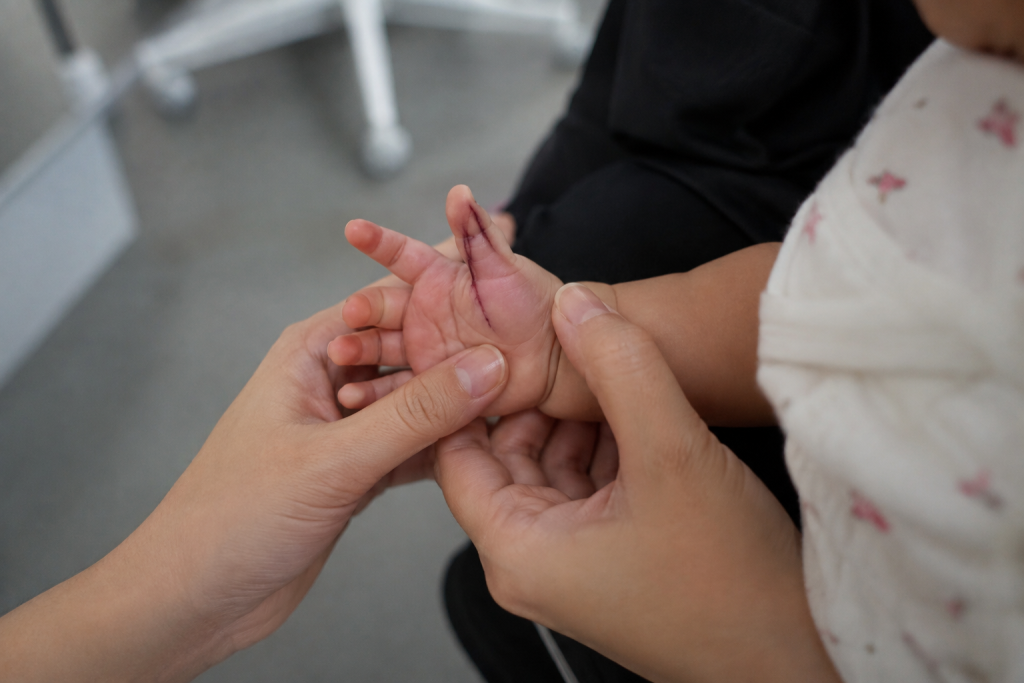
In viral images shared online, a young child lies on an operating table while what appears to be a thumb hangs from the hand, connected by only a narrow strip of tissue. To anyone without a medical background, the scene looks almost impossible to understand. Is the thumb still alive? Where is the bone? How could surgeons possibly repair something that appears to be barely attached?
What seems shocking at first glance is actually one of the most sophisticated procedures performed in pediatric reconstructive surgery. These operations are not simply about improving appearance. Their real purpose is to give a child the ability to grip, write, play, dress independently, and use their hand in everyday life.
Behind every successful reconstruction are decades of advances in microsurgery, anatomy, and rehabilitation that have transformed what was once considered impossible into routine practice at specialized children’s hospitals.
Why the Thumb Matters More Than Most People Realize
Although it is only one of five digits, the thumb contributes nearly half of the hand’s overall function.
Unlike the other fingers, it can move across the palm to meet each fingertip. This unique movement, known as opposition, allows us to hold objects securely and perform precise tasks that most of us never think about.
Something as simple as fastening a button, turning a key, holding a pencil, opening a jar, tying shoelaces, or unlocking a smartphone depends heavily on a functioning thumb.
Without it, even the simplest daily activities become surprisingly challenging.
This is why restoring thumb function is such a high priority whenever a child is born with a congenital hand difference.
When a Child Is Born Without a Fully Developed Thumb
Thumb development begins very early during pregnancy. If normal development is interrupted, a baby may be born with a congenital thumb anomaly.
The severity varies widely.
Some children have a thumb that is smaller than normal but otherwise functional. Others may have unstable joints, weak muscles, missing tendons, or underdeveloped bones. In the most severe cases, the thumb may be almost completely absent.
These differences sometimes occur as part of a genetic syndrome, but in many cases no specific cause is ever identified. Parents often wonder whether something they did during pregnancy caused the condition, yet in most cases the answer is no.
Can Surgeons Really Rebuild a Thumb Without a Bone?
One of the biggest misconceptions is that surgeons somehow create a completely new thumb from skin alone.
That is not how reconstructive surgery works.
Even when a thumb appears extremely small, there may still be important anatomical structures hidden beneath the surface. Tiny bones, cartilage, joints, tendons, nerves, and blood vessels can often be preserved and incorporated into the reconstruction.
Instead of creating new anatomy from nothing, surgeons carefully reshape, stabilize, and reposition the structures that already exist.
Depending on the child’s condition, they may reinforce joints, reconstruct ligaments, transfer tendons from nearby muscles, or realign bones to improve both strength and movement.
The goal is not simply to produce a thumb that looks normal, but one that allows the child to grasp and manipulate objects effectively.
Why Does the Thumb Sometimes Look Like It’s Hanging by a Thin Strip of Tissue?
This is often the most dramatic part of photographs or surgical videos.
To an observer, it can appear as though the thumb is attached only by a small piece of skin. In reality, that narrow bridge contains something far more important.
Running through it are the blood vessels that keep the tissue alive, along with nerves that preserve sensation.
Surgeons intentionally protect this connection during certain stages of reconstruction. As long as blood continues to flow through these vessels, the thumb remains viable while its bones, joints, tendons, and surrounding tissues are repositioned.
This technique allows surgeons to perform complex repairs without interrupting the thumb’s blood supply.
What appears fragile on the outside is actually a carefully preserved lifeline.
When Reconstruction Isn’t Enough
Not every thumb can be repaired.
If the thumb is too severely underdeveloped or completely absent, surgeons may recommend one of the most remarkable operations in pediatric hand surgery: pollicization.
Although the name sounds technical, the concept is surprisingly elegant.
Instead of attempting to build an entirely new thumb, surgeons transform the index finger into one.
The finger is not removed and sewn back on. Instead, it remains connected to its blood vessels, nerves, and tendons throughout the operation.
The surgeon carefully repositions it where the thumb belongs, rotates it into a new orientation, and reconstructs the muscles so it can perform the movements of a normal thumb.
The child is left with four fingers, but one of them now functions as a thumb.
For many children, this procedure restores the ability to pinch, grip, and perform everyday activities that would otherwise be extremely difficult.
The Brain Learns to Accept the New Thumb
One of the most fascinating aspects of thumb reconstruction has little to do with surgery itself.
Young children’s brains possess an extraordinary ability known as neuroplasticity.
After surgery and rehabilitation, the brain gradually adapts to the hand’s new anatomy. It begins treating the reconstructed thumb—or the repositioned index finger—as though it had always been the thumb.
Over time, movements that initially require conscious effort become automatic.
Children learn to hold crayons, stack blocks, catch balls, feed themselves, and eventually write with increasing confidence.
This remarkable adaptability is one reason why many reconstructive procedures are performed during the first few years of life.
Why Surgeons Operate So Early
Parents are often surprised to learn that these operations are commonly performed in infancy or early childhood.
The reason is simple.
During the first years of life, the brain is still developing the neural pathways responsible for fine motor control. Introducing a functional thumb during this critical period allows children to incorporate it naturally into their movement patterns.
Following surgery, occupational therapy and specialized rehabilitation help strengthen the hand while teaching the child how to use it effectively in everyday activities.
Can Children Live Normal Lives After These Procedures?
In many cases, they can.
Although every child is different and outcomes depend on the severity of the condition, advances in pediatric hand surgery have dramatically improved long-term function.
Many patients grow up writing normally, participating in sports, playing musical instruments, using computers, and pursuing careers that require fine hand coordination.
Their reconstructed hand may not look identical to one without a congenital difference, but its function can be remarkably close.
More Than a Surgical Success
To a surgeon, these procedures represent years of training, careful planning, and technical precision.
To parents, they represent something far more personal.
They represent the possibility that their child will one day hold a spoon independently, write their first words, tie their own shoes, or reach out with confidence to shake someone’s hand.
The next time you see a photograph showing what appears to be a thumb hanging by a tiny strip of tissue, you’ll likely view it differently.
Rather than seeing something fragile or frightening, you’ll be witnessing a carefully orchestrated step in a procedure designed to give a child something priceless: the opportunity to use their hand as naturally and independently as possible for the rest of their life.