
There’s a certain kind of judgment that doesn’t appear when you do big, dramatic things.
It appears when you do small, ordinary things—things that should probably be normal.
For me, one of those things is this: I collect my used cooking oil and take it to be recycled.
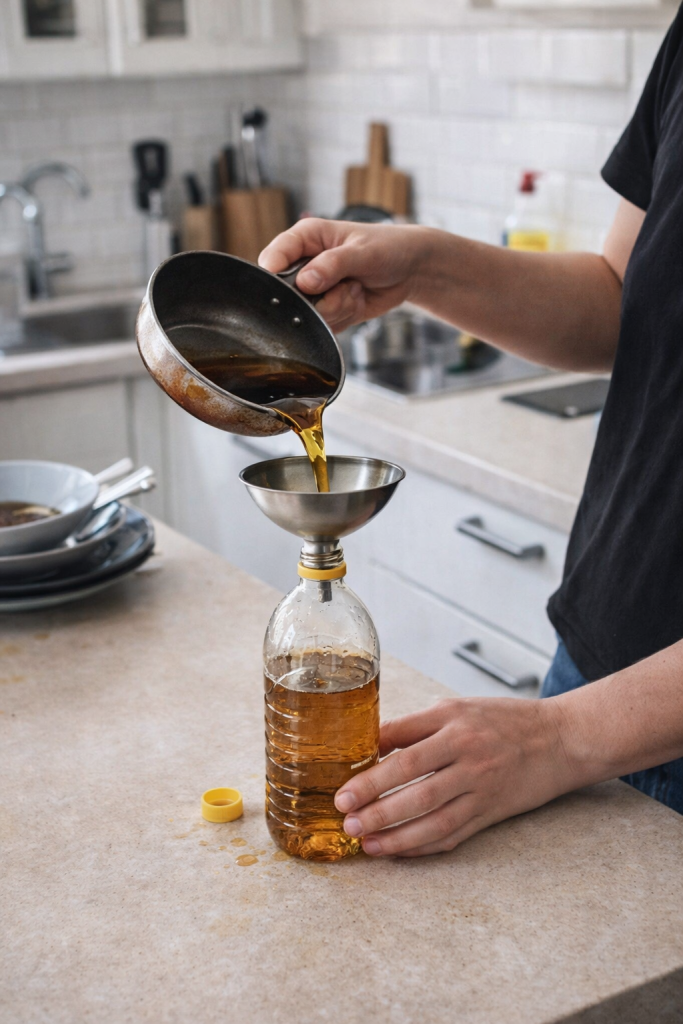
It doesn’t sound like much of a confession.
It’s not the kind of story that changes lives.
We’re talking about the oil left after frying potatoes, chicken, fish, or whatever else ends up in a pan. That leftover oil that a lot of people simply pour down the sink or the toilet without thinking twice.
I started collecting mine almost by accident. At some point I read that pouring oil down the drain can clog pipes and contaminate water systems. That even a small amount of cooking oil can cause surprisingly big problems once it reaches the sewage system.
I didn’t suddenly become an environmental activist.
It just seemed like basic common sense.
So I started doing something very simple.
I let the oil cool, strain out the food bits, and pour it into an empty plastic bottle. When I’ve collected enough, I take it to a recycling drop-off point.
That’s it.
Nothing heroic. No medals involved.
And yet, people’s reactions are fascinating.
Some people are genuinely curious. They ask where I take it, what kind of container I use, whether it has to be filtered. Some even know about the little programs where certain stores or recycling centers give you something in return—maybe detergent, maybe a discount, maybe nothing at all.
But then there’s another category of reactions.
People who immediately say:
“That sounds like way too much hassle.”
And if you listen carefully, the reasons are almost always the same.
Some people say it’s too much work.
You have to save the oil, strain it, store the bottles somewhere, and then make a special trip to drop it off.
Others say the reward isn’t worth it.
Why bother doing all that just to get a small coupon or a bottle of dish soap?
Some say they simply don’t know where to take it.
Maybe they’ve heard that certain grocery stores or recycling centers accept used oil, but when they actually ask about it, nobody seems to know the procedure.
Others say they barely use oil at all.
Maybe they cook with an air fryer or just a little spray oil, so it takes forever to fill even one bottle.
And then there’s the most honest category of all.
People who openly admit they just pour it down the drain, the sink, or throw it in the trash.
Not because they hate the environment.
Simply because it’s easier.
What fascinates me isn’t the fact that people don’t recycle cooking oil. Life is busy. Systems aren’t always well organized. Not every city makes it easy.
What fascinates me is how the simple act of doing it can sometimes feel… excessive to others.
Almost like you’re doing something strange.
I’ve noticed that whenever the topic comes up, jokes appear almost immediately. Someone suggests using the oil to start a barbecue. Someone says it can go into a diesel engine. Someone else laughs about how complicated the whole thing sounds.
Humor is interesting like that. It often shows up exactly when a topic becomes a little uncomfortable.
Because if you take it seriously, you might have to admit that there’s a slightly better option than the one you’re used to.
And maybe that’s why conversations about small everyday habits can feel surprisingly tense.
They’re not about big moral choices.
They’re about tiny things that require just a little extra effort.
Keeping a bottle.
Pouring the cooled oil into it.
Dropping it off somewhere when it fills up.
That’s all.
It’s not a sacrifice.
But it’s also not completely effortless.
Maybe that’s the real issue.
We live in a culture where we love the idea of doing the right thing—but mostly when the right thing is convenient, effortless, and visible.
We talk about responsibility.
We talk about protecting the environment.
We talk about how things are done in other countries.
But when responsibility comes down to a quiet, repetitive habit that nobody sees, the enthusiasm fades quickly.
And I’m not saying this from some moral high ground. I choose convenience plenty of times in my own life.
But collecting used cooking oil has become a strange little personal test for me. A test of how much effort we’re willing to make when no one is watching and when there’s almost no reward.
I don’t recycle cooking oil for coupons.
I don’t do it for discounts.
And definitely not for praise.
I do it because it feels like one of the simplest forms of everyday decency.
And yes, maybe for some people that already sounds like too much effort.
But maybe the real question isn’t why some people go through the trouble of doing small responsible things.
Maybe the real question is this:
When did doing almost nothing become the normal option?