
Two 13-year-old boys sit side by side in the back of a police vehicle.
They are identical twins.
To a stranger, they look almost impossible to tell apart. They are not handcuffed at that moment. They are talking quietly, trying to make sense of the number of officers around them and wondering why their family has been brought in.
One of the boys says the police presence makes him nervous.
The other seems far less concerned.
Soon afterward, one of the twins will be arrested in connection with the killing of a 64-year-old woman who lived nearby.
Months later, footage from that encounter would circulate widely online, often under dramatic captions claiming it showed the exact moment one brother realized his twin was a murderer.
That interpretation is compelling.
It is also more certain than the evidence allows.
What actually happened in Fairfax, Ohio, is disturbing enough without turning an ambiguous conversation between two children into a scripted true-crime moment.
And the real case raises a much more interesting question: what happens when a suspect has an identical twin and conventional DNA testing may not be able to distinguish between them?
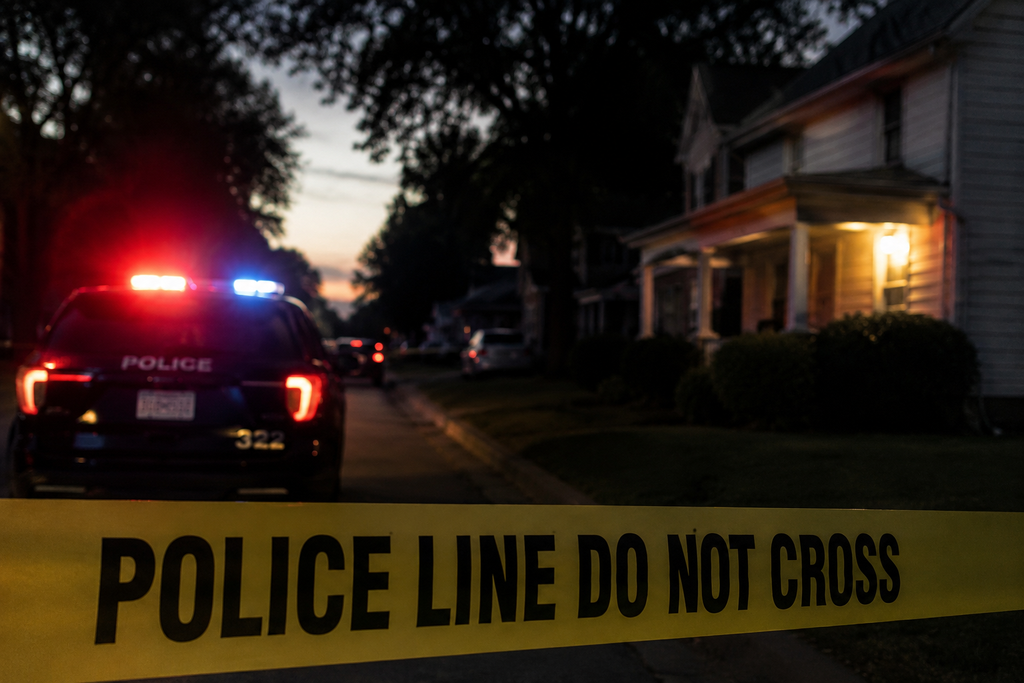
A woman was found dead inside her home
On February 2, 2025, Sheila “Denise” Tenpenny, 64, was found dead inside her home in Fairfax, a village in Hamilton County, Ohio.
Investigators believed the attack had taken place during the night.
Early in the investigation, the Ohio Bureau of Criminal Investigation indicated that whoever had entered the home may have been injured during the confrontation. Authorities asked the public to pay attention to anyone with fresh cuts, scratches, bruising, or other injuries on the hands, arms, or face.
A preliminary forensic examination reportedly identified trauma involving the head and neck.
At that stage, police had not publicly identified a suspect.
The age of the person they were looking for was not known either.
Then, on February 13, authorities announced an arrest that immediately changed the way the case was perceived.
The suspect was only 13 years old.
He lived near Denise.
The police footage that later went viral
The case drew even more attention after body-camera footage was released.
On the day investigators approached the family, the boy was with his mother and his identical twin brother.
Their mother asked officers whether they were suspected of something. Police told the family they might be able to help clarify parts of the investigation, and all three were taken to the Fairfax Police Department.
At some point, the mother was separated from the boys.
The camera inside the police vehicle kept recording.
The twins talked about the unusually heavy police presence around them. One appeared uneasy and wondered whether the number of officers was meant to intimidate them.
The other appeared noticeably calmer.
Not long afterward, one of the brothers was arrested in connection with Denise Tenpenny’s death.
This is the footage that later became the basis for countless videos claiming viewers were watching the precise instant one twin understood that his brother had committed murder.
But the recording does not allow us to know exactly what the other child understood, suspected, or believed in that moment.
The footage is real.
The emotional storyline attached to it online is an interpretation.
That distinction matters.
Denise fought back
As more details emerged, investigators became convinced that Denise had resisted her attacker.
According to information later presented by prosecutors, she scratched the boy hard enough to make him bleed.
She also apparently pulled out some of his hair during the struggle.
That became important.
Investigators reported finding hair in her hands, biological material linked to the teenager beneath her damaged fingernails, and his blood mixed with the victim’s blood inside the home.
A watch belonging to the boy was also reportedly left behind.
Cleaning products were found inside the house as well, contributing to investigators’ belief that an effort may have been made to remove evidence after the attack.
In other words, Denise did not simply become a passive victim in the forensic record.
By fighting back, she left behind physical clues.
Why identical twins complicate DNA evidence
This is where the case intersects with a genuine forensic problem.
Identical, or monozygotic, twins develop from the same fertilized egg. Because of that, their genetic profiles are extraordinarily similar.
Standard forensic DNA testing usually examines selected regions of the genome, particularly STR markers.
For most unrelated people, those markers are highly useful for identification.
With identical twins, however, conventional STR profiles are generally the same.
That means a routine DNA profile may establish that biological material came from one of the twins without necessarily revealing which twin left it.
This limitation is well known in forensic genetics.
But “identical twins have the same DNA” is still an oversimplification.
They begin with essentially the same genome, yet small genetic differences can emerge as cells divide and development progresses.
Rare mutations may appear in one twin but not the other.
With sufficiently advanced sequencing, scientists can sometimes identify those tiny differences.
That has allowed researchers to distinguish monozygotic twins in certain forensic contexts.
There is also growing research into epigenetic differences, including DNA methylation patterns, which can be influenced by development, age, environment, and life experience.
Those techniques are far more complex than routine forensic DNA profiling, however, and they are not a simple replacement for standard testing.
This case was not simply “solved by twin DNA”
The twin angle is fascinating, but it can also distort the story.
Publicly available information does not show that investigators needed an extraordinary genetic test to identify which brother had been involved.
The case included many other forms of evidence.
There were physical injuries.
There were biological traces.
There was blood inside the home.
There were personal belongings allegedly left at the scene.
And there was digital evidence.
Forensic investigations rarely depend on one clue in isolation.
DNA is powerful, but it is only one piece of a much larger evidentiary picture.
The digital trail added another layer
Some of the most unsettling details came from the teenager’s online activity.
Prosecutors later said he had searched for information related to strangulation and finding a victim before the killing.
That suggested the attack was not being viewed simply as an argument that unexpectedly turned fatal.
Authorities believed there had been some degree of preparation.
Investigators also examined activity that occurred after Denise’s death.
According to prosecutors, the teenager communicated about what had happened and later searched for information about how to handle police questioning.
One message introduced in court reportedly read:
“I think I just got caught.”
Another communication referenced the fact that the victim had fought back.
Taken together, those digital traces became part of the broader picture prosecutors built around the case.
From denying the allegations to admitting the crimes
During the early stages of the juvenile proceedings, the teenager denied the accusations.
In March 2025, a judge found him competent to proceed in court, and a defense request for his release was rejected.
The case ultimately did not go to a full trial.
On November 10, 2025, the boy, who had turned 14 by then, admitted to aggravated murder, aggravated burglary, and strangulation as part of a plea agreement.
Other charges were dismissed under the agreement.
Because he was 13 at the time of the offense, the case remained within Ohio’s juvenile justice system.
He was placed in the custody of the Ohio Department of Youth Services under the terms imposed by the court.
Are identical twins really genetically identical?
The answer depends on what we mean by “identical.”
Monozygotic twins originate from the same fertilized egg and therefore begin life with virtually the same genetic blueprint.
But the human body is constantly creating new cells.
Every cell division creates an opportunity for small mutations to occur.
Some of those mutations can happen very early in embryonic development and may be present in one twin but absent from the other.
Research has shown that these early developmental mutations are not merely theoretical.
Scientists have documented genetic differences between members of identical twin pairs.
For ordinary forensic work, those differences are usually too subtle to matter because standard DNA profiling does not examine the entire genome.
Advanced genomic sequencing, however, can sometimes search much more deeply.
An easy way to think about it is this:
Traditional forensic DNA testing compares selected passages from two nearly identical books.
Advanced sequencing can search far more of the text, looking for a tiny letter change that appears in only one copy.
That difference can be enough to distinguish the twins.
The internet turned the case into a mystery that was only partly real
It is easy to see why this story spread so quickly.
Two identical brothers.
A murder investigation.
DNA evidence.
A police recording.
And an apparent contrast between one anxious twin and one calm twin.
The ingredients sound like a crime thriller.
But the real story is more complicated and more useful than the viral version.
The presence of an identical twin did create an interesting forensic question, but investigators were not working with DNA alone.
They had physical evidence, digital evidence, injuries, objects left behind, and statements that had to be considered together.
And at the center of all of it was a woman who fought for her life.
Denise Tenpenny could no longer explain what happened inside her home.
But the struggle itself left evidence behind.
Hair.
Blood.
Material beneath broken fingernails.
Objects that did not belong there.
Digital behavior that investigators could reconstruct afterward.
That is perhaps the most important lesson of the case.
Forensic science is rarely about one dramatic clue suddenly revealing the truth.
It is about small pieces that begin to support one another until a coherent picture emerges.
And sometimes, even when two people look almost exactly alike and share nearly the same DNA, the rest of the evidence can still tell investigators which story fits.