
In 1944, Jeanne Gibson was 18 years old and living in Minnesota. The United States was deep into World War II, millions of men had been sent into military service, and factories and shipyards across the country were desperate for workers.
Gibson decided she wanted to help.
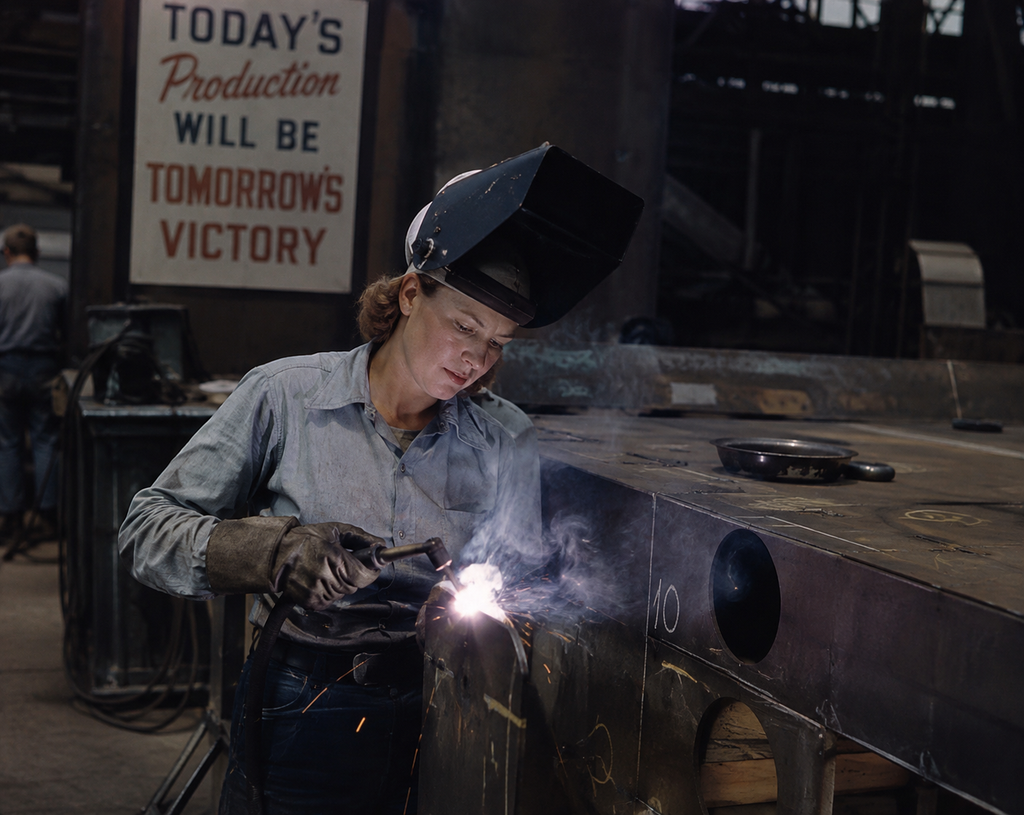
She left home with a friend and traveled across the country to Seattle, where she took a job that would have been highly unusual for a young woman only a few years earlier: welding military ships at Todd Pacific Shipyards.
More than eight decades later, Gibson was still telling people what those years had been like.
She died on July 29, 2026, at the age of 100, closing a life that stretched from wartime shipyards to academia, aviation and decades of public service.
Her story has recently resurfaced on social media, often accompanied by images that evoke the famous “We Can Do It!” poster. But the real history is both more complicated and more interesting than the viral version suggests.
She Was Not “The” Rosie the Riveter
One of the most important details about Jeanne Gibson is also one of the easiest to misunderstand.
She was not the single woman who inspired Rosie the Riveter.
“Rosie” gradually became a collective symbol for the millions of American women who entered factories, shipyards and other defense industries during World War II. These women welded, riveted, assembled aircraft, built ships and produced equipment while much of the male workforce was serving overseas.
The phrase “Rosie the Riveter” was already circulating during the war, including through a popular 1942 song. Over time, it became shorthand for an entire generation of female industrial workers.
The now-iconic “We Can Do It!” image was created by artist J. Howard Miller in 1943, but it was not originally presented as a portrait of one specific woman named Rosie.
Jeanne Gibson belonged to the real group of women that the symbol eventually came to represent.
At 18, She Crossed the Country to Work in a Shipyard
Gibson had been a teenager when the attack on Pearl Harbor brought the United States into the war in December 1941.
Like many young Americans of her generation, she felt the conflict had changed what was expected of her.
She initially considered nursing but discovered that it was not the path she wanted to pursue. Instead, in 1944, she and a friend headed west to Seattle.
There, Gibson became a welder at Todd Pacific Shipyards.
The work was demanding. She worked long shifts, six days a week, in the cold conditions of a waterfront shipyard. Later accounts of her wartime experience describe the layers of clothing she wore under her protective gear to stay warm.
This was not ceremonial work designed for wartime publicity.
She helped build destroyers for the U.S. Navy.
At one point, she reportedly spent an entire shift welding part of a ship associated with the anchor chain system.
For an 18-year-old woman in the 1940s, the experience represented far more than a paycheck. It gave her a degree of independence and responsibility that many women of the previous generation had rarely been offered.
The War Opened Doors That Had Long Been Closed
Women had always worked, but World War II dramatically expanded the types of jobs available to them.
As men entered military service, employers who had previously resisted hiring women for industrial work suddenly needed them.
Millions stepped into positions in aviation plants, shipyards, munitions factories and transportation networks.
By the end of the war, the image of the capable female industrial worker had become one of the defining symbols of the American home front.
But the transformation had limits.
When servicemen returned, many women were pushed out of wartime jobs or encouraged to return to traditional domestic roles. The opportunities created by wartime necessity did not immediately translate into lasting equality.
Gibson, however, did not return to the kind of life society might once have expected for her.
She kept moving forward.
From Welding Ships to Working in Alaska
After her time in Seattle, Gibson went north to Juneau, Alaska.
There, she worked with the Army Transportation Corps at an embarkation facility.
Her role no longer involved welding. Instead, she prepared shipping documents, manifests and so-called “hatch lists,” which helped organize cargo aboard military vessels.
It was a different kind of wartime work, but it placed her inside the enormous logistical network required to keep ships, equipment and supplies moving.
She was still a very young woman, yet within a short period she had gone from life in Minnesota to industrial work in Seattle and then military transportation operations in Alaska.
She was in Alaska when the war came to an end.
By then, however, the experience had already reshaped her sense of what she could do with the rest of her life.
She Went on to Earn a Doctorate
After the war, Gibson turned toward education.
She studied psychology and eventually pursued advanced degrees at the University of California, Berkeley, including doctoral work in educational psychology.
She would spend roughly three decades in education.
Her career placed her inside another period of major change in American history: the expansion of science education during the Cold War and the years following the Soviet launch of Sputnik.
By 1960, contemporary reports were already describing educational experiments in which Jeanne Gibson worked with young students learning scientific concepts through hands-on methods.
The young woman who had once welded military ships was now helping shape the way children learned science.
She Also Became a Pilot
Gibson’s postwar life continued to defy the expectations that had surrounded women of her generation.
She eventually earned a private pilot’s license and became involved with The Ninety-Nines, the international organization of women pilots founded in 1929.
The organization has a remarkable aviation history of its own, including early leadership from Amelia Earhart.
For Gibson, aviation became another field entered by a woman whose adolescence had begun in a world where many professional doors were still firmly closed to women.
Over the course of one lifetime, she moved through industrial work, higher education and aviation.
That alone would have made her biography extraordinary.
But in her later years, she took on another role: helping preserve the memory of the women who had worked alongside her during the war.
Recognition Came Almost 80 Years Later
For decades, the women associated with the Rosie the Riveter generation were celebrated culturally without receiving a single national honor that reflected the full scale of their contribution.
That changed when the Rosie the Riveter Congressional Gold Medal Act was signed into law in 2020.
The award was collective.
It honored the American women who had entered the workforce during World War II and supported the war effort through industrial and defense-related labor.
In April 2024, a ceremony was held at the U.S. Capitol, with surviving “Rosies” in attendance.
Jeanne Gibson was among them.
She was 98 years old.
This distinction matters because social media posts sometimes imply that Gibson personally received an individual Congressional Gold Medal.
She did not.
The medal honored the Rosie the Riveter generation collectively.
That makes the recognition no less significant. If anything, it reflects the central truth behind the Rosie story: it was never about one woman.
It was about millions.
At 100, She Was Still Telling Her Story
Even after reaching 100, Gibson remained involved in public events connected to the history of the World War II home front.
She attended commemorations, met visitors and spoke about her experiences as a young wartime worker.
In 2026, she continued appearing at events connected to Pearl Harbor and the Rosie the Riveter/WWII Home Front National Historical Park.
Only days before her death, she was honored again with a Wall of Honor banner recognizing her wartime service.
Then, on July 29, 2026, Jeanne Gibson died at the age of 100.
The timing gives the final chapter of her life an almost cinematic quality: one of the remaining women who had actually lived the Rosie story was still telling it to younger generations only shortly before she died.
The Real Story Is Stronger Than the Viral Image
Images now circulating online often place an elderly Jeanne Gibson in poses designed to resemble the famous Rosie the Riveter artwork.
They are visually powerful, but they can blur an important distinction between historical documentation and modern tribute.
Authentic photographs of Gibson do exist, and her wartime service is documented by institutions connected to the Rosie the Riveter historical record.
She does not need to be transformed into the woman from a poster to make her story compelling.
The truth is enough.
At 18, she crossed the country to weld military ships.
She later worked in Alaska for the Army Transportation Corps.
After the war, she pursued higher education, earned a doctorate, spent decades teaching and became a pilot.
Then, in the final years of her life, she helped make sure that the women of her generation would not disappear into history as anonymous factory workers.
“Rosie the Riveter” was a symbol.
Jeanne Gibson was one of the women who made that symbol possible.
The famous message said, “We Can Do It.”
Women like Gibson provided the answer.
They did.