
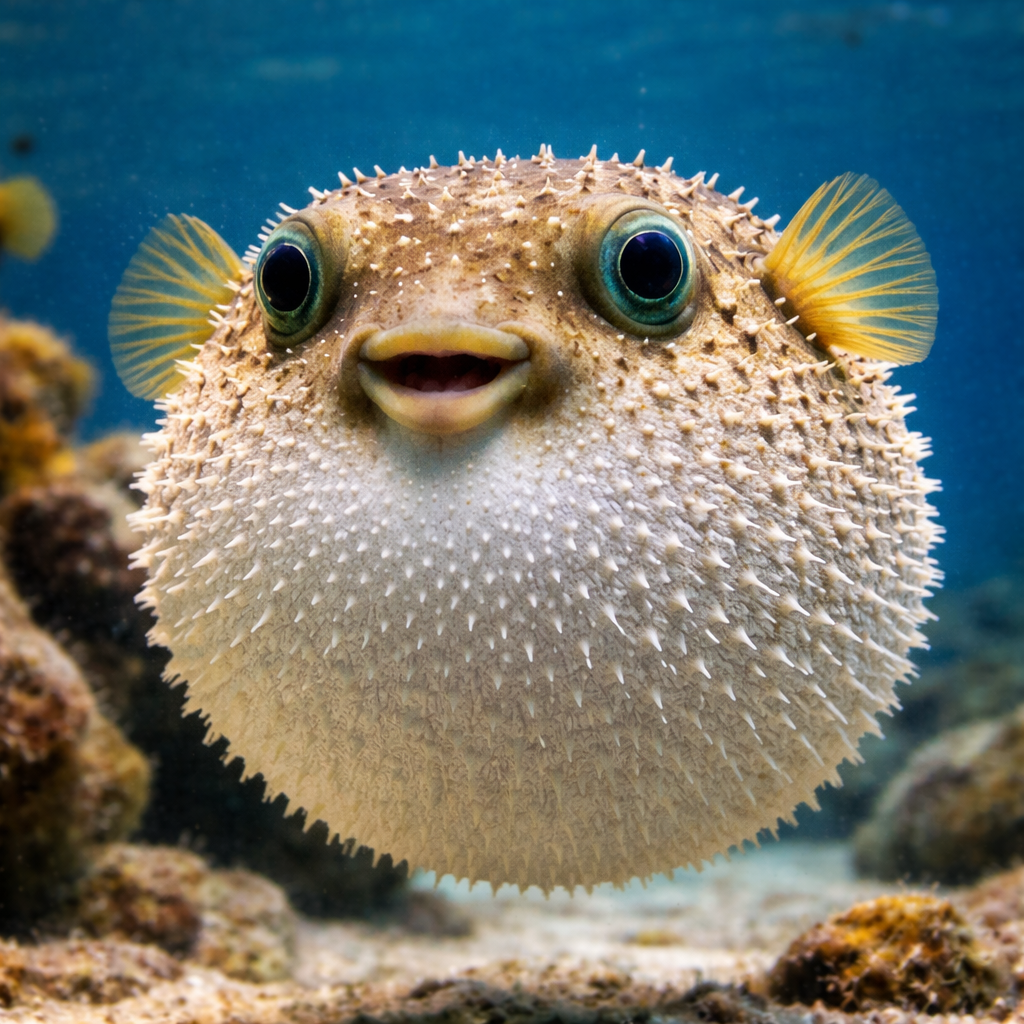
If you saw it in an aquarium, you’d probably smile. With its round body, big eyes, and almost playful expression, it looks more like a character designed to make people feel at ease than something you should be cautious around.
And yet, this same fish is considered one of the most toxic animals on the planet.
That contrast alone is enough to make it unforgettable.
A defense mechanism that looks almost surreal
When threatened, a pufferfish doesn’t rely on speed or aggression. Instead, it does something that feels almost unreal the first time you see it.
It inflates.
By rapidly filling its body with water (or air if it’s near the surface), it transforms into a much larger, balloon-like shape within seconds. Suddenly, it becomes extremely difficult for predators to bite or swallow.
In many species, small spines become more visible when the fish is inflated, adding another layer of protection.
It’s a simple strategy, but remarkably effective.
The hidden danger behind its appearance
If its size isn’t enough to deter a predator, the pufferfish has something far more serious as a backup: a powerful toxin.
Many species contain tetrodotoxin, a substance that affects the nervous system by blocking communication between nerves and muscles, which can lead to paralysis.
What makes this toxin especially unsettling is how it can act. In some cases, a person may remain fully conscious while losing the ability to move or breathe.
There is no specific antidote.
Interestingly, the fish doesn’t produce this toxin on its own. It comes from bacteria in its environment, which accumulate inside the fish, especially in organs like the liver.
How something so dangerous ends up on a plate
Despite its toxicity, pufferfish is considered a delicacy in parts of the world, especially in Japan, where it’s known as fugu.
Preparing it is not something left to chance. Chefs must undergo years of training and obtain a special license before they are allowed to serve it.
Even then, the margin for error is incredibly small.
For some, that risk is part of the appeal.
An unexpected artist of the ocean
There’s another side to the pufferfish that completely changes how you see it.
Certain species, particularly those found near Japan, create intricate circular patterns on the ocean floor. These structures can span several feet and display a level of symmetry that almost looks engineered.
They are not random.
Male pufferfish spend hours, sometimes days, carefully shaping these designs in the sand. Every detail matters, because females choose their mate based on the complexity and precision of this construction.
It’s one of the most surprising examples of artistic behavior in the animal world.
Encounters with humans
In the wild, pufferfish are not aggressive. They don’t seek out interaction and rarely pose a threat unless handled or consumed improperly.
Divers often describe them as calm and even curious, which makes the contrast between appearance and reality even more striking.
The real danger comes from underestimating them.
A living contradiction
What makes the pufferfish so fascinating isn’t just its defense mechanism or its toxicity.
It’s the contradiction.
An animal that looks harmless, almost endearing, yet carries one of the most sophisticated and dangerous defense systems in nature.
Sometimes, the most unassuming appearances hide the most complex realities.
And the pufferfish is a perfect example of that.