
Some cases don’t fade with time. Not because they lack attention, but because every answer seems to lead to more questions. The disappearance of Madeleine McCann is one of those rare cases where, even years later, the story remains open — not only legally, but emotionally.
A holiday that felt safe
In May 2007, the McCann family was staying in Praia da Luz, a coastal resort known for its relaxed atmosphere and family-friendly setting. It was the kind of place where routines soften and caution quietly slips into the background.
Madeleine McCann was just days away from turning four. She was on vacation with her parents, Kate McCann and Gerry McCann, along with her younger twin siblings.
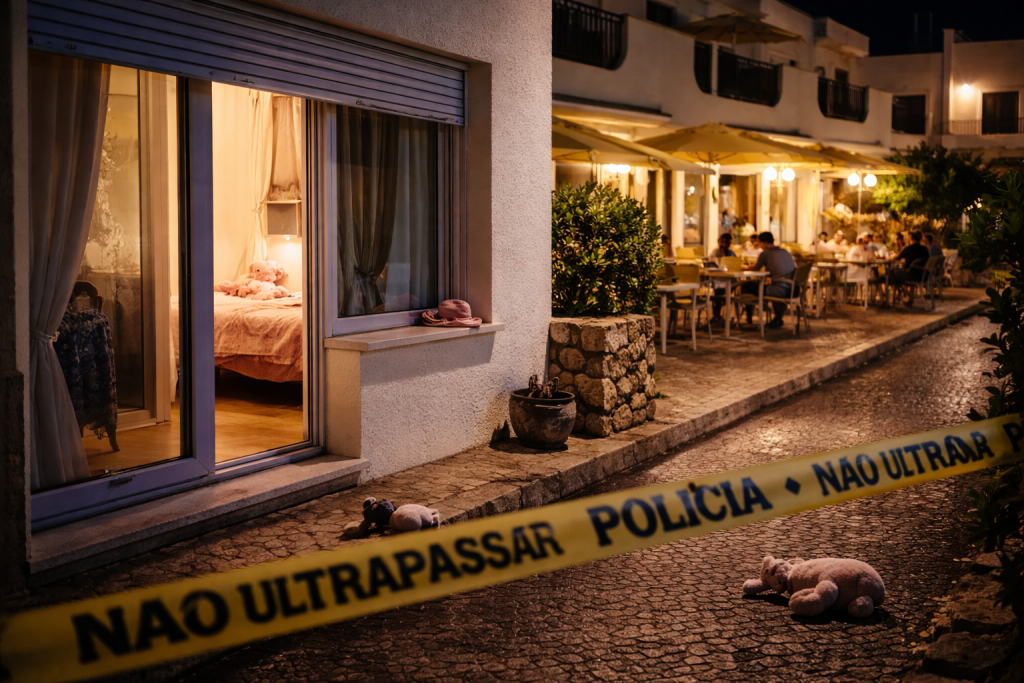
Their apartment was on the ground floor, with direct access from outside rather than through an internal hallway — a detail that would later take on much greater significance. A short distance away, roughly 50 to 60 meters, was the restaurant where the adults gathered each evening.
There was no continuous line of sight between the two. Only partial visibility, depending on where you stood.
The evening: a routine that seemed under control
On May 3, 2007, the evening followed a familiar pattern. The children were put to bed around 7:30 p.m., and the adults went to dinner around 8:30 p.m.
Instead of using the resort’s childcare services, the group chose to check on the children periodically, each adult taking turns walking back to the apartments.
At around 9:05 p.m., Gerry McCann returned to the apartment. Everything appeared normal at first glance. He didn’t fully enter the bedroom or turn on the lights, trying not to disturb the children. He noticed the bedroom door was slightly more open than expected, but it didn’t immediately raise concern.
He went back to the restaurant.
Sometime between 9:15 and 9:30 p.m., a friend of the family walked past the area and later reported seeing a man carrying a child. At the time, it didn’t seem unusual enough to trigger alarm.
Only later would that detail take on weight.
The moment everything changed
At around 10:00 p.m., Kate McCann went to check on the children.
This time, something felt off.
The bedroom door was open wider than before. The window and shutters were open. It wasn’t an obvious sign of disturbance to an outsider, but to someone who knew exactly how the room had been left, it was enough to create unease.
Inside, the silence was different.
Madeleine was gone.
At first, the reaction was practical — checking the bathroom, the closets, every place a child might hide or wander into. But within moments, it became clear this wasn’t a simple misunderstanding.
She ran back to the restaurant.
“They’ve taken her.”
The first hours: urgency without direction
The alarm was raised immediately. Resort staff, guests, and local authorities began searching the area. The response was fast, but like many cases in their early stages, it lacked a clear direction.
Nearby streets, open spaces, and surrounding areas were checked, but with every passing minute, the situation became more serious.
One of the details later questioned was how quickly the apartment itself was secured. In those initial moments, multiple people moved through the space, which may have affected the integrity of potential evidence.
It’s a small detail, but one that matters in cases like this.
The investigation: leads, setbacks, and pressure
The case quickly became one of the most high-profile investigations in Europe. Portuguese authorities led the initial inquiry, with British police later becoming heavily involved.
There were numerous leads:
– reported sightings of suspicious individuals
– accounts of vehicles in the area
– witness statements that didn’t always align
– detailed analysis of movements and communications
At one point, Kate McCann and Gerry McCann were formally named suspects by Portuguese police. The decision drew intense global attention and controversy.
Their status was later lifted, and the investigation moved forward in other directions.
A case that went global
The image of Madeleine McCann became one of the most recognized in the world. Her photo appeared across international media, airports, newspapers, and television screens.
Governments, organizations, and public figures became involved in keeping the case visible.
At the same time, the scale of attention brought complications — speculation, competing theories, and narratives that often blurred the line between fact and assumption.
Developments over time
The case has never been fully closed. Investigations have been reopened, leads revisited, and new suspects examined over the years.
One of the names that emerged in more recent developments is Christian Brückner, a German national investigated in connection with the disappearance. Authorities have continued to analyze evidence related to him, but no definitive legal conclusion has been reached.
What remains
For Kate McCann and Gerry McCann, time has not brought closure.
They have continued to search, to speak, and to keep the case in the public eye. In the absence of answers, hope and uncertainty exist side by side.
A case without an ending
The disappearance of Madeleine McCann is not just a story about one night.
It is about how quickly control can slip away, even when everything feels planned.
And about how difficult it is to live with a question that has no clear answer.
Because sometimes, the hardest part isn’t what happened.
It’s not knowing how it happened at all.