
At 32, Sandra Sánchez was not yet the dominant figure the karate world would later come to know. She was not arriving at international events as Spain’s established star, nor was she following the seemingly perfect path often associated with elite athletes.
At the 2014 Karate1 Premier League event in Paris, the official results listed her under Karate Aerogym2000 – Spain.
She won bronze.
Seven years later, at the age of 39, Sánchez stood on an Olympic podium in Tokyo with a gold medal around her neck.
The years between those two moments tell a remarkable story about persistence, late opportunities and the complicated route from a sports club to the highest level of international competition. They also reveal something that can be confusing to young athletes and their families: competing internationally, representing a club and being selected to represent your country are not necessarily the same thing.
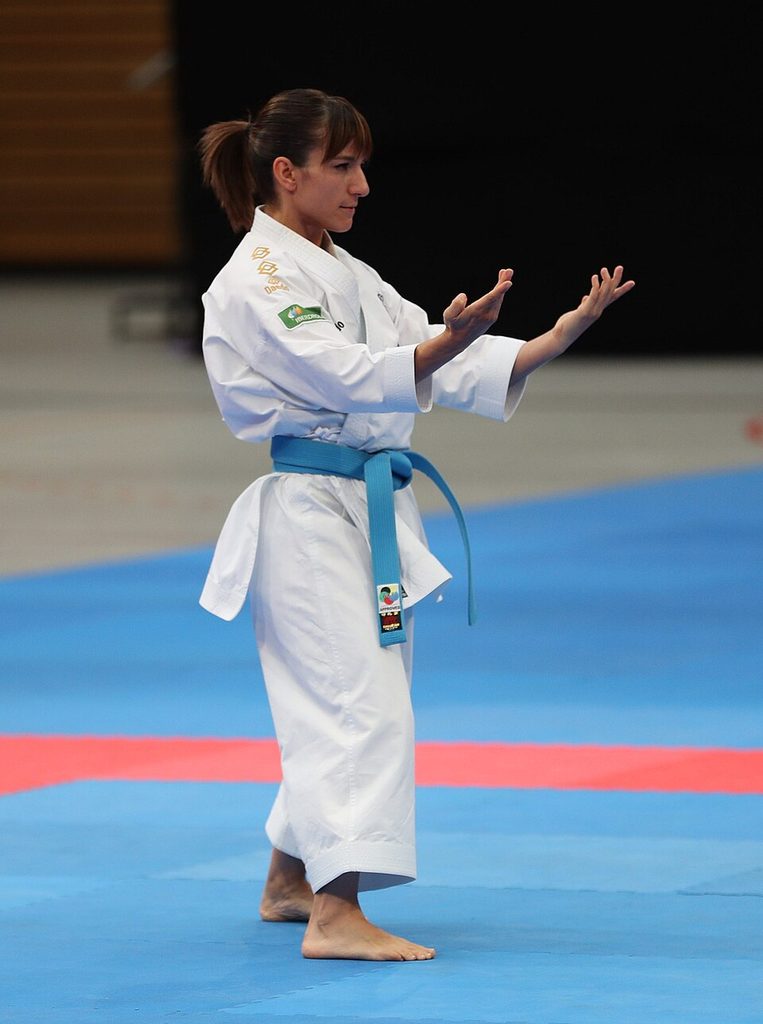
Her career did not follow the usual elite-athlete timeline
Born in Talavera de la Reina, Spain, in 1981, Sandra Sánchez discovered karate when she was only four. Her older brother was already training, and she wanted to follow him into the dojo.
Karate would eventually become the defining pursuit of her life, but her journey toward the top was anything but straightforward.
As a young woman, Sánchez reached Spain’s high-performance training environment in Madrid. Then life intervened.
Her mother was diagnosed with cancer, and Sánchez chose to return home to be with her family. It was a deeply personal decision that also changed the trajectory of her sporting career.
Instead of moving seamlessly through Spain’s elite system, she continued along a much less predictable path. She studied, worked and spent time in Australia, where she taught martial arts.
There was even a period when serious competition appeared to have been left behind.
But karate had not finished with her.
The comeback that changed everything
After returning to Spain, Sánchez was encouraged to compete again.
She also realized that simply returning was not enough. If she wanted to discover how good she could become, she needed to rebuild aspects of her karate.
That brought Jesús del Moral into the story.
Sánchez wanted him as her coach, although he initially declined. She kept asking until he eventually agreed.
The partnership became one of the defining relationships of her career.
What followed was not an immediate place on the Spanish national team. Instead, Sánchez found another way to test herself against international opposition.
That distinction would prove enormously important.
International competition does not always mean national-team selection
The phrase “international athlete” can create a misleading picture.
It does not necessarily mean that someone has already been selected to represent their country at a European or World Championship.
Depending on the event and the rules in force at the time, competitors may participate through clubs or other eligible sporting structures. Sánchez benefited from such an opportunity when she began entering the international Premier League circuit.
It gave her something invaluable: the chance to face world-class opponents and demonstrate her level even though her national-team career had not yet taken off.
The evidence can still be seen in the official results from the 2014 Karate1 Premier League in Paris.
Sandra Sánchez is listed as representing Karate Aerogym2000 – Spain.
She finished third in women’s individual kata.
At 32, she was standing on an international podium — and her greatest achievements were still ahead of her.
Then Dubai came calling
Those international appearances opened another unexpected door.
Sánchez attracted the attention of a karate club in Dubai and received an offer that would transform the practical realities of her sporting life.
She and Jesús del Moral moved to Dubai in early 2014.
Until then, Sánchez had been combining work with training and competition. In Dubai, she gained something elite athletes desperately need but do not always have: the opportunity to devote far more of her time and energy to karate.
Her results continued to improve.
Eventually, Spain could no longer overlook what was happening.
Her breakthrough arrived in her 30s
In 2015, Sánchez won the Spanish national championship.
She was 33.
By her own later accounts, her age had been part of the discussion surrounding her prospects. In many sports, 33 is an age when an athlete is expected to be approaching the end of an elite career.
Sánchez was only beginning the greatest chapter of hers.
She was selected for the European Championships in Istanbul.
Then she won them.
The athlete who had spent years outside the conventional national-team trajectory was suddenly European champion.
And it was not a one-off result.
Seven European titles, two world titles and an extraordinary Premier League record
Once Sánchez reached the summit, she remained there for years.
She won European individual kata titles in 2015, 2016, 2017, 2018, 2019, 2021 and 2022.
She became world champion in Madrid in 2018 and captured the world title again in Dubai in 2021.
Her consistency on the Karate1 Premier League circuit was extraordinary.
Guinness World Records credits Sánchez with 37 Karate1 Premier League medals between January 2014 and October 2021: 19 gold, 10 silver and eight bronze.
Consider where that extraordinary run began.
In early 2014, she was 32 and competing in Paris under the name of her club.
By the end of that period, she had become one of the most decorated kata athletes in the history of the sport.
Tokyo delivered the moment few could have predicted
Karate made its Olympic debut at the Tokyo Games.
For Sánchez, the timing could easily have worked against her. She was already 39.
Instead, it produced the defining moment of her career.
Sandra Sánchez won the women’s kata final and became an Olympic champion.
The achievement also carries unusual historical significance. Karate was not included in the Paris 2024 Olympic programme, making the Tokyo competition a unique chapter in Olympic history.
Sánchez did not immediately disappear from competition after her Olympic triumph.
She successfully defended her world title in 2021 and, in 2022, collected another European championship and World Games gold before ending her competitive career.
So, does a karate athlete need a club to compete?
Sánchez’s story highlights why this question does not have one simple answer.
Karate has several levels of competition, and they should not be confused.
For many athletes, the club is the foundation of competitive life. It is where they train, develop under coaches and enter competitions within the relevant sporting and federation structures.
International open events can operate differently from championships in which athletes officially represent their countries.
Being able to enter an international competition does not automatically mean an athlete is a member of the national team.
The 2014 Paris results provide a useful real-world illustration. Sánchez appears under Karate Aerogym2000, while other competitors in the same results are identified with national-team structures.
A European or World Championship contested by official national representatives is different. Selection and entry are governed by the relevant federation and the rules of that particular competition.
Requirements can also change over time, so current regulations should always be checked rather than assuming that the rules of one tournament apply to another.
A club can open doors, but it cannot predict an athlete’s future
For a young karateka, a good club can be enormously important.
It can provide coaching, regular training, competition opportunities and an environment in which technical, physical and psychological skills can develop.
But the name of a club alone cannot determine how far an athlete will go.
Coaching quality matters. So does access to meaningful competition, consistency, physical preparation, financial and logistical support, the athlete’s development over time and, eventually, federation selection criteria.
Sánchez’s career illustrates another important point: athletes do not all develop according to the same timetable.
Some reach international teams as teenagers. Others peak in their twenties. A very small number follow paths that almost nobody could have predicted.
Sandra Sánchez belonged to that last category.
A missed selection is a moment, not necessarily a verdict
There is an easy way to tell Sánchez’s story: a talented girl begins karate at four, works hard and eventually becomes an Olympic champion.
It is also the least interesting version because it removes almost everything that makes her career remarkable.
Her actual journey contained interruptions, work outside sport, family responsibilities, years without the international status she wanted and uncertainty about whether the opportunity she was waiting for would ever arrive.
At 32, she won a Premier League bronze in Paris representing Karate Aerogym2000.
At 33, she became European champion.
Three years later, she became world champion.
At 39, she became Olympic champion.
That does not prove that persistence inevitably produces medals. Elite sport does not work that way, and Sánchez’s achievements are exceptional precisely because so few athletes reach such heights.
What her career demonstrates is something more meaningful.
Not being selected at one stage of an athlete’s development does not, by itself, tell us where that athlete’s ceiling lies.
A selection decision reflects a particular competition, a particular moment and a particular set of circumstances.
Sandra Sánchez spent decades in karate before receiving the opportunity that transformed her international career.
When that opportunity finally arrived, she was ready for it.
And six years after winning her first European title, she stood in Tokyo as an Olympic champion.