
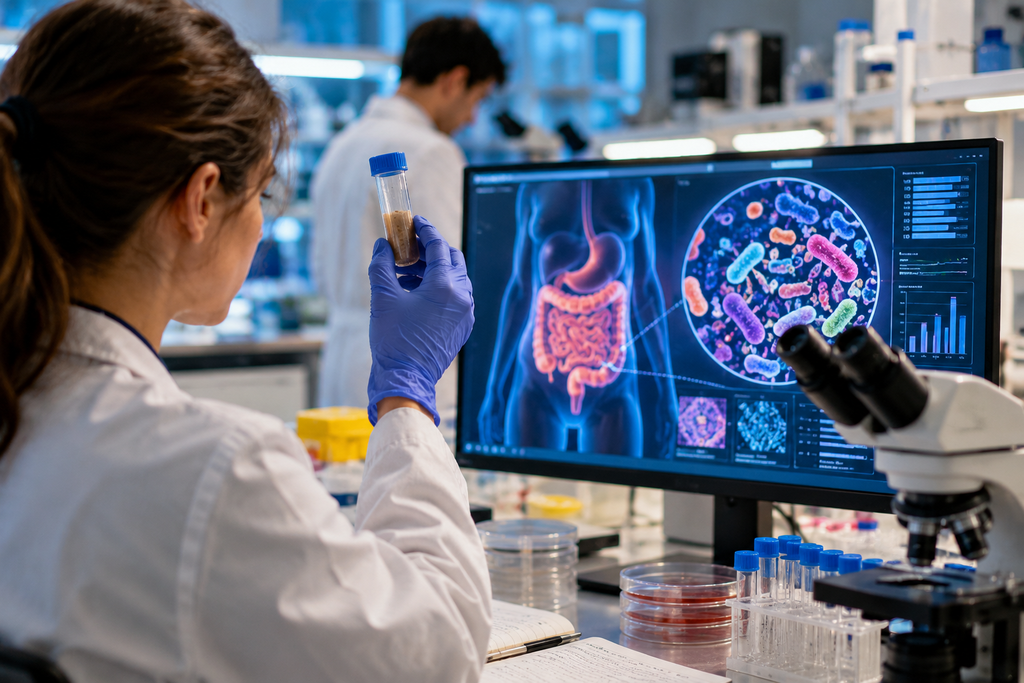
The human gut is home to a vast community of microorganisms that do far more than help digest food. They break down compounds our own cells cannot process, produce metabolites, interact with the immune system and can even alter substances that enter the body.
This microbial ecosystem, collectively known as the gut microbiome, has become one of the most closely watched areas of biomedical research.
Cancer researchers are particularly interested in it.
Studies have repeatedly found differences between the gut microbiomes of people with cancer and those without the disease. Yet there has always been a major complication: cancer is rarely the only thing distinguishing one group from the other.
Patients may be older, take different medications, have diabetes or cardiovascular disease, eat differently or experience metabolic changes related to their illness.
Any of those factors can reshape the microbiome.
So when scientists find a particular bacterium more often in people with cancer, what does that actually mean?
A large Mayo Clinic study published in Cell in September 2026 offers a much more detailed look at that question. Researchers examined the gut microbiomes of more than 1,300 cancer patients and found microbial patterns associated with specific cancer groups, early-onset disease and even the likelihood of developing a particular side effect from chemotherapy.
The findings are intriguing, but they require an important distinction from the start.
The researchers did not discover a bacterial cause of cancer.
What they found were biological signals that may help scientists understand the relationship between cancer, treatment and the microbial ecosystem living inside us.
Looking Beyond a Simple Cancer-versus-Healthy Comparison
The research was part of the Mayo Clinic Cancer Microbiome project and included stool samples from 1,364 people with cancer. Data from 287 individuals without cancer were also used for comparison.
Participants receiving cancer care came from Mayo Clinic sites in Minnesota, Arizona and Florida and represented 40 U.S. states.
Crucially, samples were collected before patients began a new treatment regimen. That gave researchers an opportunity to examine the microbiome before the next therapy could substantially alter it.
Rather than simply asking which microbes were more or less common among cancer patients, the team attempted to account for other health conditions and demographic and clinical characteristics that could influence the results.
That distinction turned out to matter.
Some microbial differences initially seen among people with cancer appeared to overlap with changes associated with other health conditions.
After researchers accounted for those potential confounding factors, however, 341 bacterial species remained associated with five cancer groups: neuroendocrine tumors, liver and intrahepatic bile duct cancers, esophageal cancer, lymphoid leukemia, and multiple myeloma and other plasma-cell malignancies.
There was no universal microbial fingerprint shared by every cancer.
Instead, different diseases showed different patterns.
Different Cancers, Different Microbial Signals
People with neuroendocrine tumors showed a broad depletion of several gut bacteria commonly associated with health.
Patients with liver and intrahepatic bile duct cancers showed increased abundance of multiple organisms, including Enterococcus faecalis.
Esophageal cancer was associated with higher levels of several species, including bacteria belonging to the genus Streptococcus.
None of these observations proves that the microorganisms caused the cancers.
A tumor can alter metabolism, inflammation, diet and other aspects of the body that may subsequently change the environment in which gut bacteria live.
But the differences were distinct enough to raise a more specific question: could the microbiome also differ according to when in life cancer develops?
Researchers explored that possibility by comparing cancers diagnosed at age 50 or younger with those diagnosed later.
The results produced some of the study’s most interesting findings.
An Unusual Signal in Early-Onset Colorectal Cancer
Rates of colorectal cancer among younger adults have attracted growing scientific attention, and researchers are still investigating why this shift is occurring.
In patients with early-onset colorectal cancer, the Mayo Clinic team detected higher fecal lactate levels along with a greater abundance of a bacterium called Veillonella parvula.
That combination is biologically interesting.
Veillonella can use lactate as part of its metabolism, while tumors themselves can generate substantial amounts of lactate.
This creates several possible explanations.
The tumor might alter its surrounding metabolic environment in a way that favors the bacterium. The microorganism might participate in biological processes relevant to the disease. Both could be influenced by another factor. Or the relationship could operate in more than one direction.
The current study cannot distinguish between those possibilities.
Most importantly, finding more V. parvula in these patients does not mean that the bacterium has been shown to cause early-onset colorectal cancer.
It is a clue worth investigating, not evidence of causation.
Early-Onset Breast Cancer Had Its Own Microbial Pattern
Researchers found another distinct signal among younger patients with breast cancer.
Early-onset breast cancer was associated with differences involving 64 bacterial species and with lower fecal levels of primary bile acids.
One organism that drew attention was Clostridium scindens, a bacterium involved in the metabolism of bile acids and steroids.
This illustrates why microbiome research extends far beyond simply cataloging which bacteria live in the intestine.
Gut microorganisms constantly manufacture, consume and transform chemical compounds. Some of those molecules can interact with human metabolism, immunity and other biological pathways.
Whether the differences observed in younger breast cancer patients contribute to disease, result from it or reflect another underlying process remains unknown.
The researchers also examined brain cancer and did not identify comparable microbiome differences between early- and later-onset cases.
That is an important negative finding.
It suggests there may not be one universal microbiome explanation for the rise or biology of cancers occurring in younger people.
The Microbiome May Also Interact With Chemotherapy
Another part of the study shifted the focus away from cancer itself and toward treatment.
Researchers examined patients receiving 5-fluorouracil, commonly known as 5-FU, a chemotherapy drug used against several cancers.
One possible side effect of 5-FU is diarrhea, which can sometimes become severe enough to complicate treatment.
The researchers already had microbiome samples collected before patients started their new therapy. That allowed them to ask whether something present in the gut beforehand was associated with who later developed the side effect.
A pattern emerged.
Patients who subsequently experienced diarrhea had lower levels of certain microbial genes involved in the metabolism of 5-FU.
Much of this activity was linked to a gut bacterium called Anaerostipes hadrus.
The organism can produce dihydropyrimidine dehydrogenase, an enzyme involved in breaking down 5-FU, and previous experimental work had already shown that A. hadrus can metabolize the drug.
In the Mayo Clinic cohort, greater microbial capacity for this process was associated with a lower risk of 5-FU-related diarrhea.
Then researchers looked for the same pattern among patients receiving another chemotherapy drug, carboplatin.
They did not find it.
That matters because it suggests the observation may be related specifically to the interaction between gut microbes and 5-FU rather than simply indicating that some patients have a generally “healthier” microbiome.
Could Gut Bacteria One Day Help Predict Treatment Side Effects?
This may eventually become one of the clinically useful directions opened by microbiome research.
Imagine being able to analyze a patient’s microbiome before treatment and combine that information with other clinical markers to estimate the likelihood of certain adverse effects.
That is not what doctors can routinely do today.
The current results need validation in prospective studies and independent populations before such microbial signatures could become clinical tools.
There is another complication as well.
If bacteria metabolize an anticancer drug, researchers need to determine not only whether that reduces toxicity but also whether it changes how much active drug reaches the tumor.
Preventing a side effect would not be beneficial if the same process weakened the treatment’s anticancer activity.
For that reason, the findings do not provide a basis for patients to try to increase a particular bacterial species themselves, nor do they demonstrate that taking a probiotic can prevent 5-FU toxicity.
That question remains a matter for future research.
Survival Was Linked to Certain Microbes Too
The researchers also examined whether bacterial patterns were associated with patient survival.
Associations appeared in several cancers, including colorectal, liver and intrahepatic bile duct, melanoma, ovarian and prostate cancers.
In liver and intrahepatic bile duct cancers, for example, Bifidobacterium longum was associated with longer survival, while Blautia A massiliensis was associated with shorter survival.
Again, these are associations rather than proof that either microorganism changes how long a patient lives.
A person’s microbiome may reflect numerous aspects of health, including diet, metabolism, immune function, disease severity and medications.
A bacterium associated with better outcomes might therefore be a marker of another biological process rather than the reason for the outcome itself.
But associations like these give scientists specific organisms and pathways to investigate experimentally.
What the Study Did — and Did Not — Discover
It is tempting to turn microbiome findings into dramatic conclusions.
This research does not show that scientists have discovered “the bacteria that cause cancer.”
It does not establish a stool test that can currently diagnose the cancers studied.
It does not show that probiotics can prevent cancer.
And it does not provide a method for changing the gut microbiome at home to reduce cancer risk or improve chemotherapy outcomes.
What researchers found is more nuanced.
Within an extraordinarily complicated microbial ecosystem, they identified patterns associated with particular cancer groups, with the age at which some cancers develop, and with how some patients tolerate a specific chemotherapy drug.
That makes the microbiome potentially valuable as a source of biological information.
If such findings are repeatedly validated, microbial signatures might eventually be considered alongside tumor genetics, blood tests, medical history and other biomarkers when researchers and clinicians characterize disease or treatment risk.
But discovering a potential biomarker and demonstrating that it improves patient care are very different stages of medical research.
This work is still much closer to the first.
The Biggest Question Is Still Unanswered
Behind all these findings lies an even more fundamental problem.
Which comes first: cancer or the altered microbiome?
There may not be one answer.
Some microorganisms could potentially influence inflammation, metabolism or immune pathways in ways that affect disease biology.
In other cases, cancer itself may reshape the body enough to alter the gut environment, causing microbial populations to change in response.
And some relationships could be bidirectional, with the disease and microbial ecosystem influencing each other over time.
Observational studies can reveal these relationships, but they cannot by themselves establish the direction of cause and effect.
That is why the next phase is so important: researchers need to test the biological mechanisms behind the microbial signals they have identified and determine whether the treatment-related findings can be reproduced in larger patient groups.
Cancer Biology May Extend Far Beyond the Tumor
Perhaps the most important message from the research is not about any individual bacterium.
It is about how we think about cancer.
A tumor does not exist in isolation. It develops inside a biological system where immunity, metabolism, medications, diet and microorganisms are constantly interacting.
The gut microbiome is part of that system.
For now, the Mayo Clinic findings do not change standard cancer treatment, and they do not justify taking probiotics or attempting to manipulate gut bacteria as a cancer therapy.
What they do provide is a map of potentially meaningful signals hidden inside an immensely complicated ecosystem.
Some may ultimately prove to be consequences of cancer rather than contributors to it. Others may turn out to have little clinical value.
But a few could eventually help explain why the same disease behaves differently from one person to another — or why two patients receiving the same drug can experience very different side effects.
The most intriguing question raised by the study, then, may not be whether bacteria “cause cancer.”
It is something broader:
How much information about disease has been hiding all along inside the microscopic ecosystem we carry with us?