
In 2013, a message posted on a Chinese online support forum began spreading across the internet for one unsettling reason: it sounded less like a plea for sympathy and more like a direct negotiation with fate.
The woman behind the post was Wang Xiao, a young patient living with advanced kidney failure. After years of treatment, dialysis sessions, and failed attempts to find a compatible donor within her family, she had reached a point where conventional solutions no longer seemed realistic.
So she decided to say publicly what most people would never dare to admit out loud.
She was searching for a terminally ill man with a matching blood type who would be willing to marry her and donate a kidney after death. In exchange, she promised she would care for him through the remainder of his illness and support his family afterward.
To some readers, the message felt shocking and emotionally cold.
To others, it felt painfully honest.
It was the voice of someone who no longer had the luxury of pretending everything would somehow work out on its own.
The Illness That Had Taken Over Her Life
According to Chinese media reports from that period, Wang Xiao had been diagnosed with severe renal failure, often referred to in local coverage as uremia, a life-threatening condition that develops when the kidneys can no longer remove toxins and waste products from the bloodstream effectively.
Under normal conditions, the kidneys continuously filter blood, regulate fluids, and help maintain chemical balance throughout the body. When kidney function declines dramatically, dangerous substances begin accumulating in the bloodstream, slowly affecting nearly every organ system.
Patients with advanced kidney disease often experience:
- extreme fatigue;
- fluid retention;
- chronic nausea;
- anemia;
- cardiovascular complications;
- breathing difficulties;
- neurological symptoms.
For many people in end-stage renal disease, dialysis becomes a permanent part of life unless a transplant becomes possible.
At such a young age, Wang Xiao’s daily routine had already become structured around hospital visits, treatment schedules, and physical exhaustion. People living with long-term dialysis frequently describe the experience as existing in a suspended state between survival and normal life.
Understanding that reality helps explain why her online post sounded so blunt.
She was not searching for romance at first.
She was searching for time.
The Man Who Answered Her Message
Among the thousands of people who saw her post was Yu Jianping, a 27-year-old former business manager who was battling multiple myeloma, a serious blood cancer that affects plasma cells inside the bone marrow.
Multiple myeloma is considered a complex and potentially aggressive disease. It can weaken bones, damage the immune system, cause severe anemia, and in some cases contribute to kidney complications as well.
Reports published in Chinese newspapers described Yu as someone whose life had already been deeply altered by illness. He had reportedly undergone a bone marrow transplant once before, only for the cancer to return later. Some outlets also stated that his family had struggled financially under the cost of treatment, with relatives selling property to continue paying medical expenses.
Emotionally, he appeared exhausted long before meeting Wang Xiao.
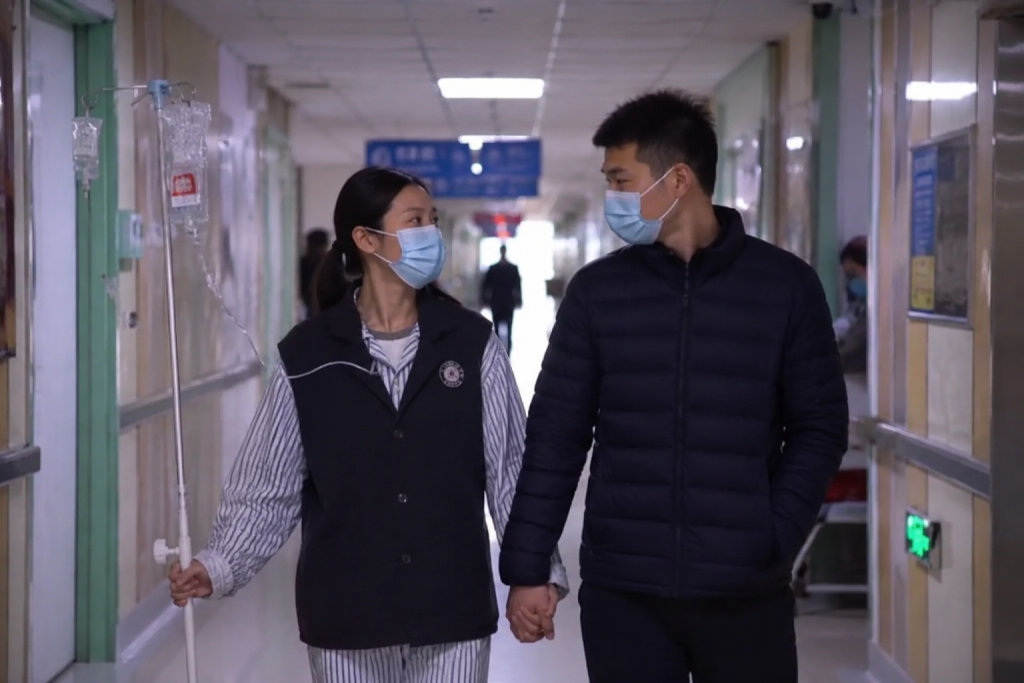
But instead of reacting with outrage or disbelief after reading her message, he responded with remarkable simplicity.
“I can marry you.”
A Relationship That Began as an Agreement
The two met in Xi’an not long afterward.
Unlike the idealized version often repeated online today, their first meetings were reportedly quiet and awkward rather than cinematic. They were not two carefree young people falling in love under normal circumstances. They were two patients who had already spent years navigating hospitals, uncertainty, and the constant awareness that their futures might be very short.
Yet something unexpected happened once they started talking regularly.
They understood each other immediately.
Both had become familiar with fear.
Both had learned how illness strips away superficial conversations.
Both were tired of people pretending not to be afraid of death.
Chinese reports about their relationship frequently mention the dark humor they shared during online conversations. In one story that later circulated widely, Wang Xiao jokingly referred to herself as a “one-handed monster” while connected to a dialysis machine because one arm had to remain still during treatment.
Yu later admitted that he had not laughed genuinely in a very long time before meeting her.
Their Marriage Was Originally Practical, Not Romantic
On July 16, 2013, the couple officially registered their marriage.
Several Chinese media outlets reported that they also created a written agreement outlining the practical nature of their arrangement. Different reports describe slightly different details, but most versions included similar conditions:
- they would maintain separate finances;
- they were not obligated to live together full time;
- if Yu died and remained medically compatible, Wang could potentially receive one of his kidneys;
- in return, she promised to help care for his father after his death.
To outsiders, the arrangement seemed difficult to understand.
But serious illness often changes the way people think about relationships, survival, and emotional priorities. When people are forced to confront mortality daily, practicality and emotional vulnerability can become deeply intertwined.
Over time, what began as a survival agreement slowly evolved into something much more personal.
How Illness Slowly Brought Them Closer
As months passed, their relationship began shifting beyond the original arrangement.
Wang accompanied Yu to treatments and medical appointments.
Yu cooked for her after dialysis sessions.
They spent long hours together in hospital corridors discussing fears most healthy people try not to think about.
Psychologists who study chronic illness have often noted that shared vulnerability can create unusually intense emotional bonds. People facing long-term medical uncertainty sometimes form deep attachments quickly because many of the social barriers present in ordinary relationships disappear.
That appears to have happened with Wang Xiao and Yu Jianping.
The more time they spent caring for one another, the less their relationship resembled a contract and the more it resembled a genuine partnership.
The Flower Stall That Changed Their Future
At one point, Yu’s condition reportedly worsened again, and his family struggled to afford additional treatment.
That was when Wang Xiao began selling flower bouquets on the street.
Beside the flowers, she placed handwritten notes explaining their story. Passersby became curious. Customers returned. Local media outlets eventually picked up the story, and public attention around the couple grew rapidly across Chinese social media.
According to multiple reports, donations and public support eventually helped raise a substantial amount of money for Yu’s medical treatment, though exact figures vary depending on the source.
What started as a small roadside flower stand gradually became symbolic of something much larger: two seriously ill people refusing to disappear quietly.
The Outcome Nobody Expected
Over time, both of their medical situations reportedly became more stable.
Yu underwent additional treatment and entered a period of remission.
Meanwhile, some reports suggested that Wang Xiao’s condition improved enough for her dialysis schedule to decrease.
Online retellings often exaggerate this phase as a miraculous recovery story, but the medical reality is more complicated. Both kidney failure and multiple myeloma can involve periods of stabilization depending on treatment response, disease progression, and individual circumstances.
Importantly, there is no public evidence that Wang Xiao ever received Yu’s kidney.
Ironically, the transplant that originally brought them together never ended up happening.
The Story That Continued Long After the Headlines
In February 2015, Wang Xiao and Yu Jianping reportedly held a larger wedding ceremony attended by friends and relatives who had gradually learned how unusual their relationship had truly been from the beginning.
By then, many people across China had already followed their story for years.
What fascinated the public was not simply the medical aspect of the case. It was the uncomfortable honesty behind it. Their relationship had not started with idealism or fantasy. It began with fear, desperation, and two people trying to negotiate survival in the only way they knew how.
And yet, somewhere in the middle of that difficult reality, genuine affection appeared.
That may be why the story continues to resonate long after the original headlines faded.
Not because it feels like a fairy tale.
But because it feels deeply human.