
From the ground, the climber was barely visible against the enormous rock face. He had reached a tiny ledge high above the base of Mount Yonah, but the route that had taken him upward had effectively become a trap.
Going higher was no longer safe. Getting back down was no longer a realistic option either.
On the evening of August 25, 2026, emergency crews in White County, Georgia, were called to Mount Yonah after a climber became stranded on its western face. He was not injured, but his position left almost no room for error.
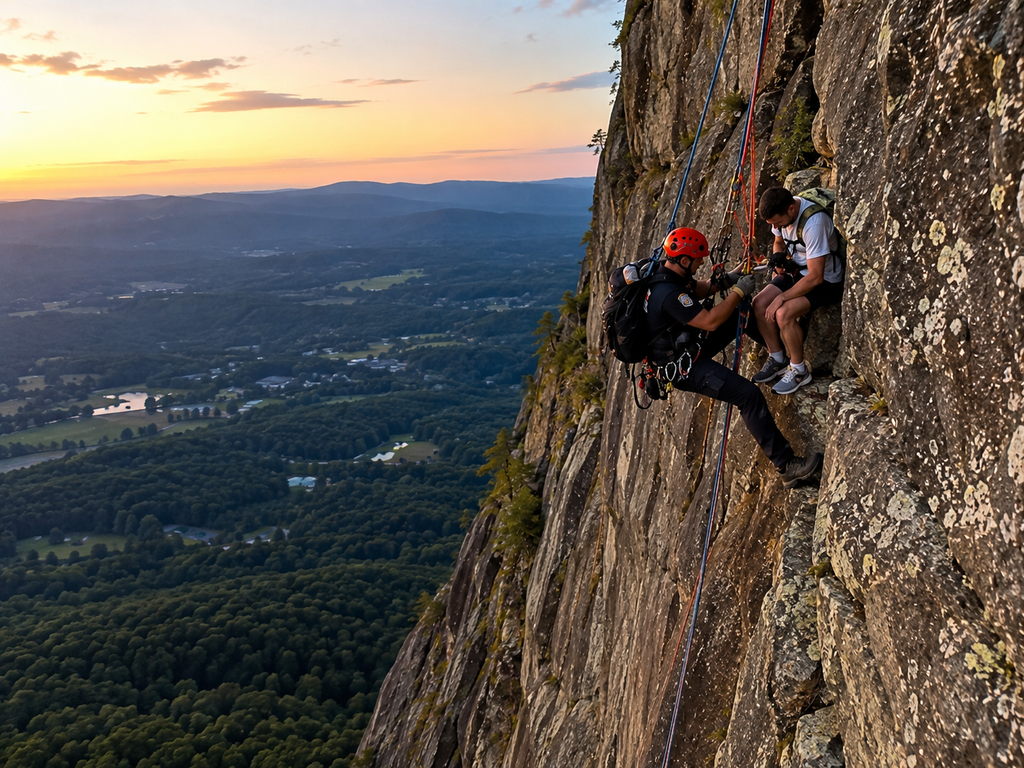
What followed was a remarkably efficient rescue involving a drone, a technical rope team and a firefighter descending directly down the rock face.
Yet the incident also illustrates something less obvious: in climbing, reaching a position successfully does not necessarily mean you can safely reverse the moves that brought you there.
A 911 call from the side of the mountain
Shortly after 7 p.m., White County emergency dispatchers received a call from a climber who said he was stuck on Mount Yonah.
According to local authorities, he had reached a point where he could neither safely continue upward nor retreat. (Now Habersham)
Emergency teams needed to know exactly where he was before attempting a technical rescue, so White County Emergency Management deployed a drone.
The aerial search quickly revealed just how precarious his position had become.
The climber was approximately 260 feet — about 79 meters — above the base of the rock face, standing on a ledge reported to measure roughly 20 by 20 inches, or about 51 by 51 centimeters. (Now Habersham)
He had found somewhere to stop.
Finding a safe way out was another matter.
How can someone climb up but be unable to climb back down?
To someone watching from below, the solution can appear deceptively simple: if he climbed there, why not just reverse the route?
Rock climbing does not always work that way.
When moving upward, a climber generally searches for holds ahead and above the body. While descending, footholds can be below the climber’s field of view, body positioning changes, and a sequence that felt manageable in one direction may be significantly harder to reproduce in reverse.
There is another problem.
A climber can complete several manageable moves before discovering that the terrain ahead has suddenly become much harder. At that point, the previous moves may also be difficult or dangerous to reverse.
With appropriate protection, a mistake or failed move does not necessarily result in an uncontrolled fall. Without an effective fall-protection system, however, the consequences can be dramatically different.
That is why stopping can sometimes be the most important decision a climber makes.
The terminology matters: free climbing is not necessarily free soloing
Some reports describing the Mount Yonah incident referred to the man as a “free climber.” That wording can easily create another misconception.
In climbing terminology, free climbing does not mean climbing without a rope.
Free climbing means that the climber uses natural features of the rock — primarily hands and feet — to make upward progress. Ropes and protective equipment may still be used to arrest a fall; they simply are not used as mechanical assistance to move upward.
Free solo climbing is different.
In free soloing, the climber ascends without a rope-based safety system capable of stopping a fall. The distinction is crucial because the consequences of a mistake can therefore be radically different.
The American Alpine Club has repeatedly discussed the particular risks associated with unroped climbing and scrambling, including incidents involving highly experienced climbers. (American Alpine Club)
Reports from Mount Yonah indicate that the stranded man did not have a system that allowed him to safely retreat from his position. But without a detailed account from the climber himself, it is better not to assign a more specific climbing discipline than the available evidence supports.
The dramatic drone footage had a practical purpose
The aerial footage makes the rescue look almost cinematic. But the drone was not there primarily to record dramatic images.
It was part of the rescue operation.
Finding a person on a large rock face can be difficult even when rescuers know the general area from which a 911 call originated. A relatively small difference in location can also affect where ropes can be anchored and how rescuers approach the casualty.
White County Emergency Management’s unmanned aircraft allowed crews to locate the climber rapidly and assess his position before sending a rescuer over the edge. Local reporting based on information from public-safety officials credited the drone with helping teams identify his location quickly. (WRWH)
The technology solved one problem.
The next part still required a person to go down after him.
Firefighter Will Roper went over the edge
Once rescuers had established the climber’s location, they prepared a technical rope system from above.
Firefighter Will Roper then rappelled down the rock face toward the stranded man.
Roper reached him, secured him into the rescue system and worked with the team positioned above to get both men back to safety.
White County Fire Services, White County EMS, White County Emergency Management and the Georgia Department of Natural Resources were involved in the response. Local officials reported that the rescue was completed approximately 42 minutes after emergency personnel arrived on scene. The climber was brought out without injury. (Now Habersham)
There was another remarkable detail behind the footage.
Although Roper had trained for technical rope rescues, this was reportedly his first real mountain rescue involving an actual stranded person. His previous preparation had involved training scenarios with mannequins and fellow firefighters.
Speaking afterward, he acknowledged the tension of going over the edge for the real thing. (FOX 5 Atlanta)
Training had turned an extraordinary situation into a sequence of procedures that the rescue team could execute methodically.
Experience changes risk, but it does not abolish it
The Mount Yonah story becomes more interesting when another detail is considered.
According to Roper’s account of their conversation, the climber indicated that he had previous experience on Mount Yonah but had ended up on the wrong route.
That matters because outdoor accidents are often portrayed as the inevitable result of complete inexperience. The reality is more complicated.
Experienced climbers generally have better movement skills, route-reading ability and risk awareness than beginners. But familiarity can never eliminate environmental uncertainty, navigation errors, changing conditions or ordinary human mistakes.
The American Alpine Club’s accident-prevention material has highlighted this problem in discussions of serious incidents involving experienced people on familiar terrain. Experience is enormously valuable, but it cannot make an inherently consequential mistake harmless. (American Alpine Club)
In this case, recognizing that the situation had exceeded what could safely be solved alone may itself have prevented an accident.
Rescue is not failure
Adventure stories tend to celebrate the person who keeps going.
Mountain safety sometimes requires exactly the opposite instinct.
Once the climber was stranded roughly 260 feet above the base of Mount Yonah, attempting increasingly uncertain moves simply to avoid calling for help could have transformed a rescue operation into something far worse.
Instead, he stopped.
He contacted emergency services. A drone located him. A technical team established a rope system. A firefighter descended the cliff, secured him and brought him back.
Nobody was injured.
The spectacular footage naturally draws attention to the height, the tiny ledge and the rescuer suspended against a vast wall of rock. But the most useful lesson from Mount Yonah is less dramatic.
Good judgment in the mountains is not only about knowing how to move forward. Sometimes it is recognizing the moment when the safest next move is not to move at all.