
What would happen if a human lost an arm and, instead of forming a scar, the body rebuilt everything perfectly—bones, muscles, nerves, and blood vessels—exactly as before? For us, this idea still belongs to science fiction. For a small, delicate-looking animal with feathery external gills and a permanent “smile,” it is biological reality.
The axolotl (Ambystoma mexicanum) is not just an unusual species—it is one of the most important models scientists have today for understanding the limits, or perhaps the hidden potential, of the living body.
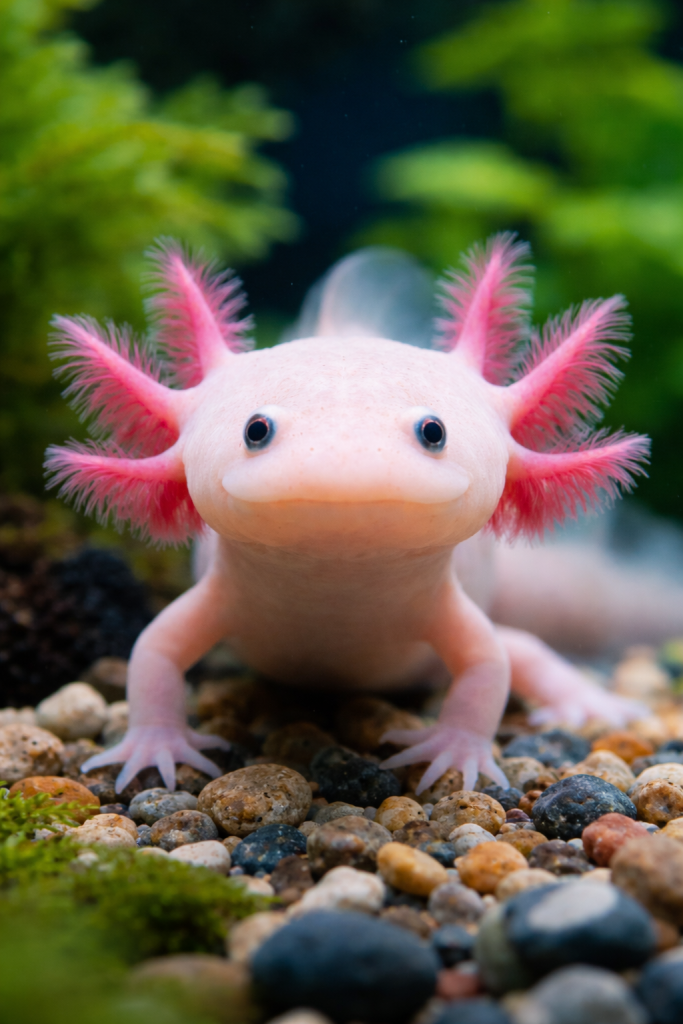
An Organism That Doesn’t Repair—It Rebuilds
In the human body, healing focuses on closing wounds quickly. This process almost always leads to scar tissue, an efficient but imperfect solution where the original structure is not fully restored.
In axolotls, things work differently. Instead of repairing, the body rebuilds.
This animal can regenerate entire limbs, its tail, parts of the heart, segments of the brain, the spinal cord, and even structures of the eye. The new tissue is structurally and functionally identical to the original. There are no scars, no deformities, and no weaker replacements.
Even more remarkable, regeneration is not limited to simple tissues. The axolotl is a vertebrate, meaning it has a spinal column and a central nervous system. Portions of the spine and spinal cord can regenerate, and nerve connections can reform in ways that restore function.
In laboratory observations, the same limb has been regenerated multiple times without noticeable loss of quality. For humans, an injury leaves a mark. For the axolotl, it marks the beginning of reconstruction.
How Is This Possible?
After an injury, the axolotl’s body enters a unique biological state. Instead of triggering typical wound-healing pathways, nearby cells temporarily lose their specialized identity and revert to a more flexible, stem-like state.
This process, known as dedifferentiation, leads to the formation of a structure called a blastema—a kind of biological reconstruction center where developmental programs are reactivated.
Cells within the blastema receive precise signals about their position, what type of tissue they must become, and the order in which structures should be rebuilt. The result is a highly organized and controlled regeneration process that restores original proportions and function.
Researchers have also observed that axolotls can accept transplanted tissue from other axolotls with relatively limited immune rejection, suggesting a more permissive immune response. In addition, their genome is about ten times larger than the human genome, containing extensive genetic material linked to regeneration processes that are still being studied.
Why Can’t Humans Do This?
If nature has already solved this problem, why can’t we do the same?
Humans do have some regenerative abilities—skin heals, and the liver can partially regenerate—but these processes are limited. Key differences include a stronger inflammatory response that favors scarring, the inability to form a functional blastema, and limited capacity to reprogram mature cells.
In simple terms, the human body prioritizes rapid closure of a wound, not full reconstruction.
Why the Axolotl Matters for Science
The axolotl is one of the most widely studied organisms in regenerative biology and medicine. Its ability to regenerate complex structures, including the spinal cord, makes it highly relevant for research into neurological injuries.
Scientists are working to understand how regeneration-related genes are activated, how cells communicate during reconstruction, and how inflammation can be regulated. Its ability to regenerate parts of the heart and brain without scarring makes it especially valuable for studying cardiovascular and neurological conditions.
While practical medical applications are still under investigation, the insights gained from axolotl research are helping shape the future of regenerative medicine.
Where It Lives and How It Survives
The axolotl lives exclusively in freshwater, primarily in the lakes and canals of Xochimilco, near Mexico City. It is a strictly aquatic animal and is not adapted for life on land, even though it has rudimentary lungs and can occasionally gulp air from the surface.
If removed from water for extended periods, it can quickly dehydrate and may not survive. In laboratory conditions, axolotls can be induced to transition into a more terrestrial form through hormonal changes, but in doing so, they lose much of their regenerative ability and become more vulnerable.
Is It Dangerous and What Does It Eat?
The axolotl is not dangerous to humans. It is not venomous, not aggressive, and generally avoids conflict.
It feeds on worms, aquatic insects, larvae, small crustaceans, and small fish. Its eyesight is limited, but it compensates by detecting movement and vibrations in the water. It captures prey through suction, quickly drawing it into its mouth.
Because of its relatively slow metabolism, an adult axolotl can go several days without food and, in some cases, up to one or two weeks under controlled conditions. However, prolonged fasting is not ideal and can affect its health.
Lifespan and Vulnerability
In captivity, axolotls can live around 10 to 15 years, sometimes longer with proper care. In the wild, their lifespan is often shorter due to environmental pressures.
Despite their remarkable regenerative abilities, axolotls are sensitive to changes in their habitat and depend on stable environmental conditions.
An Animal That Stays “Young” for Life
Axolotls exhibit a phenomenon called neoteny, meaning they retain juvenile characteristics throughout their lives. They remain aquatic, keep their external gills, and do not fully transition into a terrestrial adult form like other salamanders.
This lifelong biological “plasticity” may be one of the keys to their regenerative capacity.
The Paradox: Famous, Yet Critically Endangered
Although axolotls are well known and widely studied in laboratories and aquariums, they are critically endangered in their natural habitat.
Pollution, urban expansion, and invasive species have significantly reduced wild populations. As a result, an animal that could help shape the future of medicine is at risk of disappearing from the environment where it evolved.
What the Axolotl Teaches Us
The axolotl is more than a biological curiosity. It is proof that complete regeneration of complex structures is possible in nature.
It shows that scarring is not the only solution, and that living systems can rebuild, not just repair.
We do not yet know whether humans will ever achieve similar capabilities. But we do know that such processes exist.
The real question is no longer whether full regeneration is possible, but how close we are to understanding it well enough to apply it.