
At first glance, it hardly looks like a caterpillar.
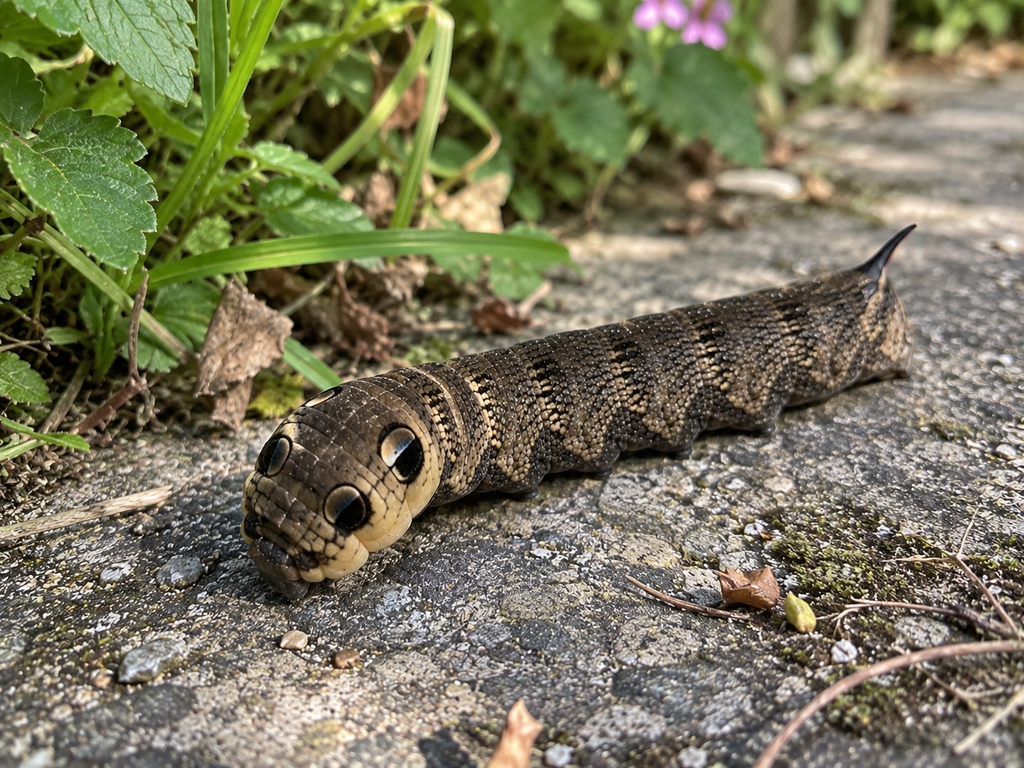
Its body is thick and heavy, its markings resemble enormous eyes, and when disturbed, the front of its body can suddenly take on the appearance of a tiny snake staring back at you.
For anyone finding one among garden plants or crawling across a path, the reaction is understandable: what exactly is this creature, and should you keep your distance?
The answer is much less alarming than its appearance suggests.
This is the caterpillar of the elephant hawk-moth, Deilephila elpenor, a widespread member of the Sphingidae family. Its larval stage is famous for an extraordinary defensive display, while the adult moth looks dramatically different, with striking pink and olive-green wings.
And those intimidating “eyes” on the caterpillar? They aren’t eyes at all.
A face that doesn’t really exist
The caterpillar’s actual head is surprisingly small and easy to overlook.
When the animal senses danger, it pulls its head and the front portion of its body backwards. This makes the segments immediately behind the head appear larger and draws attention to prominent oval markings known as eyespots.
Suddenly, the outline changes.
Instead of looking like a soft caterpillar that might make an easy meal, it can resemble the head of a small snake.
The Royal Horticultural Society describes this defensive response and notes that the swollen front of the caterpillar, together with its eye-like markings, is thought to give it a snake-like appearance that may deter predators.
It is a clever illusion because the threatening “face” we see isn’t its face at all.
It’s surprisingly large
Size makes the encounter even more convincing.
A fully grown elephant hawk-moth caterpillar can reach around 8 centimetres in length. Mature larvae are commonly brown or greyish, although green forms also occur.
At the opposite end from the head is a small horn-like projection, another characteristic commonly associated with hawk-moth caterpillars.
Despite appearances, this isn’t a stinger.
For someone unfamiliar with the species, however, the combination of its size, false eyes and unusual body shape can make it look far more threatening than an ordinary garden caterpillar.
So, can it hurt you?
Its appearance is essentially a bluff.
The elephant hawk-moth caterpillar isn’t equipped with venomous fangs or a dangerous stinger, and there is no reason to kill one simply because of its intimidating appearance.
In fact, the Royal Horticultural Society considers the occasional feeding damage caused by these caterpillars insufficient to justify control in gardens and encourages gardeners to tolerate them as part of garden biodiversity.
If one is feeding quietly on vegetation, leaving it where it is will usually be the best option.
Why you might find one wandering across the ground
One of the easiest times to notice these caterpillars is when they appear to have abandoned their plants.
That doesn’t necessarily mean something has gone wrong.
Once a larva has finished growing, it eventually stops feeding and begins looking for a protected place where it can pupate. That search may take it away from vegetation and across lawns, patios, paths or other exposed areas.
This explains why people sometimes encounter a large caterpillar apparently travelling with no obvious destination.
If it is crossing a busy path where it could easily be stepped on, moving it a short distance to nearby shelter can protect it. Otherwise, there is little reason to interfere.
What’s on the menu?
Elephant hawk-moth caterpillars are strongly associated with willowherbs, particularly rosebay willowherb, but their menu isn’t restricted to a single plant.
They are also found on plants including bedstraws and fuchsia, which helps explain why the species can turn up in ordinary gardens rather than only in wild habitats. The RHS also lists enchanter’s nightshade among recorded food plants.
Much of the caterpillar’s feeding takes place after dark.
A remarkably large larva can therefore live among garden plants without attracting much attention — until the day it decides to wander somewhere much more visible.
The brown “snake” becomes a pink moth
If you have only seen the caterpillar, the adult can come as a genuine surprise.
After pupation, the rather sombre brown larva eventually emerges as an elegant moth dominated by vivid pink and olive-green markings. Adults have a wingspan of roughly 6–7 centimetres and are primarily active at night.
The transformation is striking enough that photographs of the larva and adult placed side by side can look as though they belong to completely unrelated animals.
But the adult has another remarkable characteristic that isn’t visible in a photograph.
It can see colour at night.
A moth that can distinguish colours under starlight
This is where Deilephila elpenor becomes more than simply a caterpillar with an unusual disguise.
In a landmark experiment published in Nature in 2002, researchers Almut Kelber, Anna Balkenius and Eric Warrant investigated the elephant hawk-moth’s visual abilities under extremely dim conditions.
They demonstrated that the moth was capable of using colour vision at light intensities corresponding roughly to a starlit night. The researchers also found evidence of colour constancy — the ability to identify colours despite changes in illumination.
For a nocturnal insect, this is an extraordinary ability.
Further research into the visual system of elephant hawk-moths has helped scientists understand how nocturnal insects gather and process the tiny amounts of light available after sunset.
So the same animal that spends its youth fooling observers with false eyes eventually becomes a moth capable of navigating a visual world that is almost dark to us.
Why is it called an “elephant” hawk-moth?
The name doesn’t come from the colourful adult.
It refers to the caterpillar.
Its narrow, flexible front section was historically thought to resemble an elephant’s trunk, giving rise to the “elephant” part of the common English name. “Hawk-moth” refers to the family of powerful, fast-flying moths to which the species belongs.
There is something rather fitting about the confusion.
Humans saw an elephant when naming it, while its defensive posture makes many modern observers think of a snake.
In reality, of course, it is neither.
Where does it go in winter?
Toward the end of the larval stage, the caterpillar leaves its food plant and pupates close to ground level, often among vegetation and leaf litter.
In much of its European range, it spends the winter as a pupa. When conditions become suitable the following season, the adult moth emerges and the cycle begins again.
Timing varies with geography and climate, so observations from one European country shouldn’t automatically be used as an exact calendar for another.
The broader pattern, however, explains something important: a large caterpillar wandering around late in its development may simply be searching for the place where it will spend the next stage of its life.
This isn’t an exotic creature
The elephant hawk-moth has a broad Eurasian distribution. Records collected through biodiversity databases such as GBIF show how widely Deilephila elpenor occurs, and the species is also recorded in Romania.
That means a photograph of one taken in a Romanian garden isn’t evidence of some unusual tropical species suddenly appearing in the country.
It belongs here.
What makes the encounter memorable isn’t its exotic origin, but how effectively its appearance can fool someone who has never seen it before.
Sometimes the best response is simply to watch
We tend to make very quick decisions about unfamiliar animals. Something strange appears in the garden, and the first questions are often whether it bites, stings or needs to be removed.
The elephant hawk-moth caterpillar is almost perfectly designed to encourage that reaction.
Its survival strategy depends partly on looking more intimidating than it really is.
But once we know what we’re seeing, the encounter becomes much more interesting than frightening.
Left undisturbed, that bulky caterpillar with its enormous false “eyes” will eventually disappear into a sheltered spot and undergo a complete transformation. What emerges later bears little resemblance to the supposed miniature snake: a vivid pink-and-olive moth that flies after sunset and can distinguish colours in light dim enough to challenge human vision.
Sometimes the strange creature crossing a garden path doesn’t need to be feared or removed.
It just needs enough time to become something entirely different.