
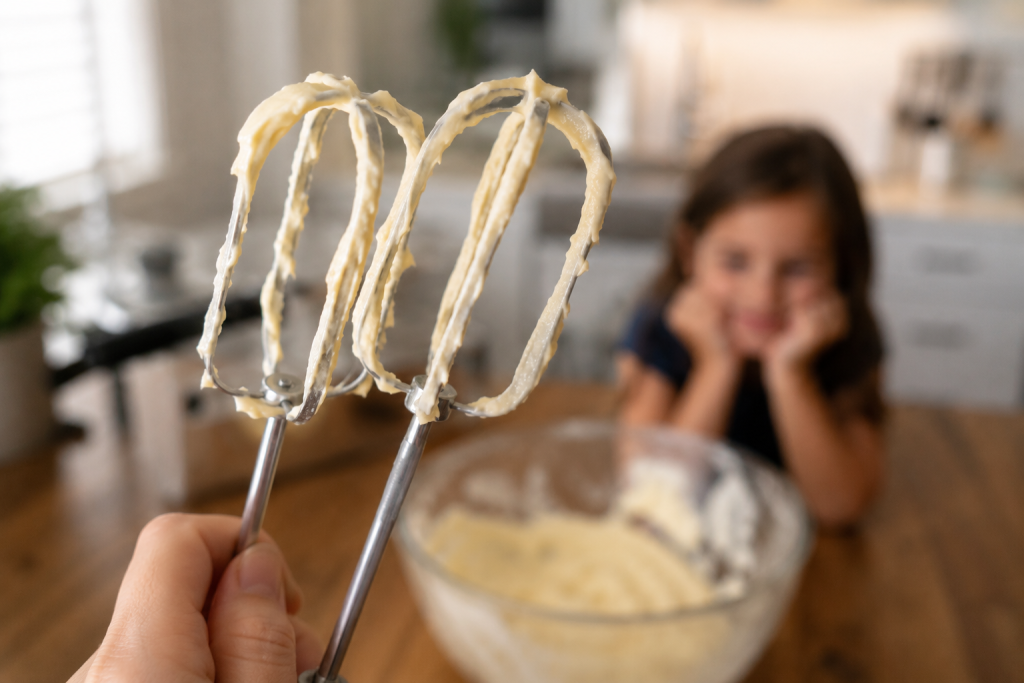
For many people, one of the most vivid memories of home baking has little to do with the finished cake itself. Long before the dessert came out of the oven, there was a moment children eagerly waited for: the chance to lick the mixer beaters coated with cake batter.
As a parent poured the mixture into a baking pan, those remaining traces of vanilla-scented batter often felt like a special reward. It was a simple ritual shared across countless households, one that became part of family life and childhood nostalgia.
Today, however, food safety experts view that familiar tradition a little differently.
Why So Many People Remember It Fondly
Researchers who study memory have long noted that taste and smell are among the strongest triggers of nostalgia. The aroma of a cake baking in the oven, combined with the sweetness of uncooked batter, can instantly bring back memories of family kitchens, celebrations, and time spent with parents or grandparents.
For children, licking the beaters was rarely just about the flavor. It often felt like being included in the baking process, turning an ordinary afternoon into something memorable.
What We Have Learned About Raw Batter
For decades, most warnings about uncooked cake batter focused on raw eggs. Certain eggs can occasionally carry bacteria such as Salmonella, which is why food safety authorities recommend avoiding foods that contain raw or undercooked eggs.
What many people do not realize is that eggs are not the only concern.
Research over the past several years has shown that raw flour can also contain harmful bacteria, including certain strains of Escherichia coli (E. coli). Because flour is made from grains grown outdoors and is not treated as a sterile product, microorganisms can sometimes survive until the flour is cooked or baked.
While the baking process destroys these pathogens, they may still be present in uncooked dough or batter.
Does That Mean Everyone Was Taking a Risk?
Technically, yes—but context matters.
Generations of children sampled cake batter, cookie dough, and mixer beaters without experiencing any health problems. The overall risk for healthy individuals is relatively low, which is why many people associate the practice with pleasant childhood memories rather than illness.
The challenge is that contamination cannot be detected by appearance, smell, or taste. A batch of batter may be perfectly safe, while another could contain bacteria that lead to foodborne illness.
That uncertainty is why modern food safety recommendations tend to be more cautious than those commonly followed decades ago.
A Small Piece of Childhood Worth Remembering
The image of a child waiting beside the kitchen counter for a turn with the mixer beaters remains a familiar one in many parts of the world. It represents family traditions, homemade desserts, and the excitement that came before the first slice of cake was ever served.
Understanding the science behind raw ingredients does not erase those memories. Instead, it helps explain why food safety guidance has evolved over time.
Today, some recipes are specifically designed for safe consumption before baking, using heat-treated flour and ingredients that eliminate the concerns associated with traditional raw batter. It is a modern solution that allows people to enjoy a familiar flavor while reducing potential risks.
For many adults, though, the memory itself remains the sweetest part: standing in the kitchen, watching a cake take shape, and hoping someone would hand over the mixer beaters before they were washed.