
Some products become famous because of how they taste. Others become famous because of the story behind them. This coffee sits right at the intersection of both—and for many people, that story is hard to ignore.
The idea is simple, yet unsettling at first glance: coffee beans that have passed through an animal’s digestive system, later collected, processed, and turned into one of the most expensive cups of coffee in the world. The instinctive reaction is often skepticism or even disgust. But behind that reaction lies a process that is real, studied, and more complex than it initially seems.
The real question isn’t just whether it’s strange. It’s whether the science behind it actually justifies the reputation.
From fruit to cup: nature’s unexpected filter
The coffee known as Kopi Luwak originates primarily in Indonesia and parts of Southeast Asia. Despite common misconceptions, it has nothing to do with monkeys. The key player is a small, nocturnal mammal called the Asian palm civet.
What makes this animal important isn’t just what it eats, but how it chooses. Civets instinctively select the ripest coffee cherries—the ones richest in sugars and aroma. In a way, they act as natural quality control, filtering out inferior fruit before the process even begins.
Once consumed, the fruit’s pulp is digested, but the beans themselves remain intact as they pass through the digestive tract. And this is where things become scientifically interesting.
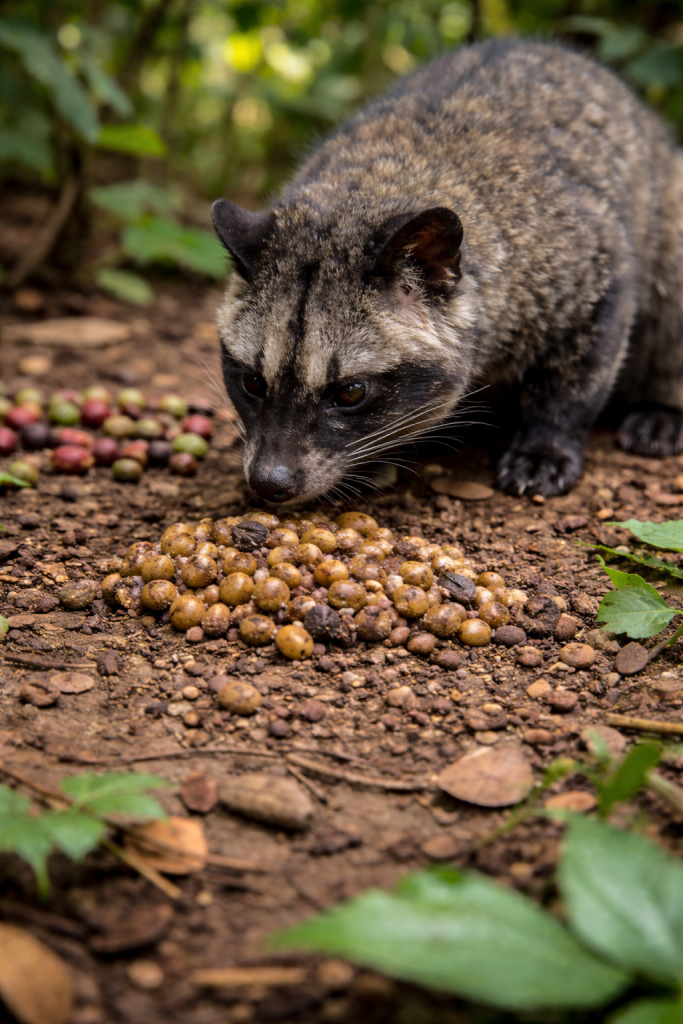
What actually happens inside the digestive system
During digestion, the beans are exposed to enzymes and a unique chemical environment. This doesn’t “digest” the beans completely, but it does alter them in subtle yet meaningful ways.
Certain proteins—especially those associated with bitterness—begin to break down. At the same time, the internal structure of the bean shifts, which later affects how it reacts during roasting.
Unlike traditional coffee fermentation, which happens externally through bacteria and yeast, this process takes place inside a living organism. That makes it far less controlled, but also biologically distinct.
The end result is a bean that has been naturally modified, potentially leading to a different flavor profile.
From something unusual to something safe
After collection, the beans undergo thorough cleaning, drying, and roasting. The roasting stage is especially important, not just for flavor development but for safety.
High temperatures eliminate harmful microorganisms, meaning the final product is safe to consume. Whatever discomfort the origin might suggest, the coffee that ends up in the cup meets normal safety standards.
The taste: exceptional or just different?
Marketing often describes this coffee as uniquely smooth, refined, and superior. The reality is more nuanced.
Professional tastings tend to agree on a few characteristics: lower acidity, a smoother mouthfeel, and reduced bitterness. Some describe earthy or slightly sweet undertones.
However, many coffee experts argue that the same process that reduces bitterness may also strip away some of the complexity found in high-end specialty coffees. In other words, it may not be “better”—just different.
And that distinction matters more than most people expect.
Why it became so expensive
Originally, this coffee was rare because it was collected from wild environments in small quantities. As global demand increased, production shifted toward farming systems.
This is where the conversation becomes more complicated. Organizations like World Animal Protection have raised concerns about how these animals are sometimes kept—often in confined conditions and fed unnaturally to increase output.
What started as a rare, natural process has, in many cases, turned into something more industrial. And that shift raises ethical questions that are hard to ignore.
Science or storytelling?
There is real science behind this coffee. The chemical changes are documented, the process is understood, and the effects on flavor are measurable.
But its global reputation cannot be explained by science alone. The story—the shock value, the rarity, the idea of drinking something unconventional—plays an equally powerful role.
In the end, the experience depends on what you’re looking for. If you’re chasing pure flavor, there are many coffees that compete or even surpass it. If you’re drawn to the story, then this cup offers something few others can.
Because sometimes, what we value most isn’t just what we taste—but the story we tell ourselves while drinking it.